



In most South Carolina injury cases, a settlement pays more in your pocket than a trial. That’s because fees, expert costs, liens, delay, appeal risk, and fault risk can eat into a verdict fast – even when the jury number looks higher.
If I had to boil the article down, it comes to this:
- Settlement often wins on net pay when fault is mostly clear, the offer is close to case value, and trial costs would cut the upside.
- Trial can pay more when injuries are severe, future losses are high, proof is strong, and there is enough insurance or assets to collect a larger verdict.
- In South Carolina, 51% fault means $0 recovery.
- A case that settles may close in about 9 to 18 months. A trial can take 1.5 to 3+ years.
- More than 90% of South Carolina personal injury lawsuits settle before trial.
- A big verdict does not always mean a bigger check if policy limits are low or the defendant cannot pay.
- The number that matters most is net recovery: gross amount minus attorney fees, case costs, and medical liens.
My short take: if the settlement offer is close to what a jury would likely award after fault cuts, costs, and delay, settlement usually pays more. If the offer is low and the case has strong proof plus collectible coverage, trial may be worth the risk.
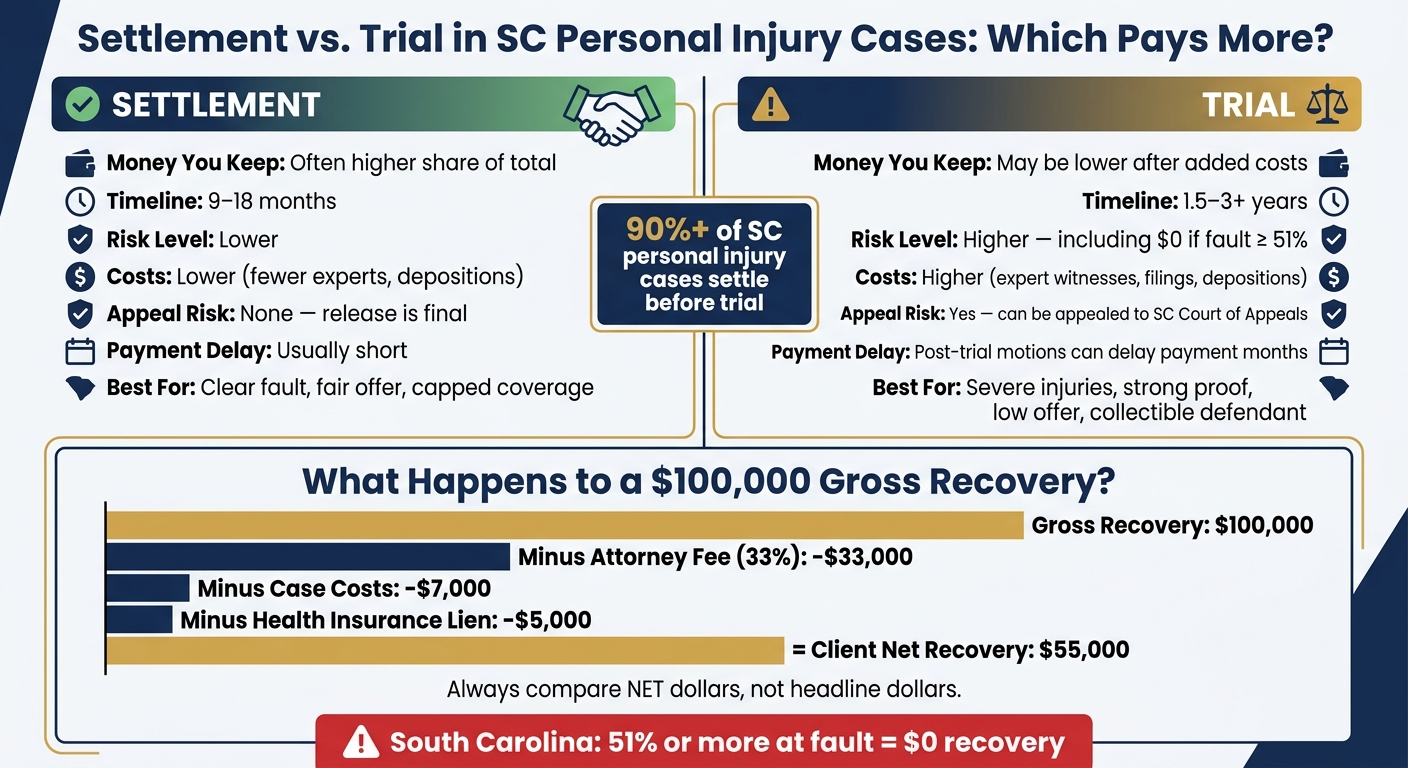
Settlement vs. Trial in SC Personal Injury Cases: Net Recovery Breakdown 2026
Quick comparison
| Point | Settlement | Trial |
|---|---|---|
| Money you may keep | Often higher as a share of the total | May be lower after added costs |
| Risk | Lower | Higher, including a $0 result if fault hits 51% |
| Time | About 9–18 months | About 1.5–3+ years |
| Costs | Lower | Higher |
| Payment delay | Usually shorter | Post-trial motions and appeals can delay payment |
| Best fit | Clear fault, fair offer, capped coverage | Severe injuries, strong proof, low offer, collectible defendant |
Before choosing, I’d want answers to five plain questions from a personal injury claim checklist:
- How much fault could the defense pin on me?
- Is the offer close to the likely trial value?
- Have I reached maximum medical improvement?
- Can a larger verdict actually be collected?
- What does the net sheet show after fees, costs, and liens?
That is the whole article in a simple form: compare net dollars, not headline dollars.
sbb-itb-ce0cbb0
When a Settlement Usually Pays More Net
Clear liability, solid records, and a fair insurance offer
Settlement often leads to a better net payout when liability is clear and the records are strong. When medical records line up and treatment is documented well, the insurer has less room to argue about what the case is worth. A fair settlement should track the likely verdict value, minus fees, costs, and liens, and it gives you a fixed net number.
Policy limits and collectability can cap recovery
A verdict doesn’t always put more money in your pocket. If a jury awards $100,000 but the at-fault driver carries only a $25,000 policy and has no assets, the amount you can actually recover may still be $25,000 – and trial costs may still come out of the client’s share.
That changes the math fast. A bigger verdict may look better on paper, but without collectible assets or other coverage, the final check may not change at all. That’s why collection risk matters. Before you turn down a settlement, check whether the defendant has assets beyond the policy and whether other coverage could add to the recovery, including umbrella coverage and underinsured motorist (UIM) coverage. A larger verdict only helps if you can collect it.
Faster resolution, lower costs, and less financial risk
Settling also tends to cut litigation costs, including expert fees and other case expenses. In some cases, an early settlement can mean a lower contingency fee, which leaves more of the recovery in the client’s hands.
That said, the savings don’t always win out. If liability is disputed or damages are high, those lower costs may not make up for the chance of a much larger verdict.
Do not settle before reaching maximum medical improvement. A signed release ends the claim, even if later complications or surgery come up.
But if the case has more upside than downside, trial may still lead to more net compensation.
When Trial Can Produce a Higher Payout
Serious injuries with strong medical proof
Trial can lead to a bigger payout when the injuries are severe and the medical proof is strong enough to back up future losses. Cases involving permanent disability, spinal cord injuries, traumatic brain injuries, or multiple surgeries often have more upside in court. Why? Because it’s easier to show a jury the full picture of future care, long-term limits, and day-to-day harm.
This matters most with non-economic damages – pain, suffering, and disfigurement. That’s the part of a case where jury verdicts often come in higher than settlement offers. And that gap can be large. Still, a higher verdict only helps if it holds up after fees and case costs. That’s where trial can turn a modest offer into a much larger result.
Liability disputes and low settlement offers
Trial can also pay more when the other side fights fault or makes an offer that falls short of what the case is worth. In that spot, a credible trial threat can change the math. If the defense thinks you’re ready and able to try the case, it may increase the offer before a verdict ever happens.
That said, leverage has limits. It only works when the case has enough verdict potential to justify the added expense and delay.
The verdict must be large enough to cover the extra cost and risk
This is the main line to watch. Trial makes sense only when the likely upside is bigger than the added cost, delay, and risk of losing.
A few things can cut hard into the final payout:
- In South Carolina, if you are found 51% or more at fault, you recover nothing.
- Trial usually means higher attorney fees and more expert-witness costs.
- Those added costs can sharply reduce your net check.
What Affects How Much You Actually Take Home
Shared fault, medical proof, and damages evidence
Big case numbers can look great on paper. But what the client actually receives usually comes down to three things.
First is fault. In South Carolina, comparative fault can cut your recovery in a big way. If you’re 51% or more at fault, you recover nothing. If you’re found 20% at fault on a $100,000 award, your recovery drops by that same share, leaving you with $80,000.
Second is medical proof. Gaps in treatment, missed appointments, and records that don’t line up give the defense room to argue that the injury wasn’t as serious as claimed. That’s a problem for both injury value and damages. Steady records from the date of injury through maximum medical improvement help support both economic and non-economic damages.
Then comes the next hit to the total: litigation costs and liens.
Fees, costs, liens, and the time value of money
Attorney contingency fees in South Carolina usually range from 30% to 40% of the gross recovery. Then the firm is paid back for case expenses it covered up front, such as filing fees, deposition transcripts, expert witness fees, and medical records. After that, liens may need to be paid, including those from health insurers, medical providers, or litigation loans.
A simple example shows how fast the number changes. On a $100,000 settlement, a 33% attorney fee ($33,000), $7,000 in case costs, and a $5,000 health insurance lien leaves the client with $55,000.
So yes, the gross recovery matters. But the net number is what pays the bills.
Time matters too. A smaller payout now can beat a bigger amount that takes years to get and still carries risk.
Even after that, two more things can shift the end result: when the money arrives and whether it can be collected at all.
Appeals, payment delay, and collectability
A trial win doesn’t always mean a check shows up right away. The defense can file post-trial motions or appeal, which may delay payment for months or longer, even after a good verdict. Settlement usually brings the case to an end without that wait.
There’s also collectability. A verdict is only worth what can actually be collected. If the defendant has low insurance limits and few personal assets, a big verdict may not turn into a bigger payout.
With that in mind, comparing settlement and trial side by side can make it easier to see which route is more likely to lead to the better net result.
South Carolina Decision Guide: Settlement vs. Trial in 2026
Settlement vs. trial comparison table
Once you look at net recovery, not just the headline number, the settlement-vs.-trial choice gets a lot clearer.
Here’s a quick side-by-side look at the main tradeoffs.
| Factor | Settlement | Trial |
|---|---|---|
| Gross Recovery Potential | Usually capped by negotiation and policy limits | Can produce a larger award when liability and damages are strong |
| Certainty of Payment | High once signed | Uncertain; recovery can drop to $0 if fault exceeds 50% |
| Timeline | Typically months to about a year | Often 1 to 3+ years, including potential appeals |
| Legal Costs | Lower; fewer experts, depositions, and court fees | Higher; expert witnesses, filings, and other litigation costs add up |
| Appeal Risk | None; the release is final | Verdicts can be appealed to the South Carolina Court of Appeals |
| Net Recovery | Often higher on a percentage basis, but not always in dollars | Can be lower after fees and costs are deducted |
A short checklist for choosing the better financial path
If the table still leaves you on the fence, these five questions can help sort out which path makes more financial sense:
- Is liability clearly on your side, or could trial push you over 50% fault?
- Is the offer close to your realistic case value? If yes, the added cost of trial may wipe out much of the gap.
- Have you reached MMI and confirmed the full prognosis? Settling too early can leave future medical costs uncovered.
- Can the defendant actually pay a larger verdict?
- Do you have an itemized net sheet showing fees, costs, and liens? Compare net numbers, not gross figures.
Conclusion: Which option usually pays more?
In many cases, settlement pays more in your pocket when the offer is fair, liability is fairly clear, and trial costs would eat into the upside. Trial tends to make sense only when the proof points to a much larger award and the defendant has enough insurance coverage or assets to make that award collectible.
That’s the part people sometimes miss: a bigger verdict on paper doesn’t always mean more money at the end. A faster, lower-cost settlement can beat a larger verdict that takes years and may be appealed. The better financial path turns on the facts of your case – how strong it is, how much shared-fault risk you face, whether the money can be collected, and what remains after every fee, cost, and lien is taken out.
FAQs
How do I estimate my net recovery?
Start with the gross recovery – the total settlement or verdict – then subtract every deduction to estimate your net recovery.
These deductions often include outstanding liens, advanced legal costs, and your attorney’s contingency fee, which usually falls between 30% and 40%.
That last part can take a big bite out of the final number. So don’t just accept a summary page. Ask for a raw ledger and unredacted invoices so you can check the costs yourself.
Should I wait until MMI to settle?
Generally, yes. It’s usually best to wait until you reach maximum medical improvement (MMI) before settling.
If you settle too soon, it can be tough to put a fair dollar amount on your injury. Future treatment, lasting symptoms, or later complications may still be unknown. And that matters.
Once you sign a settlement, it’s legally binding. In most cases, you can’t go back and ask for more money later if your condition gets worse or your medical bills end up higher than expected.
What if the insurance policy is too low?
If policy limits don’t cover all of your damages, the next step is usually to look for more insurance money or show bad faith.
A lawyer can help track down other places coverage may exist, including:
- Excess or umbrella policies
- Commercial coverage
- Your own underinsured motorist coverage
There’s another angle too. If the insurer refused a reasonable settlement offer within the policy limits when you were willing to accept it, you may be able to take the case to trial and pursue a verdict that goes beyond those limits.