




South Carolina courts do not start with a joint-custody or sole-custody favorite. I’d put it this way: the judge looks at the child first, the facts second, and the custody label last.
If you want the short answer, here it is:
- There is no automatic presumption for joint or sole custody in South Carolina.
- Judges use the child’s best interests standard.
- Joint custody is more likely when parents can communicate, live close enough to keep school and routines steady, and share day-to-day parenting.
- Sole custody or primary physical custody is more likely when there are safety issues, heavy conflict, substance abuse, neglect, or one parent keeps disrupting the child’s life.
- South Carolina law treats mothers and fathers equally. The old rule that favored mothers of young children is gone.
- Courts look at many facts, including caregiving history, home stability, school and medical needs, domestic violence, and sometimes the child’s preference.
In other words: the court prefers the setup that gives the child the safest and steadiest life.
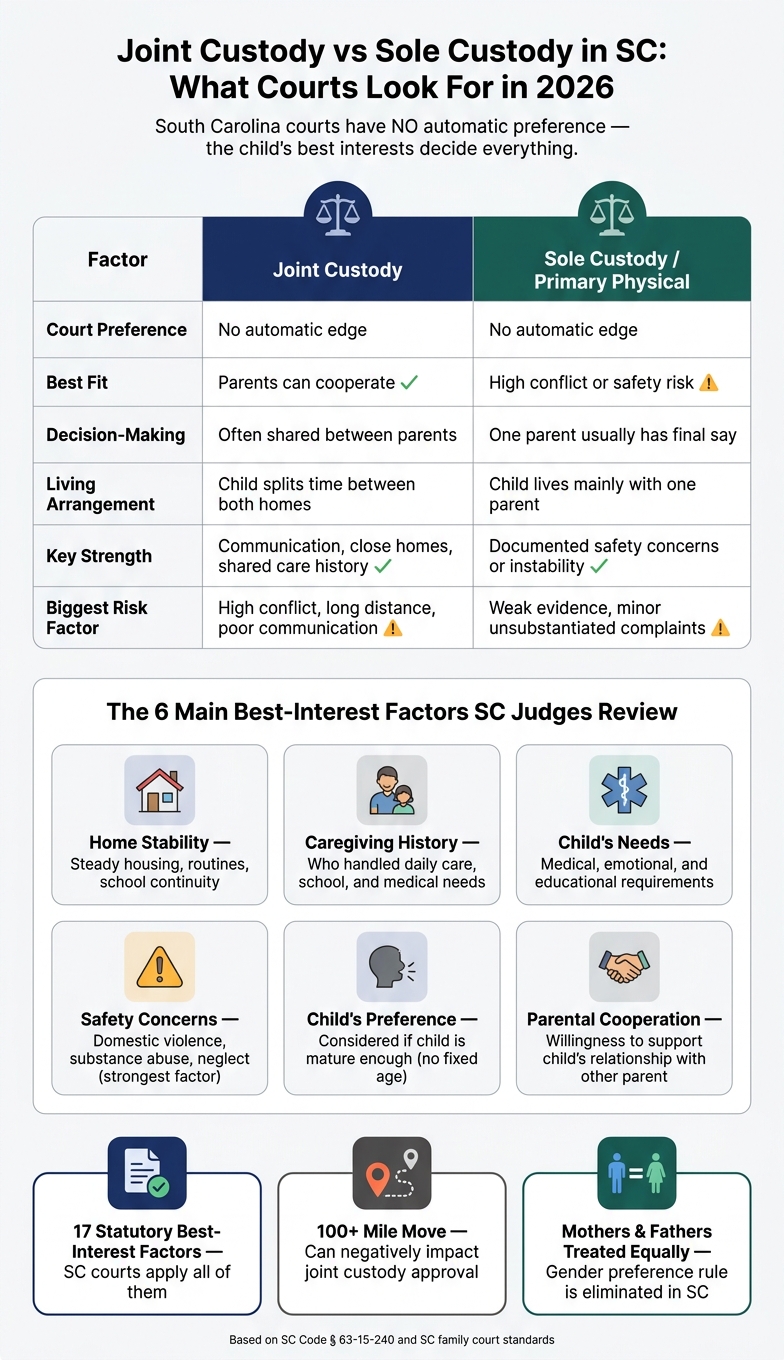
Joint Custody vs Sole Custody in SC: 2026 Court Comparison Guide
Quick Comparison
| Issue | Joint Custody | Sole Custody / Primary Physical Custody |
|---|---|---|
| Court preference in 2026 | No automatic edge | No automatic edge |
| Main fit | Parents can work together | Conflict or risk makes shared parenting hard |
| Decision-making | Often shared | Often one parent has final say |
| Living arrangement | Child spends time in both homes, or parents share legal custody | Child usually lives mainly with one parent |
| What helps most | Steady communication, parenting plan, close homes, shared care history | Proof of safety concerns, instability, lack of cooperation |
| What hurts most | High conflict, long distance, poor communication | Weak proof, minor complaints without a clear pattern |
A few points stand out from the article:
- South Carolina courts use 17 statutory best-interest factors.
- A move of more than 100 miles can affect how a judge looks at parenting time and school stability.
- Even when one parent gets sole custody, the other parent often still gets visitation unless contact would put the child at risk.
- Temporary custody hearings often rely on sworn affidavits, so records and written proof matter a lot.
If I were boiling the full article down to one line, it would be this: South Carolina courts are not choosing between “joint” and “sole” in the abstract – they are choosing the plan that best protects the child’s safety, routine, and long-term well-being.
sbb-itb-ce0cbb0
How South Carolina Judges Compare Joint Custody and Sole Custody
Once the legal standard is in place, South Carolina judges look at how each custody setup works in day-to-day life. The label matters less than the facts. Judges focus on the child’s best interests, review the full record, and give extra weight to safety concerns. In plain English: if there’s a serious safety issue, that can outweigh almost everything else.
After the court applies the best-interests standard, the next issue is pretty simple: can both parents share responsibility without hurting the child’s stability?
The Main Factors Courts Weigh in 2026 Custody Cases
Judges use the statutory factors based on the facts of each family. The same rule can play out very differently from one case to the next. The main things courts look at include:
- Caregiving history: Judges look at who handled daily care, school issues, and medical needs.
- Each parent’s home stability: Stable housing, steady routines, and school continuity matter. Recent long-distance moves also factor into the analysis.
- The child’s emotional, medical, and educational needs: If a child has ongoing medical issues or learning challenges, the court may favor a setup that protects those routines.
- Judgment and conduct (moral fitness): This looks at judgment, relationships, and each parent’s ability to provide a safe home.
- Domestic violence, substance abuse, or neglect: These issues are among the strongest reasons a court may lean toward sole custody or supervised visitation.
- The child’s preference: A judge may consider what the child wants if the child is mature enough. There’s no fixed age, but older children and teenagers may carry more weight.
Taken together, these factors often point the court toward either shared parenting or a more limited setup. High cooperation tends to support joint custody. High conflict or safety risk tends to push the court toward sole custody or primary physical custody.
How Judges Weigh Strengths and Weaknesses on Both Sides
Courts don’t stop at one good fact or one bad fact. They look at the whole picture. A parent with a stable home doesn’t automatically come out ahead if that parent has a poor track record of communicating with the other parent. On the flip side, a parent who served as the main caregiver may still face limits on joint custody if cooperation is a problem.
One point that often gets close attention is whether a parent is likely to support the child’s relationship with the other parent – when it is safe to do so. Judges often view that kind of conduct as a sign of sound judgment. It can help a parent’s case because it shows the focus is on the child, not on scoring points.
As Terence M. Hoffman, Esq. put it:
"The court is not there to reward one parent or punish the other… The court is trying to decide what arrangement gives the child the strongest chance at safety, stability, and healthy development."
That’s what drives the final call: whether joint custody can work in a stable, safe way, or whether sole custody is the better fit for the child’s needs.
When Joint Custody Fits South Carolina Court Expectations
South Carolina courts want to see that shared parenting can work in day-to-day life, not just sound good on paper. If that proof isn’t there, judges often lean toward a primary-parent setup instead.
Facts That Support Joint Legal or Joint Physical Custody
If there’s no safety issue, the court looks for signs that shared parenting can function in a steady, practical way. Strong cases usually show a clear history of hands-on care: school involvement, medical appointments, homework help, and the child’s daily routines. Courts also pay close attention to how parents communicate. Respectful, documented communication can help show that joint decision-making is workable.
For joint physical custody, distance matters. The homes need to be close enough to keep school and daily routines on track. A move of more than 100 miles from the child’s primary residence is one factor courts may weigh against some joint setups.
Judges also tend to look more favorably on joint custody when parents submit a detailed parenting plan. That plan should spell out schedules, holidays, transportation, and how disputes will be handled. In joint legal custody cases, a tie-breaker provision may give one parent final decision-making power on limited issues, such as education or nonemergency medical decisions.
In plain terms, these are the facts that often matter most.
| Factor | What Courts Look For |
|---|---|
| Communication | Parenting app logs, respectful email/text history |
| Caregiving History | Doctor visit records, school conference attendance, daily routine involvement |
| Stability | Local residency, consistent routines, proximity to the child’s school |
Hypothetical Example: When a Judge May Approve Joint Custody
The following is a hypothetical example for illustration purposes only.
A simple example shows how these facts can line up in one case.
Take two parents who separated in early 2025. One regularly handled school pickups and parent-teacher conferences. The other took care of pediatric appointments and after-school activities. Neither had moved far from the child’s school, and both kept a steady routine at home.
When they went to family court, they submitted a joint parenting plan with a 2-2-3 rotating schedule, a holiday calendar, and final decision-making authority on education and nonemergency medical decisions if they couldn’t agree. They also agreed to use a co-parenting app for day-to-day communication.
After reviewing the caregiving records, the distance between the homes, and the parenting plan, the judge approved joint legal custody with joint physical custody under the proposed schedule. That kind of record can push a case toward joint custody.
When Sole Custody or Primary Physical Custody Is More Likely
When shared parenting falls apart or starts putting a child at risk, South Carolina courts often shift toward sole custody or primary physical custody. The court uses the best interests of the child standard, so if one parent can’t work with the other – or if there’s a real safety issue – joint custody becomes much less likely.
Safety Concerns and Instability That Can Lead to Sole Custody
If joint custody isn’t workable, the court looks at the facts that support a more limited setup.
Domestic violence is one of the clearest reasons a case may move toward sole custody. Under S.C. Code § 63-15-50, a parent found to have committed domestic violence may receive visitation only if the court finds that adequate provisions can be made for the safety of the child and the victim.
Judges also look hard at other warning signs, including substance abuse, untreated mental health conditions, neglect, unsafe housing, and ongoing criminal activity. Parental alienation matters too. That includes interfering with the child’s relationship with the other parent, and it’s listed as a statutory factor under S.C. Code § 63-15-240. If conflict between the parents is so intense that it disrupts the child’s day-to-day life, that can also push the court away from joint custody.
Even in sole custody cases, courts usually still allow visitation for the noncustodial parent unless contact would actively endanger the child.
What Evidence Courts Use to Assess Risk and Limits on Parenting Time
Courts want proof, not just accusations. Put plainly, saying something happened isn’t enough. Judges look for records, reports, and other documents that back it up.
| Evidence Type | What It Shows the Court |
|---|---|
| Police & DSS Records | Documented abuse, neglect, or violence that affects custody and visitation |
| Medical & Counseling Records | Substance use, mental health concerns, or the child’s treatment needs |
| School Records | Academic stability and whether each parent is engaged in the child’s education |
| Communication Logs | Patterns of conflict, disparagement, or interference with the other parent |
| Guardian ad Litem Findings | Independent findings from home visits and interviews with the child and both parents |
If the risk is proven, the court can limit parenting time without cutting off contact altogether. Depending on what the record shows, a judge may order supervised visitation, protected exchanges, no overnights, or a rule that a parent must stay sober for 24 hours before parenting time.
How to Prepare for a Custody Case in SC and Protect Your Position
Judges make custody decisions based on evidence. That means preparation matters just as much as the custody label itself.
Records and Documentation That Can Strengthen Your Case
What you document matters just as much as what you say. Judges look for objective proof of each parent’s role in the child’s life.
The main records usually fit into five groups:
| Document Category | Specific Items to Gather |
|---|---|
| Educational | Report cards, attendance records, IEP/504 plans, emails with teachers |
| Medical | Vaccination records, therapy notes, summaries of doctor visits, prescription logs |
| Communication | Text threads, emails, call logs, parenting app exports (e.g., OurFamilyWizard) |
| Logistical | Parenting calendars, travel itineraries, daycare receipts, extracurricular schedules |
| Legal/Safety | Police reports, DSS findings, protective orders, drug test results (if applicable) |
A parenting calendar can carry more weight than memory alone. It helps show missed visits, daily routines, and key events in a clear way. Courts also look closely at communication logs. Respectful, child-focused messages can help your position, while hostile or insulting exchanges can hurt it in a big way.
What matters most is pattern. One bad weekend or one missed pickup usually won’t decide a case. A steady record over time is far more persuasive.
Parenting Conduct and Legal Steps That Matter Before Court
Once your records are in order, the next piece is your day-to-day conduct. Put plainly, the court will look at how you act, not just what you claim.
Document your child’s current routine and your part in it. Show who handles school drop-offs, doctor visits, homework, meals, bedtime, and activities. Small details can paint a clear picture of daily parenting.
You also need to be careful about how you talk and write. Don’t speak badly about the other parent in front of your child or on social media. South Carolina judges may weigh parental disparagement under S.C. Code § 63-15-240. And every text or email should be written as if a judge may read it later, because that does happen.
A few legal steps can also shape the early part of the case:
- File for temporary orders early so there’s a formal schedule in place and one parent can’t keep changing things on their own.
- Temporary hearings are based on sworn affidavits, not live testimony, so organized records matter a lot.
- Bring a draft parenting plan that covers schedules, holidays, transportation, and how future disputes will be handled.
- In contested cases, a Guardian ad Litem may investigate, interview both parents, and review records.
Conclusion: The Court’s Preference Is the Child’s Best Interests
South Carolina courts decide custody based on the child’s best interests. Your records, your conduct, and your parenting plan all help shape that outcome.
FAQs
Can a judge order joint legal custody but primary physical custody to one parent?
Yes. South Carolina family courts can award joint legal custody to both parents while naming one parent’s home as the child’s primary physical residence.
Legal custody covers major decisions about the child’s life. Physical custody deals with where the child lives and which parent handles day-to-day care.
A judge may approve this setup if it serves the child’s best interests.
How much does my child’s age affect whether the judge will consider their preference?
In South Carolina, a child can’t decide custody or make the final call about where they live. That decision belongs to the judge.
The judge may consider what the child wants, but that preference is only one part of the bigger picture.
In general, the older and more mature the child is, the more weight a judge may give that opinion. Even then, the court can ignore the child’s preference if it seems to rest on improper motives, like wanting a home with fewer rules.
What should I do before a temporary custody hearing in South Carolina?
Before a temporary custody hearing in South Carolina, file a detailed parenting plan that lays out the day-to-day setup. Cover parenting time, holidays, communication, and how major decisions will be made.
You should also gather organized, objective evidence to back up your position. That can include:
- School records
- Medical records
- Communication logs
- Exchange logs
- Proof of your caregiving history
These hearings are often brief and may rely heavily on sworn affidavits. That means clear, verifiable facts carry a lot of weight.