



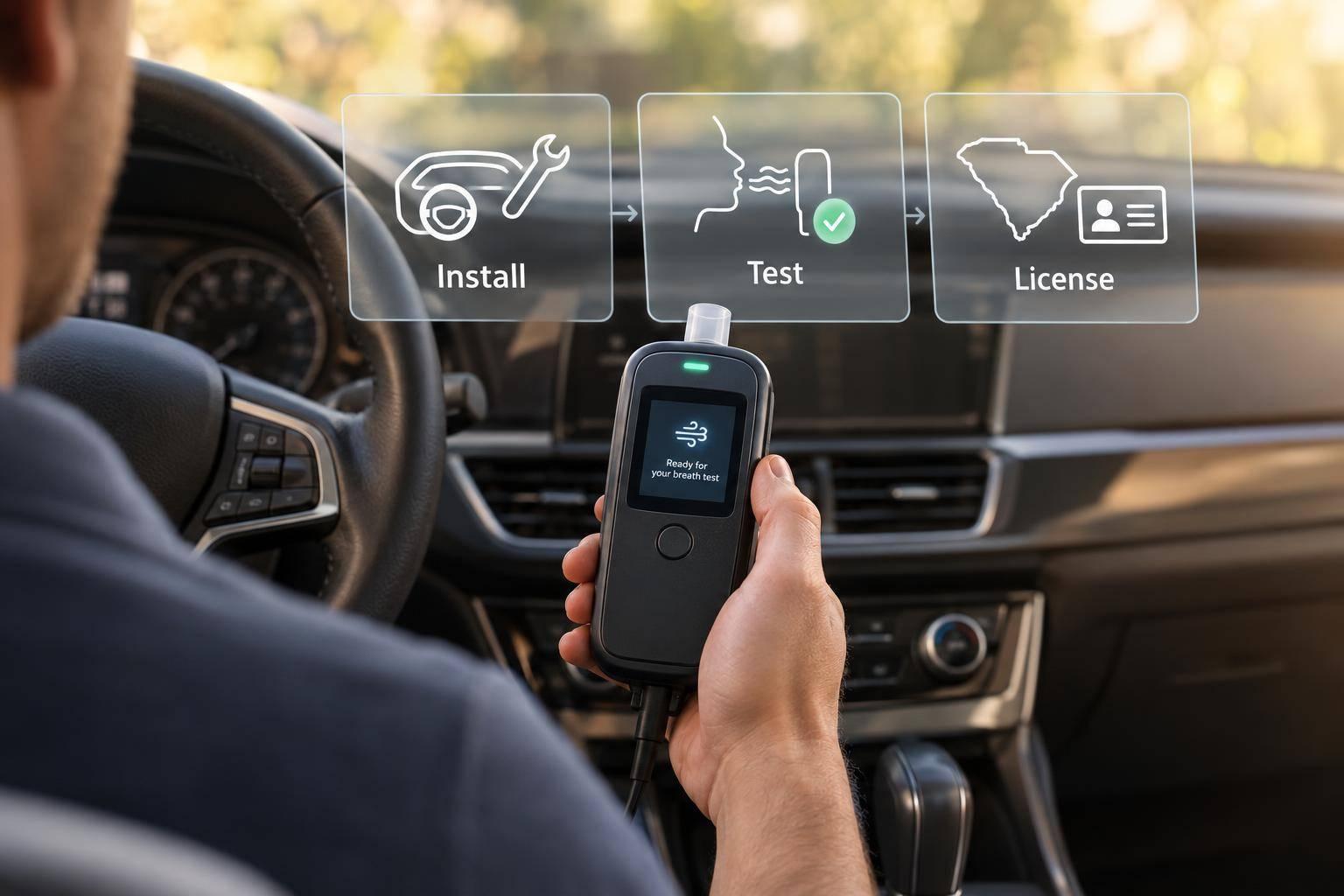
Installing an ignition interlock does not give permission to drive after a South Carolina DUI. Drivers must confirm SCDMV requirements, enroll in ADSAP, and obtain an “II” restricted license. The required interlock period starts when that license is issued.
The device blocks starting at a breath alcohol reading of 0.02 or higher, prompts retests while driving, and requires service visits every 60 days. Requirements depend on the offense date, conviction, and suspension status. DUI and DUAC convictions for offenses on or after May 19, 2024, generally require interlock regardless of BAC, subject to legal exceptions.
Drivers should also confirm vehicle restrictions, keep testing and service records, and report device problems promptly. SCDMV handles licensing; SCDPPPS administers the interlock program.
When South Carolina Requires Ignition Interlock
South Carolina’s ignition interlock rules depend on your offense date, conviction type, and suspension status. Here’s how those details affect whether you need an ignition interlock device (IID).
IID Eligibility
| Situation | IID requirement | Authority or verification point |
|---|---|---|
| Offense dated January 1, 2008, through September 30, 2014 | Participation was optional, but choosing not to enroll could extend the suspension by three years. | SCDPPPS guidance. |
| First offense dated October 1, 2014, through May 18, 2024 | Required for a BAC of 0.15% or higher; optional below 0.15%. | Earlier statutory rules and SCDPPPS guidance. |
| Offense dated October 1, 2014, through May 18, 2024 | Refusing required enrollment could leave your license suspended until you complete the IID program. | SCDPPPS guidance. |
| DUI or DUAC conviction for an offense on or after May 19, 2024 | Required regardless of BAC, with exceptions set by law. | S.C. Code §§ 56-5-2930, 56-5-2933, and 56-5-2990. |
| Felony DUI or child endangerment conviction | Required to clear the suspension. | S.C. Code §§ 56-5-2945 and 56-5-2947. |
| Temporary alcohol license after refusal, BAC of 0.15% or higher, or an under-21 alcohol suspension | Requirements depend on your suspension and hearing status. IID installation starts only after the suspension is upheld or you waive the hearing. | S.C. Code § 56-5-2951. |
A 0.00 BAC may qualify for an exception. A medical waiver may excuse you from using the device, but your license stays suspended for the applicable interlock period.
For an older case – or one where the requirements aren’t clear – review your driving record, conviction documents, test results, and suspension notices before contacting SCDMV.
sbb-itb-ce0cbb0
Steps to Install the Device and Get Driving Permission
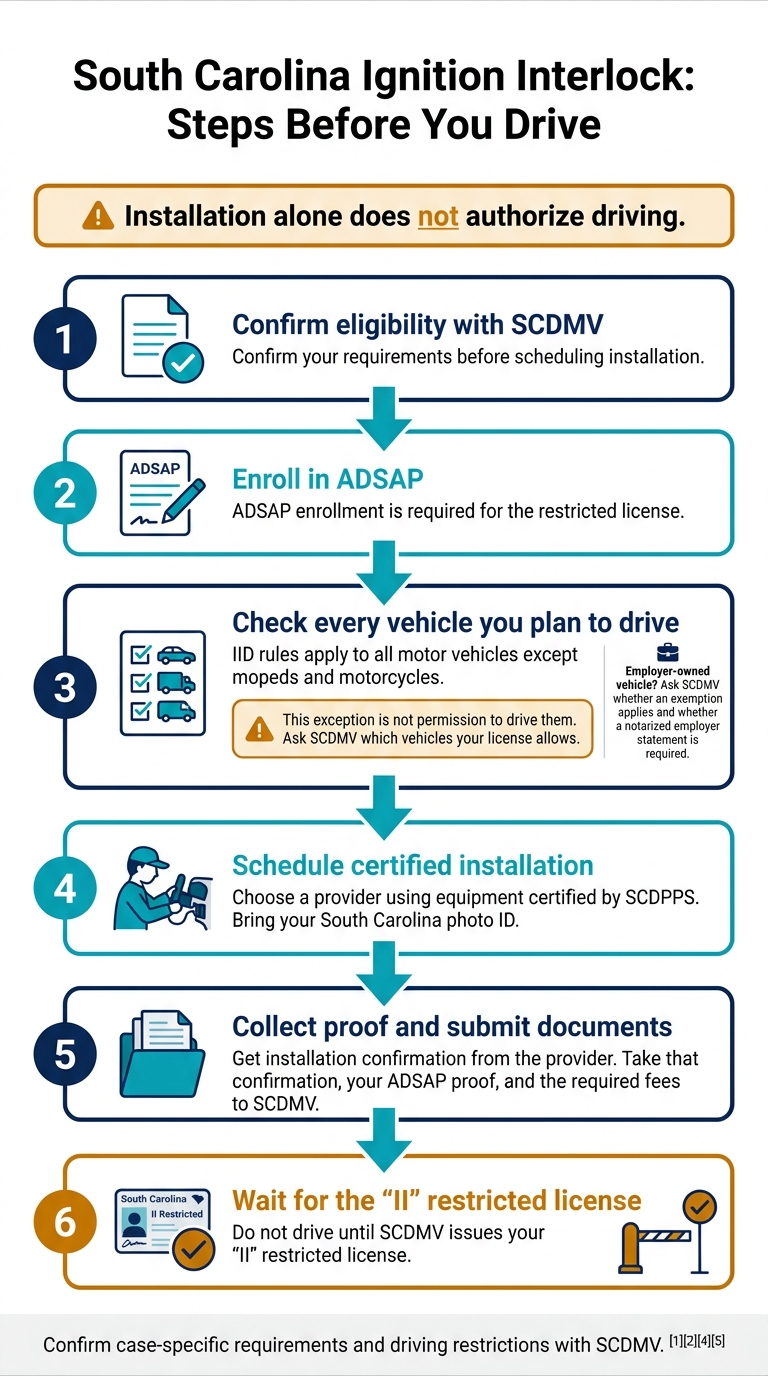
South Carolina Ignition Interlock: Steps Before You Drive
Once you know you need an IID, confirm your eligibility with SCDMV before scheduling installation. You’ll also need to enroll in ADSAP, which is required for the restricted license.
Check Which Vehicles Need a Device
List every vehicle you plan to drive. IID rules apply to all motor vehicles except mopeds and motorcycles.
That exception isn’t permission to drive them. Ask SCDMV which vehicles your license allows you to operate.
If you need to drive an employer-owned vehicle, ask SCDMV whether the employer-vehicle exemption applies and whether you need a notarized employer statement.
Confirm SCDMV Issues the Restricted License Before Driving
Schedule installation with a provider that uses equipment certified by the South Carolina Department of Probation, Parole and Pardon Services (SCDPPPS). Bring your South Carolina photo ID, and get installation confirmation from the provider.
Take that confirmation, your ADSAP proof, and the required fees to SCDMV to get the "II" restricted license.
Installation alone does not authorize driving. Wait until SCDMV issues your "II" restricted license before you drive.
Follow Testing Rules and Handle Device Problems
After installation and license approval, stay on top of testing, service visits, and problem records.
Complete Breath Tests and 60-Day Inspections
Daily compliance starts as soon as the device is installed. Give a steady breath sample before starting the vehicle. The device also prompts random breath retests while you drive. Pull over safely before retesting. Never let someone else blow into the device, bypass it, or cover the camera.
During service visits, a technician calibrates the device, checks that it’s securely mounted, and downloads stored data, including alcohol readings. Keep your installation and service records.
Document Failed Tests and Technical Problems
Document a failed start or device malfunction right away. After a failed start, follow the device’s waiting period and testing instructions. If driving is unsafe, stop safely.
Record the date, time, vehicle, error message, and what happened. Report technical problems promptly through the provider’s reporting process, and keep repair records.
Follow Agency Reporting Rules
If a problem leads to agency review, act immediately to meet the reporting deadlines. Follow all SCDMV and SCDPPPS deadlines. Contact the service center immediately if you miss an inspection, and get legal advice before disputing a reading or violation. A criminal defense lawyer serving Spartanburg County can help you navigate these administrative challenges.
Conclusion: Checklist Before You Drive
Installation alone does not authorize driving. Confirm your SCDMV requirements and wait until your “II” restricted license has been issued and is active.
Before you drive, check each item:
- Offense date: Confirm whether your offense occurred before May 19, 2024, or on or after that date.
- Requirement source: Check whether your case involves a suspension, conviction, or temporary alcohol license.
- Vehicles: Make sure every vehicle you drive is covered.
- Proof: Keep written confirmation of installation on file.
- License: Verify that your “II” restricted license has been issued and is active.
- Service: Put each 60-day inspection date on your calendar.
- ADSAP and assessments: Track completion.
- Orders: Follow all court and SCDMV orders that apply to your case.
- Driving limits: Review every restriction, including any work-driving exemption and required paperwork. Repeat offenders usually cannot use that exemption until they have served one year of suspension or had an IID for one year.
FAQs
How long will I need an ignition interlock in South Carolina?
In South Carolina, the required period depends on your conviction or circumstances:
- First DUI: Six months.
- Second DUI: Two years.
- Third DUI: Three years, or four years if the third offense occurred within five years of the first.
- Fourth or subsequent offense: Life.
Child endangerment requires three months. Terms for felony DUI and administrative license suspensions vary.
Can I challenge a false positive interlock reading?
Yes. The Program Administrator or their designee may remove the point if the administrator finds that the violation was not willful and was unavoidable.
If you have fewer than four points, you may appeal to a South Carolina Department of Probation, Parole and Pardon Services hearing officer. If you have four or more points, you have 30 days from the assessment notice to request a contested case hearing.
What must I do before removing my interlock?
Before you can remove your ignition interlock device in South Carolina, you must complete the full participation period required by state law. That period depends on your offense: six months for a first offense or longer for subsequent convictions. If you don’t follow program rules, your participation period may be extended.
Brendan M. Delaney Law Firm, LLC can help you understand the requirements for license suspension and device removal.
Related Blog Posts
- How DUI Affects Your License in SC
- Common Mistakes After a DUI Arrest
- What Happens When You Are Pulled Over For DUI In Spartanburg County
- DUI vs DWI in South Carolina: What’s the Difference and Which Charge Are You Facing?
{“@context”:”https://schema.org”,”@type”:”FAQPage”,”mainEntity”:[{“@type”:”Question”,”name”:”How long will I need an ignition interlock in South Carolina?”,”acceptedAnswer”:{“@type”:”Answer”,”text”:”In South Carolina, the required period depends on your conviction or circumstances: First DUI: Six months. Second DUI: Two years. Third DUI: Three years, or four years if the third offense occurred within five years of the first. Fourth or subsequent offense: Life. Child endangerment requires three months. Terms for felony DUI and administrative license suspensions vary.”}},{“@type”:”Question”,”name”:”Can I challenge a false positive interlock reading?”,”acceptedAnswer”:{“@type”:”Answer”,”text”:”Yes. The Program Administrator or their designee may remove the point if the administrator finds that the violation was not willful and was unavoidable. If you have fewer than four points, you may appeal to a South Carolina Department of Probation, Parole and Pardon Services hearing officer. If you have four or more points, you have 30 days from the assessment notice to request a contested case hearing.”}},{“@type”:”Question”,”name”:”What must I do before removing my interlock?”,”acceptedAnswer”:{“@type”:”Answer”,”text”:”Before you can remove your ignition interlock device in South Carolina, you must complete the full participation period required by state law. That period depends on your offense: six months for a first offense or longer for subsequent convictions. If you don’t follow program rules, your participation period may be extended. Brendan M. Delaney Law Firm, LLC can help you understand the requirements for license suspension and device removal.”}}]}