



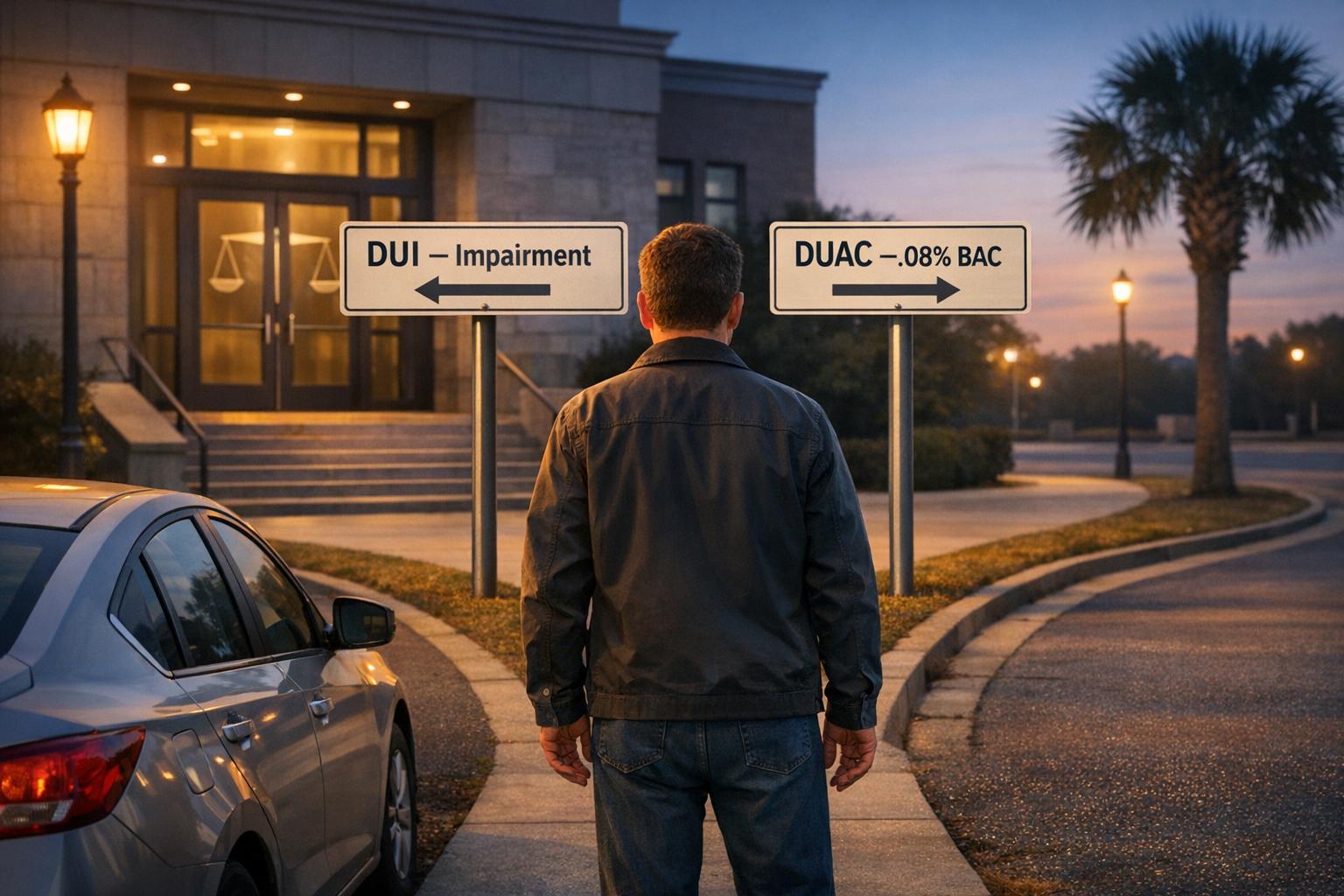
If you’re charged with impaired driving in South Carolina, you’ll encounter two main terms: DUI (Driving Under the Influence) and DUAC (Driving with an Unlawful Alcohol Concentration). Here’s what you need to know:
- DWI is not a recognized charge in South Carolina. The state only uses DUI and DUAC.
- DUI focuses on proving that your ability to drive was impaired by alcohol, drugs, or both. Evidence includes officer observations, field sobriety tests, and BAC (Blood Alcohol Concentration) results.
- DUAC is based solely on a BAC of 0.08% or higher, regardless of visible impairment. It’s a "per se" offense and relies entirely on chemical test results.
Both charges carry the same penalties, including fines, jail time, license suspension, and mandatory participation in the Alcohol and Drug Safety Action Program (ADSAP). A conviction for either will remain on your record permanently and can significantly impact your insurance rates and driving privileges.
Quick Tip: Check your ticket for the offense code:
- 56-5-2930 = DUI
- 56-5-2933 = DUAC
Understanding the differences between these charges can help you prepare your defense and determine the best course of action.
DUI and DUAC in South Carolina: What the Law Says
South Carolina enforces two separate impaired driving laws: DUI (Driving Under the Influence) and DUAC (Driving with an Unlawful Alcohol Concentration). Understanding the difference between the two can significantly impact how a case is approached and defended.
DUI: Driving Under the Influence
Under SC Code § 56-5-2930, DUI refers to operating a vehicle while your ability to drive is significantly impaired by alcohol, drugs, or both. To convict someone of DUI, the State must prove three key points:
- You were driving a motor vehicle in South Carolina.
- You were under the influence of a substance.
- Your ability to drive was "materially and appreciably impaired."
DUI is based on impairment, not just a specific blood alcohol content (BAC). Prosecutors often rely on evidence like police observations (e.g., erratic driving, slurred speech, bloodshot eyes), results from field sobriety tests (like the Walk and Turn or One-Legged Stand), video recordings, and chemical tests. A BAC reading can support the case, but it is not the sole determinant.
"Technically, there is no legal limit for DUI. The State must prove that you were intoxicated to the extent that your faculties to drive were materially and appreciably impaired… regardless of what your actual blood alcohol content (BAC) was." – Johnny Gardner, Attorney
While BAC results are not definitive for DUI, they do carry weight. Under SC Code § 56-5-2950, a BAC of 0.08% or higher creates a presumption of impairment. However, the State still needs to establish that your driving ability was compromised.
DUAC, on the other hand, relies entirely on chemical evidence.
DUAC: Driving with an Unlawful Alcohol Concentration
DUAC, as outlined in SC Code § 56-5-2933, is a "per se" offense. This means that a BAC of 0.08% or higher is enough to secure a conviction, regardless of whether there are signs of physical impairment.
"It is unlawful for a person to drive a motor vehicle within this State while his alcohol concentration is eight one-hundredths of one percent or more." – SC Code § 56-5-2933
For a DUAC charge, the pivotal evidence is a breath or blood test taken within two hours of arrest. If the test shows a BAC of 0.08% or above, no further proof of impairment (like erratic driving or failed sobriety tests) is required. This process often begins when you are pulled over for DUI. Notably, you cannot be charged with both DUI and DUAC for the same incident.
| Feature | DUI (SC Code § 56-5-2930) | DUAC (SC Code § 56-5-2933) |
|---|---|---|
| What Must Be Proven | Impaired faculties | BAC of 0.08% or higher |
| Primary Evidence | Driving behavior, field tests, video, BAC | BAC test result only |
| Impairment Required | Yes | No |
| Substances Covered | Alcohol, drugs, or both | Alcohol only |
| Penalties | Fines, jail time, license suspension | Same as DUI penalties |
These differences highlight how DUI and DUAC cases are prosecuted differently in South Carolina courts.
Why DWI Is Not a Recognized Offense in South Carolina
Unlike some states, South Carolina does not recognize DWI (Driving While Intoxicated) as a separate offense. The term is often used informally but refers to DUI in this state.
This distinction can confuse those from other states where DWI and DUI represent different charges. In South Carolina, any impaired driving charge will fall under either DUI or DUAC.
"In South Carolina, the difference between DUI, DWI, and OUI is in name only. South Carolina does not have separate DWI and OUI statutes. DUI is the primary offense in South Carolina." – Jim Tucker, Attorney, McKinney, Tucker & Lemel, LLC
sbb-itb-ce0cbb0
DUI vs. DUAC: Key Differences
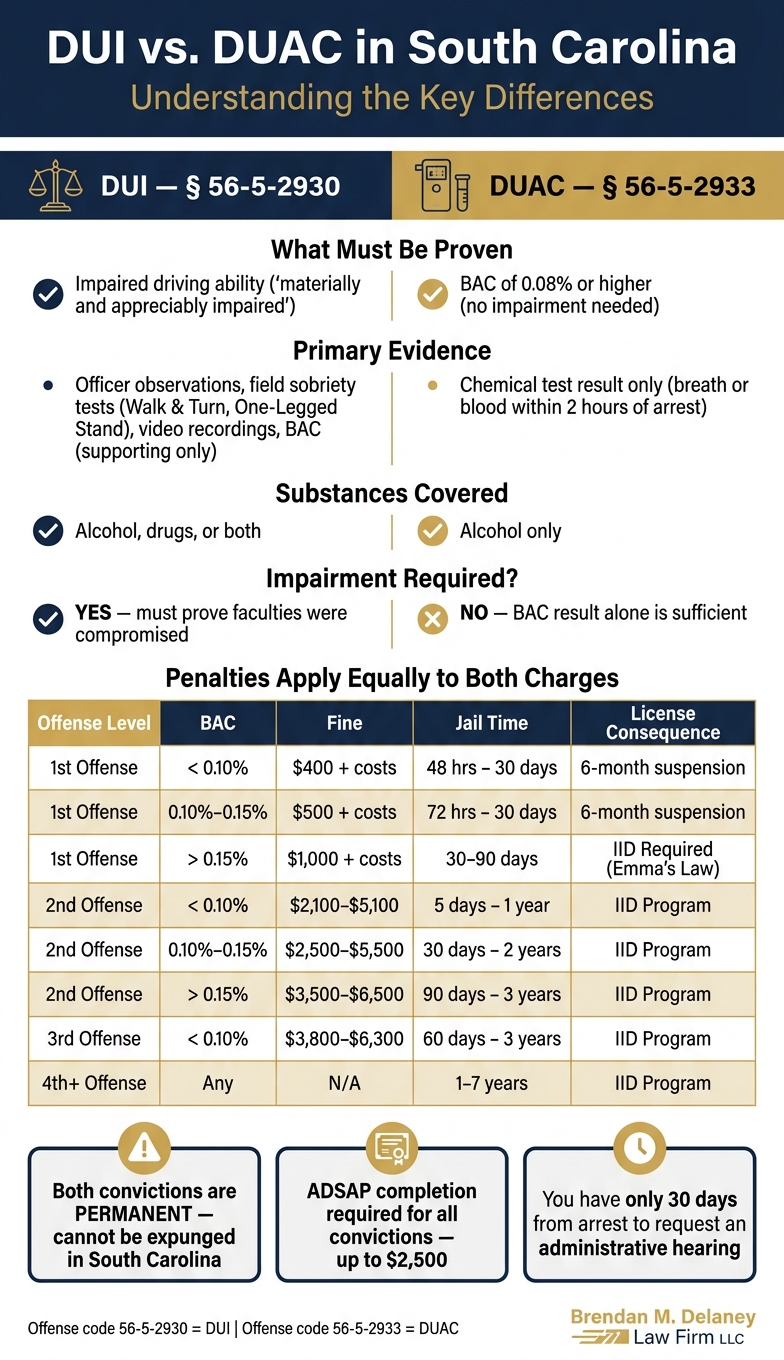
DUI vs DUAC in South Carolina: Key Differences & Penalties
What Prosecutors Must Prove for Each Charge
The main difference between DUI (Driving Under the Influence) and DUAC (Driving with an Unlawful Alcohol Concentration) lies in the type of evidence required to secure a conviction. For a DUI conviction, prosecutors must demonstrate that your ability to drive was materially and appreciably impaired. This means they rely on observable evidence, like erratic behavior or poor performance on field sobriety tests. On the other hand, a DUAC conviction doesn’t require evidence of impairment. Instead, a chemical test showing a BAC (Blood Alcohol Concentration) of .08% or higher is sufficient.
"DUAC charges are often easier for prosecutors to prove because they rely on objective chemical test results rather than subjective observations of impairment." – Seibert Law & Mediation
If you refuse to take a breath or blood test, a DUAC charge is off the table, leaving DUI as the only possible charge. Additionally, DUAC is specific to alcohol-related offenses. If drugs or a mix of substances are involved, DUI is the applicable charge.
This difference in evidence requirements is crucial to understanding how these charges are prosecuted and the penalties that follow.
Penalties and Consequences
While the evidence needed for DUI and DUAC convictions differs, both carry the same penalties in South Carolina. The consequences include fines, potential jail time, and license restrictions. The severity of the punishment depends on your BAC level and the number of prior offenses on your record within the state’s 10-year lookback period.
| Charge Level | BAC Level | Fine (Approx.) | Jail Time | License Suspension |
|---|---|---|---|---|
| 1st Offense | < .10% | $400 + costs | 48 hours – 30 days | 6 months |
| 1st Offense | .10% – .15% | $500 + costs | 72 hours – 30 days | 6 months |
| 1st Offense | > .15% | $1,000 + costs | 30 days – 90 days | IID Program |
| 2nd Offense | < .10% | $2,100 – $5,100 | 5 days – 1 year | IID Program |
| 2nd Offense | .10% – .15% | $2,500 – $5,500 | 30 days – 2 years | IID Program |
| 2nd Offense | > .15% | $3,500 – $6,500 | 90 days – 3 years | IID Program |
| 3rd Offense | < .10% | $3,800 – $6,300 | 60 days – 3 years | IID Program |
| 4th or Sub. | Any | N/A | 1 – 7 years | IID Program |
Under Emma’s Law, any conviction involving a BAC of .15% or higher automatically requires an Ignition Interlock Device (IID). This device must be installed in your vehicle, and you are responsible for the associated costs. Additionally, all convictions require completion of the Alcohol and Drug Safety Action Program (ADSAP), which can cost up to $2,500 ($500 for education and $2,000 for treatment).
"DUAC is not a lesser charge: A plea down from DUI to DUAC does not lower your punishment, and the conviction stays on your record permanently." – Shaun Kent Law
Effects on Your Record and Insurance
Both DUI and DUAC convictions come with long-lasting consequences. In South Carolina, these charges remain permanently on your record and cannot be expunged because they are classified as traffic offenses.
"In most cases, DUI convictions can’t be expunged under South Carolina law. Even first DUI offenses stay on your driving record permanently." – Jim Tucker, Attorney, McKinney, Tucker & Lemel, LLC
The impact of a conviction extends beyond the courtroom. Your insurance rates will likely increase significantly, and you will be required to carry SR-22 insurance for three years. For individuals whose jobs involve driving or require professional licenses, the repercussions can be as severe as the legal penalties, affecting both career prospects and financial stability.
How to Tell Which Charge You Are Facing
Reading Your Charging Documents
Take a look at your blue traffic ticket. The "Section" or "Offense Code" field will tell you exactly what you’re charged with:
- If it says 56-5-2930, you’re dealing with a DUI charge.
- If it says 56-5-2933, you’re facing a DUAC charge.
The ticket will also include a written description of the offense. For example, "Driving Under the Influence" signals a DUI, while "Driving with an Unlawful Alcohol Concentration" confirms a DUAC. Additionally, your ticket will list your initial court date and specify whether the case will be heard in a Magistrate or Municipal court.
One important note: A DUI charge can be changed to a DUAC if a valid chemical test is conducted within two hours of the stop and there was reasonable suspicion for the test.
Your charging documents are essential. They not only specify the statute but also detail the evidence supporting the charge. This evidence can help clarify whether you’re facing a DUI or DUAC.
Key Differences Between DUI and DUAC Charges
The type of evidence mentioned in your documents will make it clear which charge applies. DUI-related paperwork will describe evidence like field sobriety test results and observations made by the officer. A key phrase to watch for is "materially and appreciably impaired" – a subjective standard, as explained by DUI defense attorney James R. Snell, Jr.:
"Materially and appreciably impaired is a subjective impression, not an objective standard. This means it is up to police officers to guess or have an opinion who they are charging."
DUAC paperwork, on the other hand, will focus almost entirely on chemical test results. If your Blood Alcohol Concentration (BAC) is .08% or higher, that’s the primary evidence used for a DUAC charge.
"Unlike DUI, DUAC does not require proof that your driving was impaired. If your BAC is above the legal limit, you can be charged with DUAC, regardless of how well you were driving." – Austin McDaniel Law
Here’s a quick comparison of the two charges:
| Feature | DUI (§ 56-5-2930) | DUAC (§ 56-5-2933) |
|---|---|---|
| SC Code Citation | § 56-5-2930 | § 56-5-2933 |
| Key Phrase in Documents | "Materially and appreciably impaired" | BAC of .08% or higher |
| Primary Evidence | Officer observations, field sobriety tests | Chemical test results (breath, blood, or urine) |
| BAC Requirement | Not required; can charge below .08% | Mandatory; requires valid test result of .08%+ |
Lastly, do not plead guilty at your bond hearing, regardless of whether you’re charged with DUI or DUAC. Both charges carry serious consequences, and entering a plea too soon could limit your legal options. Always review your documents with an attorney first.
How Brendan M. Delaney Law Firm LLC Can Help

24+ Years Handling DUI and DUAC Cases in South Carolina
With more than 24 years of experience navigating South Carolina’s legal system, Brendan M. Delaney Law Firm LLC has the kind of in-depth knowledge that’s crucial when dealing with DUI or DUAC charges. These cases often hinge on specific details like how statutes are worded, the timing of chemical tests, and whether officers followed proper procedures. This expertise guides the firm’s approach to building a strong defense for every client.
How the Firm Builds Your Defense
Defending against DUI and DUAC charges requires a strategy tailored to the unique evidence in each case. A key starting point is examining the legality of the traffic stop. If an officer lacked probable cause, any evidence collected afterward could be excluded under the "fruit of the poisonous tree" doctrine.
From there, the focus shifts based on the type of charge:
- For DUI charges, the defense works to challenge claims of "material and appreciable impairment." This involves reviewing video footage, ensuring field sobriety tests were conducted according to NHTSA guidelines, and identifying other possible explanations for observed behavior. Notably, the South Carolina Supreme Court has ruled that "evidence arising from HGN tests is not conclusive proof of DUI", highlighting the limitations of even widely used roadside tests.
- For DUAC charges, the defense centers on the chemical testing process. This includes examining breathalyzer calibration records, checking for expired solutions, and investigating potential radio frequency interference that could affect results. The breathalyzer’s reliance on a fixed multiplier of 2,100 – a population average – may not account for individual physiological differences. Additionally, if a client’s independent blood test request was denied, it could lead to the suppression of the state’s test results altogether. For first-time offenders, the firm also explores pre-trial diversion programs that could help avoid a lasting criminal record.
Conclusion
In South Carolina, DUI (Driving Under the Influence) and DUAC (Driving with an Unlawful Alcohol Concentration) differ significantly in their legal requirements. A DUI charge hinges on proving impairment, while a DUAC charge only requires evidence that your BAC (Blood Alcohol Concentration) was 0.08% or higher. This distinction can shape your defense strategy and influence the outcome of your case.
It’s important to understand that neither a DUI nor a DUAC conviction can be removed from your record in South Carolina. Both will remain as permanent marks on your criminal and driving history, which is why avoiding common mistakes after a DUI arrest is critical.
Additionally, acting quickly is essential to fight a license suspension. If you’ve been charged, you have just 30 days from the date of your arrest to request an administrative hearing. Missing this deadline could result in losing your driving privileges even before your criminal case is resolved.
To navigate these challenges, Brendan M. Delaney Law Firm LLC offers a free initial consultation to evaluate your case. With over 24 years of experience handling DUI and DUAC cases in South Carolina, the firm is well-prepared to scrutinize the evidence, defend your rights, and assist you through both the legal and administrative processes.
FAQs
Can I be charged with DUI if my BAC is under 0.08%?
Yes, in South Carolina, you can face a DUI charge even if your BAC is under 0.08%. The law requires the state to demonstrate that your ability to drive was materially and appreciably impaired by alcohol or drugs. Factors such as your driving behavior, physical condition, or performance on field sobriety tests can be used as evidence. Additionally, a BAC of 0.05% or higher can be taken into account along with other signs of impairment.
What happens if I refuse the breath or blood test in South Carolina?
In South Carolina, simply driving within the state means you automatically agree to undergo chemical testing – like breath, blood, or urine tests – if you’re arrested for DUI. This is part of the state’s implied consent law.
What happens if you refuse? Refusing a test leads to an automatic license suspension for at least six months. However, there’s an option to avoid suspension: you can enroll in the Ignition Interlock Device Program. Keep in mind, though, that your refusal can also be used as evidence against you in court.
If you want to fight the suspension, you’ll need to act quickly. You have 30 days to request an administrative hearing to challenge the decision. Time is of the essence!
How can I challenge a breath test result in a DUAC case?
To dispute a breath test result in a DUAC case, start by looking into whether the device was correctly calibrated and maintained. It’s also crucial to check if the officer adhered to proper procedures, such as the mandatory 20-minute observation period before the test. You could challenge the qualifications of the person administering the test, question the timing of when it was conducted, or use video footage and field sobriety test performance to point out possible inaccuracies in the results.