




One mistake can cut your payout – and being 51% at fault in South Carolina can bar your claim.
If I’m hurt in a crash or slip-and-fall, I can damage my own case by waiting to get care, leaving out proof, talking too freely to the insurer, posting online, or missing filing dates. In South Carolina, if I’m 50% or less at fault, my money is cut by that share. If I’m 51% or more at fault, I recover $0.
Here’s the short version:
- Get medical care fast and keep up with treatment
- Save every record tied to the accident, injury, and costs
- Don’t give recorded statements or sign forms too soon
- Stay off social media while the claim is open
- Watch the clock because many claims have a 3-year limit, and some have less time
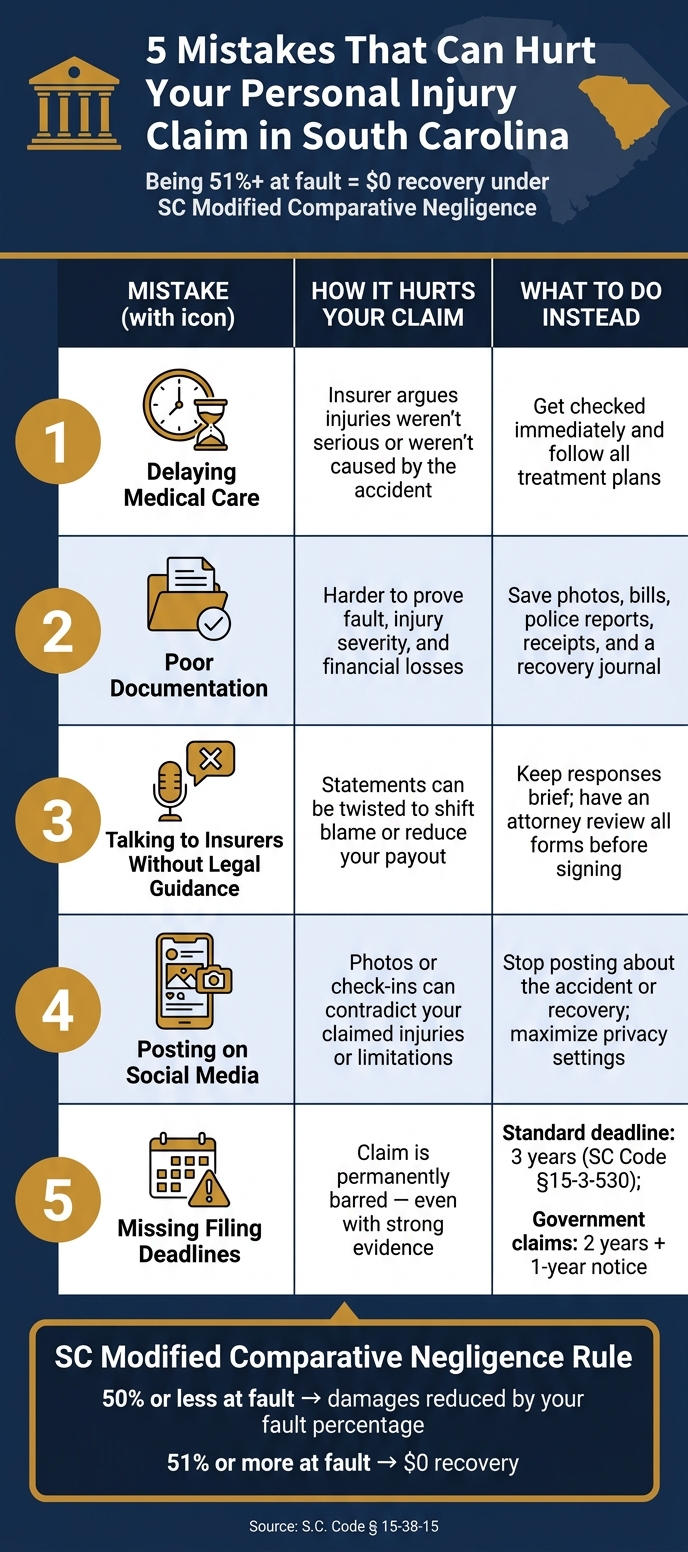
5 Mistakes That Can Hurt Your SC Personal Injury Claim
Quick Comparison
| Mistake | How it hurts a claim | What I should do instead |
|---|---|---|
| Waiting for medical care | Insurer may say I wasn’t hurt badly or the accident didn’t cause it | Get checked right away and follow treatment |
| Poor documentation | Harder to prove fault, injury, and losses | Follow a personal injury claim checklist to track photos, bills, and reports |
| Talking to insurers without guidance | My words can be used to shift blame or shrink payment | Keep it brief and review forms before signing |
| Posting on social media | Posts or photos may be used against me | Stop posting about the accident or recovery |
| Missing deadlines | I can lose the claim outright | Track deadlines and get legal help early |
This article explains those five mistakes in plain English so I can protect my claim before the insurance company finds a weak spot.
sbb-itb-ce0cbb0
Why Small Mistakes Can Cost You in a South Carolina Injury Case
Insurance adjusters and defense lawyers look for small gaps: a missed follow-up visit, a statement that doesn’t match, or a delay in care. That’s where the trouble starts. Each gap gives the insurer one more reason to push back on your claim.
Every personal injury case comes down to three things: liability, causation, and damages. In plain English, that means who caused the accident, whether the accident caused your injury, and what the injury cost you. If there are gaps in your medical care, insurers may argue your injuries are overstated or came from something else. Those same gaps can also help the defense shift part of the blame to you and cut the amount they may have to pay.
The table below shows what adjusters often watch for and why it matters:
| What Adjusters Look For | How It Hurts Your Claim |
|---|---|
| Missed treatment | Gives the insurer a basis to dispute causation or argue the injuries are not serious |
| Inconsistent accounts | Can be used to argue comparative fault or challenge your credibility |
| No incident report | Creates a factual dispute over what happened |
| Missing proof of losses | Reduces the amount of documented damages |
| Social media posts | Photos or posts may be used to contradict claimed limitations |
These are the same weak spots insurers use when they try to cut a payout. And the first mistake, often the one that does the most damage, is waiting too long to get medical care.
1. Not Getting Prompt Medical Care and Following Up
The first mistake is waiting too long to get checked after a crash. Right after an accident, adrenaline can hide pain. That means injuries like whiplash, concussions, and soft tissue damage may not show up for hours or even days. If you delay care, the insurer gets an easy opening to question your claim from day one.
A gap in treatment lets the insurer argue that something else caused your injuries or that the injuries were minor from the start. Medical records do more than show that you were hurt. They help prove causation and damages by linking the crash to the harm you suffered.
Follow-up care matters just as much as the first visit. Every missed appointment gives the insurer more room to say your injuries are unrelated or not that serious. They may also argue that you made things worse by not sticking with treatment.
When you see a doctor, mention every symptom, even if it seems small. If it does not appear in your medical record, it becomes much harder to prove later. Once treatment begins, keep good records with:
- Photos
- Bills
- Notes
2. Failing to Document the Accident, Injuries, and Losses
After you get medical care, your next job is simple: save the proof.
A personal injury claim can rise or fall based on documentation. If photos are missing, witnesses were never identified, or no accident report exists, the insurance company has more room to argue about what happened and pay less.
That’s why it helps to keep one file for everything tied to the crash and your recovery. Put your bills, receipts, repair estimates, travel costs, and insurer letters in one place so each loss is easy to show.
A daily recovery journal matters too. Write down your pain levels, what you can’t do, and how your recovery is going. That kind of steady record can support pain-and-suffering damages when other paperwork falls short. Also, hold on to damaged personal items, and take photos of them before putting them away in a safe place.
Use these categories to build a complete claim file:
| Category | What to Collect |
|---|---|
| Official Records | Police report, accident report |
| Medical Proof | Doctor notes, MRI results, prescriptions, therapy records |
| Visual/Physical | Scene photos, vehicle damage, damaged personal items |
| Financial Records | Medical bills, repair estimates, out-of-pocket receipts, insurance correspondence |
| Testimonial | Witness contact info, written statements, recovery journal |
3. Giving Insurance Companies Statements or Signing Forms Without Legal Guidance
After you document the crash, the next mistake is saying too much to the insurance company. Adjusters often reach out fast. Their job is to pay as little as they can, so even an offhand guess about speed, distance, or who caused the crash can be turned against you.
Signing forms can create a different set of problems. A medical authorization may give the insurer access to records that have nothing to do with the accident. And a release can shut down your claim, even if new injuries show up later or your costs end up being higher than expected.
You are generally not required to give a recorded statement to the other driver’s insurer. It’s usually smarter to decline politely until a South Carolina attorney has looked at the request. Let your lawyer deal with the insurer, check any paperwork before you sign, and wait until the full picture is clear on your injuries and future costs.
Staying quiet on the phone helps. But that’s only part of it. Online posts can still hurt the claim.
4. Posting About the Accident or Injuries on Social Media
Even if you stay off the phone, your social media activity can still come back to bite you. Insurance adjusters and defense lawyers often watch online accounts for posts that seem to clash with your claim.
A tagged photo or location check-in can be used to say your injuries aren’t as serious as you reported. Say you claim a back injury that limits your movement, but a photo shows you looking active at a party or other social event. The defense may point to that image and argue that the injury isn’t as severe. Check-ins can create the same issue because they suggest a level of activity that doesn’t match your medical limits.
During discovery, defense lawyers may get access to your posts and messages, even if the content is marked private. Posts that show physical activity can be used to challenge claims of pain, physical limits, or disability. Social media evidence can also be used to shift fault and cut compensation under South Carolina’s modified comparative negligence rule. And posting isn’t the only danger. Deleting content can damage your case too.
Don’t remove old posts before talking to an attorney. After an accident, deleting content can be seen as destroying evidence.
For now, stop posting about the accident, your injuries, or your recovery until the claim is over. Set your privacy controls as high as you can, and ask friends and family not to tag you.
5. Missing South Carolina Deadlines and Waiting Too Long to Get Legal Help
Miss a deadline, and it can wipe out everything else you did right. You might have strong proof, clear fault, and serious injuries. But under S.C. Code § 15-3-530, you generally have three years from the date of your injury to file suit in South Carolina. If that deadline passes, your case can be permanently barred, no matter how strong your evidence is or how serious your injuries are.
The basic rule sounds simple. The hard part is that the exceptions are not. Under S.C. Code § 15-3-530, you generally have three years to file suit in South Carolina, but claims tied to a government entity, like a city bus or a state-owned vehicle, may come with shorter deadlines and notice rules. That can cut down your time fast.
Waiting can also hurt your claim long before the filing deadline runs out. Crash scene proof can disappear. Witnesses can move away or forget key details.
Act fast and contact a South Carolina personal injury attorney as soon as you can after the accident. Early action gives your attorney time to investigate while the facts are still fresh, preserve evidence, and file the claim the right way.
Handling the Insurer Alone vs. Having a South Carolina Attorney Speak for You
After a crash, the other driver’s insurance company will often reach out fast. There’s a reason for that. Adjusters want your statement before you know how bad your injuries are or how the accident may affect you in the weeks ahead.
If you handle the claim by yourself, it’s easier to give incomplete answers, agree to broad record requests, or feel pushed into an early settlement. Do not sign a broad medical release or settlement form without having it reviewed first. That kind of paperwork can open up records that have nothing to do with the crash or cut off your claim before the full damage is clear.
Here’s where the risks tend to show up when you deal with the insurer alone versus having a South Carolina attorney speak for you.
| Risk Area | Handling Alone | With a South Carolina Attorney |
|---|---|---|
| Misstatements | High; casual remarks or apologies can be twisted into admissions of fault. | Low; the attorney manages communications and helps keep your statement accurate and limited. |
| Control over information | Low; insurers may request broad access to your full medical history. | High; the attorney limits records shared to what is relevant to the claim. |
| Settlement and future damages | High; early lowball offers may arrive before the full scope of injuries is known, and long-term care costs or lost earning potential can go unaccounted for. | The attorney can assess whether an offer matches your current and future losses, including future medical needs and lost wages. |
| Fault-shifting tactics | Vulnerable; under S.C. Code § 15-38-15, being found more than 50% at fault bars recovery entirely. | Defended; the attorney builds evidence to counter unfair blame-shifting. |
A South Carolina attorney can take over insurer calls and keep the claim centered on the facts. That matters more than most people think. One loose comment can be used against you later, while a lawyer can keep the record tight and on point.
Once those communications are handled, the next move is to preserve the records that back up your claim.
Evidence Checklist to Follow After an Accident in South Carolina
Once you stop giving the insurer easy ways to poke holes in your claim, the next step is simple: save the proof. Good records can keep an injury claim from turning into a fight over who caused the crash, how badly you were hurt, or what it cost you. Proof matters. And in many cases, the police report is one of the first things an insurer will want to see.
Start at the scene if you can, and keep saving records after that. Here’s what to collect:
| What to Collect | Why It Matters | Timing |
|---|---|---|
| Police/incident report | Establishes the official facts of the crash | Immediately |
| Photos of the scene, vehicles, injuries, and road conditions like skid marks | Visual proof of damage and conditions | Immediately |
| Witness names and contact details | Memories fade; people move away | At the scene |
| Damaged clothing, gear, or equipment | Physical evidence of impact; do not clean or repair | Preserve as-is |
| Surveillance footage from nearby businesses or doorbell cameras | Can be overwritten within days | As soon as possible |
| Medical records, bills, prescriptions, repair estimates, and receipts | Documents the financial cost of your injuries | Ongoing |
| Mileage log for medical appointments | Adds to your total recoverable damages | Ongoing |
| Insurer correspondence | Creates a paper trail of what was said and offered | Save everything |
| Pain and recovery journal | Shows daily impact on your life; humanizes the claim | Start immediately |
Two items need extra care. First, use a daily pain journal. Write down your pain levels, how well you slept, what you couldn’t do, and any emotional effects. Those day-to-day notes can help show what life looked like after the accident.
Second, pay attention if your symptoms shift. If new pain shows up later, or your condition gets worse, ask your doctor whether imaging or other testing is needed.
After the evidence is preserved, deadline rules become the next risk.
South Carolina Filing Deadlines and Timing Issues to Know
The filing deadline in South Carolina depends on the type of claim. Some cases follow the standard time limit. Others move on a much shorter clock.
If your case involves a government vehicle, a public employee, a road, or public property, the South Carolina Tort Claims Act may shorten the deadline and add an extra step. Claims against government entities are often subject to a 2-year filing deadline, and a formal notice of claim may be due within 1 year.
Wrongful death claims usually must be filed within 3 years from the date of death, not the date of the injury that later caused the death. That detail matters more than people think. A family may focus on medical care, funeral plans, and day-to-day life, only to find out the legal clock started at a different point than expected.
| Claim Type | Government Entity Deadline | Notice Requirement |
|---|---|---|
| Government Entity Claims | 2 years | Often 1 year |
| Wrongful Death | 3 years from date of death | Varies |
Time also affects proof. Surveillance footage may be deleted in a matter of days. Witnesses move, change phone numbers, or simply forget small facts that later turn out to matter a lot.
Think of the deadline as the last safe day, not the day to begin. A missed deadline can end an otherwise strong claim just as fast as a bad statement or skipped medical care. Acting early gives you more room to preserve evidence and pin down which deadline applies before the window closes.
Conclusion
In South Carolina, five mistakes do the most damage to an injury claim: waiting too long to get medical care, poor records, careless talks with the insurance company, social media posts, and missed deadlines. Any one of them can reduce what you recover or wipe out the claim altogether under S.C. Code § 15-38-15.
The main point is straightforward: move fast, keep records of everything, and get legal help before you speak with the insurer. The earlier you protect evidence and get support, the better shape your claim is in.
FAQs
What if I felt fine right after the accident?
Even if you feel fine right after an accident, get medical care as soon as you can. Adrenaline and shock can hide pain and other symptoms, so an injury may not show up until hours – or even days – later.
There’s another reason this matters: prompt care creates a medical record that ties your injuries to the accident. Without that record, an insurance company may try to say your injuries are minor, came from something else, or were already there before the crash.
Can I still recover if I was partly at fault?
Yes. South Carolina follows a modified comparative negligence rule. That means you can still recover damages if you were partly at fault, as long as your share of the blame is 50% or less.
There’s a catch, though: your compensation goes down by your percentage of fault. So if you’re found 20% at fault and awarded $100,000, you’d recover $80,000.
If your share of fault goes above 50%, you can’t recover damages.
What should I bring to a personal injury consultation?
Bring any documents that show what happened and how you were injured. That includes medical records from your first treatment, like emergency room reports, ambulance records, and discharge instructions.
You should also bring:
- Police reports or workplace incident reports
- Photos or videos from the scene
- Witness contact information
- Other parties’ insurance and driver’s license details
- Any personal notes you wrote about what happened
These items help show both the event itself and what happened afterward.