


Probation in Spartanburg allows individuals convicted of crimes to avoid jail time by complying with specific court-ordered conditions. Managed by the South Carolina Department of Probation, Parole, and Pardon Services (SCDPPPS), probation offers a chance for rehabilitation while ensuring public safety.
Key Points:
- Eligibility: Probation is available for most crimes, except those punishable by death or life imprisonment. Judges decide eligibility based on the offense and individual circumstances.
- Conditions: Probationers must follow laws, maintain employment, pay fines, and meet other requirements like community service or treatment programs. Serious offenses may impose stricter rules, such as GPS monitoring for sex offenders.
- Violations: Failing to meet probation terms can lead to hearings where judges may extend, modify, or revoke probation. Violations include technical (e.g., missed meetings) or substantive (e.g., new crimes).
- Pretrial Intervention (PTI): First-time offenders may qualify for PTI, a diversion program that can result in dismissed charges upon successful completion.
Understanding probation rules and seeking legal advice are crucial for navigating the system effectively.
How Probation Works in Spartanburg: Process and Requirements Overview
Who Qualifies for Probation
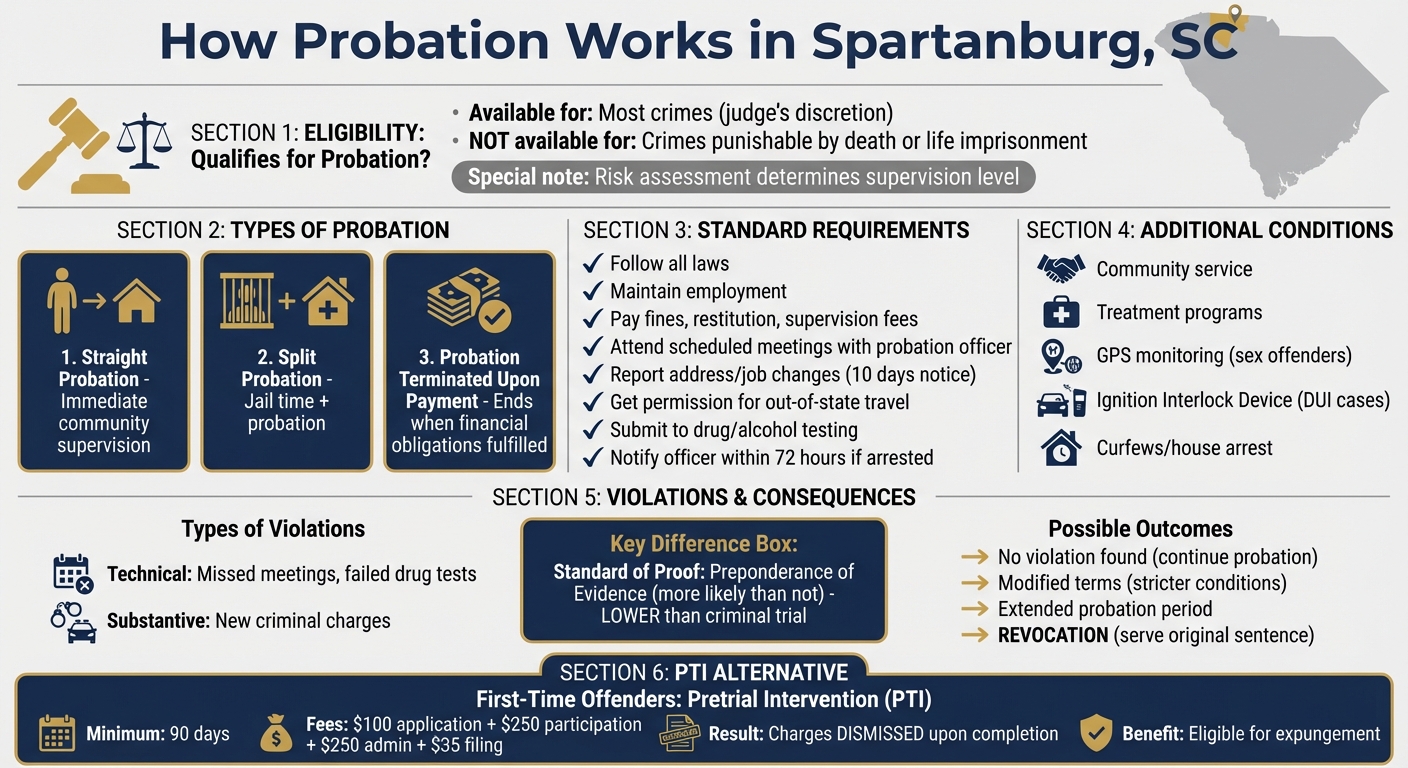
Understanding eligibility is essential when navigating probation in Spartanburg. In South Carolina, probation can be granted for most crimes at the judge’s discretion during sentencing. According to South Carolina Code Section 24-21-410, probation is not available for crimes punishable by death or life imprisonment. This means that whether someone qualifies depends on the specific offense, the individual’s background, and the judge’s evaluation of the case.
To qualify, defendants must agree in writing to allow warrantless searches and seizures of their person and property by probation agents or law enforcement, provided there is reasonable suspicion. This is a standard requirement for most offenders. However, those convicted of Class C misdemeanors or unclassified misdemeanors with a maximum sentence of one year are not subject to this condition. These rules help shape the framework for the probation conditions that follow.
The South Carolina Department of Probation, Parole, and Pardon Services (SCDPPPS) uses an actuarial risk assessment to predict the likelihood of reoffending. This assessment influences the level of supervision and can even impact whether probation is granted. Factors such as prior criminal history, age, and the nature of the offense are all considered in this evaluation.
Types of Crimes That May Qualify
In Spartanburg, probation is typically available for most misdemeanors and lower-level felonies. Depending on the offense, the court may assign different probation structures, such as:
- Straight probation: Immediate community supervision without incarceration.
- Split probation: A combination of jail time followed by probation.
- Probation terminated upon payment: Probation ends once financial obligations are fulfilled.
However, certain serious crimes limit or exclude probation eligibility. For example, "no parole" offenses – which include Class A, B, and C felonies or crimes carrying a maximum sentence of 20 years or more – require offenders to serve at least 85% of their sentence before release into a Community Supervision Program. Additionally, "Jessie’s Law" mandates a minimum 25-year prison sentence for sex predators, effectively removing standard probation options.
Defendants aged 17 to 24 at the time of conviction may have a different path under the Youthful Offender Act (YOA). This law allows for an indeterminate sentence of up to six years, often offering more lenient terms compared to traditional sentencing.
How a Defense Attorney Can Help
Given the complexity of probation eligibility, having a skilled defense attorney can make a significant difference. Attorneys can advocate for probation by presenting mitigating factors and negotiating for conditional discharge. For qualifying defendants, a conditional discharge may be an option. In these cases, the court defers a judgment of guilt, placing the individual on probation with their consent. If they meet all probation conditions, the case is dismissed without a conviction.
Attorneys can also evaluate whether defendants qualify for alternative sentencing options, such as the Youthful Offender Act, based on their age and specific circumstances. Legal expertise ensures that defendants receive the most favorable outcome possible within the framework of the law.
sbb-itb-ce0cbb0
What Probation Requires
Probation in Spartanburg comes with clear and enforceable conditions aimed at ensuring public safety and helping individuals reintegrate into the community. These conditions aren’t uniform for everyone – courts can tailor them to fit the specific circumstances of each case. Knowing what’s expected is essential for probationers to avoid violations and successfully complete their supervision.
Typical Probation Requirements
South Carolina law, under SC Code § 24-21-430, allows probation agents or law enforcement to conduct warrantless searches of a probationer’s person, vehicle, or belongings if they have reasonable suspicion. However, this rule doesn’t apply to individuals convicted of Class C misdemeanors or unclassified misdemeanors carrying a maximum sentence of one year.
Probationers are required to follow all laws, avoid harmful behaviors, maintain steady employment, and meet financial obligations such as fines, restitution, and supervision fees. The South Carolina Department of Probation, Parole, and Pardon Services (SCDPPPS) offers an online system to make these payments more convenient.
Travel is also regulated. Probationers are generally allowed to move freely within South Carolina’s 46 counties but need permission from their probation officer or the court to travel outside the state. Additionally, they must notify their probation officer at least ten days before changing their residence or job. If they’re questioned or arrested by law enforcement, they typically have 72 hours to inform their probation officer.
Beyond these standard conditions, additional requirements may be imposed based on the offense or the individual’s situation. These can include community service, substance abuse or mental health treatment, curfews, or even house arrest. For DUI or alcohol-related offenses, probationers may be required to install an Ignition Interlock Device (IID) in their vehicles.
Sex offenders face stricter rules. Under "Jessie’s Law", GPS monitoring is mandatory, and they must follow residency restrictions, such as staying at least 1,000 feet away from schools, parks, and playgrounds. In October 2025, a statewide Halloween curfew was enforced for sex offenders under supervision whose offenses involved crimes against children. They are also required to register biannually for life, pay a $150 annual registration fee to the Sheriff’s Department, and adhere to specialized curfews unless deemed indigent.
These conditions set the framework for the monitoring and supervisory processes discussed next.
Supervision and Reporting
Probation officers play a key role in ensuring compliance through scheduled visits and checks on living conditions.
Drug and alcohol testing is a common enforcement tool, with officers authorized to request urinalysis or blood tests at any time. High-risk individuals may be subject to 24/7 GPS tracking managed by the Intelligence Tracking and Communications (ITAC) Center, which monitors for violations like curfew breaches or tampering with the device. GPS systems can also create "exclusion zones", areas where the probationer is electronically barred from entering.
The level of supervision is determined by a risk assessment that evaluates the likelihood of reoffending. For those who meet all probation conditions except financial obligations, their case may shift to "Administrative Monitoring" once the term of supervision ends.
This structured supervision ensures that any violations are quickly identified, allowing for immediate corrective measures when necessary.
What Happens If You Violate Probation
In Spartanburg, violating probation is a serious matter that sets off a legal process with potentially severe consequences. South Carolina identifies two primary types of probation violations: technical violations (like missing a meeting or failing a drug test) and substantive violations (committing a new crime while on probation). If your probation officer believes you’ve violated the terms, they will file a violation report and request a revocation hearing.
The Violation Hearing
Probation violation hearings for adults in Spartanburg are conducted in General Sessions court, as outlined in South Carolina Code § 24-21-460. These hearings differ from criminal trials in significant ways. For starters, there’s no jury – only a judge decides the outcome. The probation officer presents evidence, and you have the opportunity to admit or deny the allegations. Your attorney can challenge the evidence and present supporting documents, such as pay stubs, medical records, rehabilitation program enrollment forms, or letters from employers, to argue your case.
The standard of proof in these hearings is much lower than in criminal cases. As Seaton & Duncan explain:
"Unlike criminal trials, where the prosecution must prove guilt beyond a reasonable doubt, probation violations only require proof by a preponderance of the evidence."
In simpler terms, the judge only needs to believe that the violation was more likely than not. Based on the evidence and your compliance history, the judge has broad authority to decide your fate. Possible outcomes include:
| Potential Outcome | Description |
|---|---|
| No Violation Found | Probation continues under the same terms. |
| Modification of Terms | Stricter conditions may be added, like mandatory counseling or increased reporting. |
| Extension | The probation period is extended to give you more time to comply. |
| Revocation | Probation ends, and you may have to serve the remainder of your original sentence. |
Each decision depends on the nature of the violation and your overall track record while on probation.
Penalties for Violations
The penalties for violating probation vary based on the type of violation and your history of compliance. Minor technical violations might result in administrative actions, such as warnings or adjusted probation terms. However, more serious or repeated violations often lead to a court hearing.
For technical violations, judges might impose stricter measures like house arrest, mandatory counseling, or increased reporting requirements. They could also extend your probation or revoke any earned time credits. On the other hand, substantive violations – such as being charged with a new crime – carry harsher penalties. In these cases, the judge may revoke your probation entirely, requiring you to serve the original suspended sentence. Additionally, leaving South Carolina without permission while on probation could lead to extradition back to the state, with you being responsible for the transport costs.
Having an experienced attorney by your side is crucial during this process. As Shaun Kent notes:
"Your lawyer can speak for you, challenge the evidence, or explain why the violation happened. Judges sometimes consider things like medical issues, job loss, or honest mistakes."
A skilled defense attorney can present mitigating factors, argue for less severe penalties, and show that any failure to pay fines was due to genuine financial hardship rather than willful neglect. If you suspect a violation, don’t wait – contact a defense attorney immediately. Waiting until the hearing date can make it much harder to prepare a strong defense.
Pretrial Intervention Programs
For first-time offenders in Spartanburg facing criminal charges, the Pretrial Intervention (PTI) program offers an alternative to the usual probation process. Unlike probation, which follows a conviction or guilty plea, PTI is a diversion program that takes place while charges are still pending. Successfully completing PTI can lead to your charges being dismissed entirely, helping you avoid a criminal record.
The program is managed by the Circuit Solicitor’s Office and applies to both General Sessions and Misdemeanor/Magistrate cases. Acceptance into PTI is determined by the Solicitor – not a judge – based on factors like the nature of your offense, your criminal history, and recommendations from the arresting agency and any victims involved. PTI is a one-time opportunity; participation in the program disqualifies you from applying again in the future. It serves as an alternative to traditional probation, which occurs only after a conviction.
PTI Eligibility and Requirements
To be eligible for PTI in Spartanburg, you must be at least 18 years old and have no significant prior criminal record. However, certain offenses – such as DUI, blackmail, violent crimes (as defined by South Carolina law), and specific traffic violations – automatically disqualify you. Applications must be submitted within the required deadlines. The review process typically takes four to six weeks, though this can vary depending on your case.
The program comes with several fees:
- A non-refundable $100 application fee
- A $250 participation fee (split into two payments of $125)
- A $250 administrative fee and a $35 filing fee for expungement
- An additional $49 fee for participants aged 18 to 25 charged with alcohol or drug-related offenses, which covers the "Alive at 25" program
It’s important to verify your criminal history before applying, as the application fee is non-refundable.
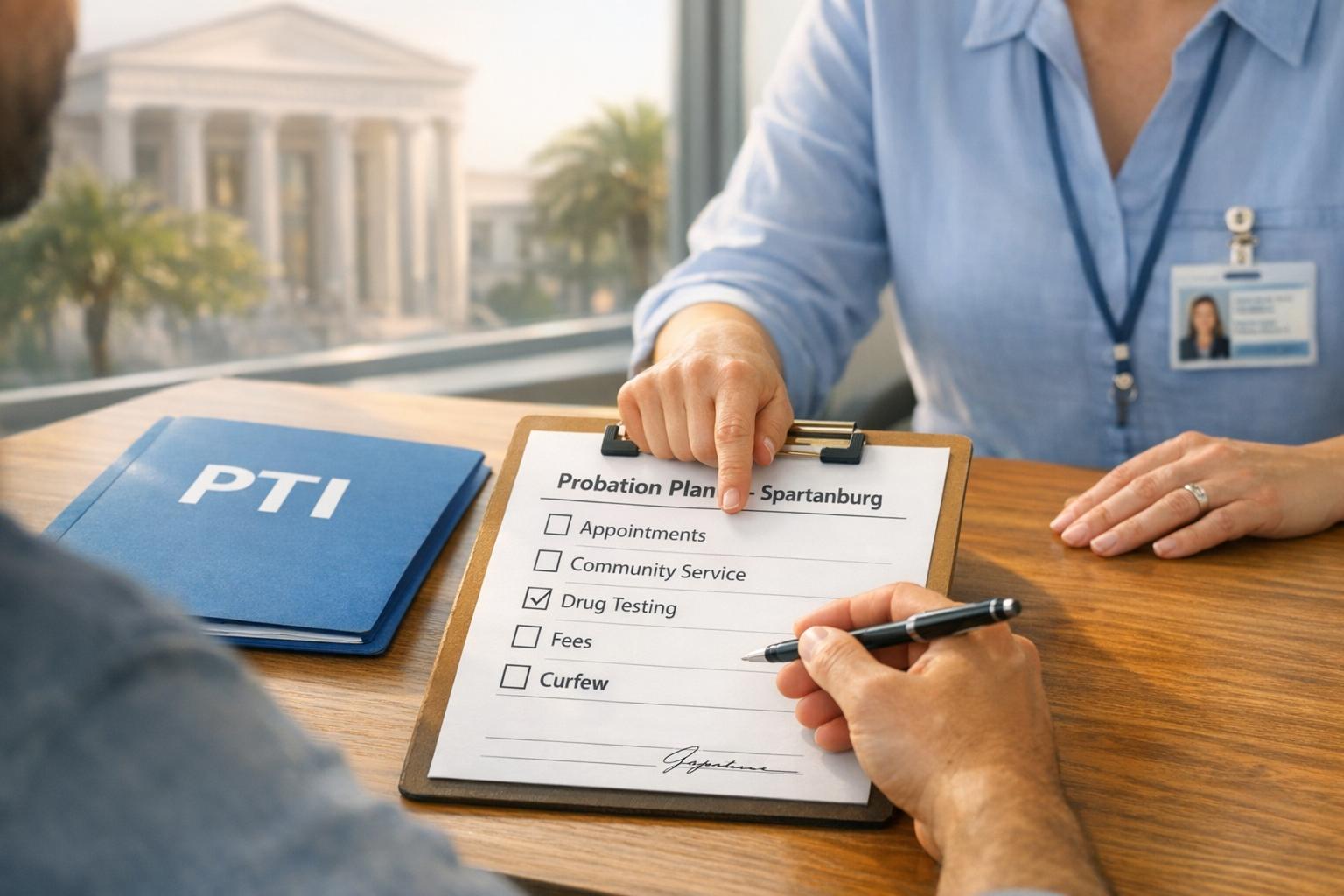
Once accepted, participants must complete a minimum of 90 days in the program. Requirements include monthly case management meetings, community service, counseling or educational programs, random drug testing, and restitution payments. Depending on the nature of your charges, you may also be required to submit written law reports, attend prison presentations, or complete the "Alive at 25" program. Missing your initial appointment or being rearrested during the program results in immediate termination, and your case will return to standard prosecution.
Why PTI May Be Beneficial
PTI offers several advantages for eligible participants. Most notably, it provides the opportunity to have charges dismissed, leaving you without a criminal conviction. After successfully completing the program, the Solicitor’s Office will perform a final criminal history check. If no new offenses are found during your participation, you’ll receive an expungement packet, allowing you to apply for the removal of all official records related to your arrest. According to South Carolina Code of Laws Section 17-22-150:
"The effect of the [expungement] order is to restore the person, in the contemplation of the law, to the status he occupied before the arrest."
The expungement process typically takes 10 to 12 weeks. Unlike standard prosecution, which results in a permanent criminal record if convicted, PTI gives first-time offenders a genuine second chance to move forward without the burden of a criminal history.
Conclusion and Key Takeaways
Probation in Spartanburg offers an alternative to incarceration, but it comes with strict conditions that demand full compliance. These include following all state and federal laws, staying in regular contact with your local SCDPPPS office, and fulfilling all court-ordered requirements.
The system enforces these rules rigorously. Failing to meet any condition can lead to serious consequences, including revocation of probation and the reinstatement of your original sentence. Violations – whether they involve missing required meetings or facing new criminal charges – are evaluated using a lower standard of proof (preponderance of the evidence) compared to criminal trials, making it easier for the court to rule against you. It’s crucial to document progress, pay fees promptly through the SCDPPPS online portal, and maintain open communication with your supervision officer to avoid complications.
Given the high stakes, seeking professional legal advice is critical. An experienced attorney can help you understand your probation terms, defend your rights during violation hearings, and navigate the complexities of the system. With over 650 employees across South Carolina, SCDPPPS actively monitors probation compliance in Spartanburg County, highlighting the need for thorough preparation and legal support when your freedom is on the line. This underscores the earlier discussion on the importance of understanding probation requirements and securing legal guidance to navigate Spartanburg’s criminal justice system effectively.
FAQs
What happens if you violate probation in Spartanburg?
If you’re on probation in Spartanburg, violating its terms can lead to serious consequences, including the revocation of your probation. This could result in serving the original sentence handed down by the court, which might mean time in jail or prison. The punishment largely depends on the specifics of the violation and the judge’s decision.
Some common violations include missing appointments with your probation officer, failing to pay fines or restitution, committing new offenses, or not following other court-ordered conditions. If you’re accused of violating probation, you’ll likely need to attend a hearing where the court will decide the next steps. It’s critical to approach the situation seriously and seek legal advice to ensure your rights are protected.
What is the difference between Pretrial Intervention (PTI) and standard probation?
Pretrial Intervention (PTI) and standard probation serve different purposes and occur at distinct stages in the legal process. PTI is designed as a diversion program for individuals who are first-time, non-violent offenders. The goal? To help participants avoid formal prosecution altogether. Those who successfully complete the program often have their charges dismissed, focusing on rehabilitation and reducing the likelihood of future offenses.
On the other hand, probation is a court-ordered form of supervision that happens after someone has been convicted or sentenced. It acts as both a form of punishment and an opportunity for rehabilitation. Those on probation must adhere to strict conditions set by the court, and failing to meet these requirements can result in serious penalties, including jail time.
To put it simply, PTI provides a chance to avoid a conviction entirely, whereas probation involves ongoing oversight after a conviction has already occurred.
What does a defense attorney do to help someone qualify for probation?
A defense attorney plays a crucial role in helping a defendant pursue probation. They carefully analyze the case details, emphasize factors that may reduce the severity of the situation, and craft a persuasive argument to demonstrate to the court or prosecutor why probation is an appropriate option.
Important factors include the type of offense, the defendant’s prior criminal record, and any evidence suggesting they are unlikely to commit another crime. A skilled attorney works to safeguard the defendant’s rights while striving to secure the most favorable result.