


Getting charged with a DUI in Spartanburg County involves two separate processes: a criminal trial to determine guilt and an administrative DMV hearing to address your license suspension. These proceedings are independent, meaning success in one doesn’t guarantee success in the other. Here’s what you need to know:
- Criminal Trial: Determines whether you’re guilty of DUI, with penalties including fines ($400–$1,000), potential jail time, and mandatory enrollment in the Alcohol and Drug Safety Action Program (ADSAP). Cases are handled in Municipal, Magistrate, or General Sessions Court based on the severity of the offense.
- Administrative DMV Hearing: Focuses on whether your license will be suspended under South Carolina’s implied consent law. You have 30 days from your arrest to request this hearing.
The trial process includes pre-trial motions, jury selection, evidence presentation, and closing arguments. The prosecution must prove your guilt beyond a reasonable doubt, often relying on chemical tests, officer testimony, and field sobriety tests. The defense can challenge evidence, cross-examine witnesses, and present alternative explanations to create reasonable doubt.
If convicted, penalties depend on your BAC level and prior offenses, ranging from fines and license suspensions to jail time and mandatory programs. Repeat offenses carry harsher consequences, including longer suspensions and ignition interlock device requirements.
Acting quickly and securing skilled legal representation is critical to navigating this process and protecting your rights.
Pre-Trial Motions and Hearings
Initial Appearance and Arraignment
In Spartanburg County, your first court appearance usually happens 30 to 60 days after your arrest. To keep the docket moving, many defendants attend this session together, streamlining the process for the court system.
At this appearance, the judge reads the DUI charges against you and asks for your plea. You have three options: guilty (admitting to the offense, which moves the case to sentencing), not guilty (leading to further legal proceedings), or no contest (accepting a conviction without admitting guilt). This step ensures you understand the charges and officially records your plea.
Additionally, you’ll need to inform the court whether you plan to hire a private attorney, request a public defender, or represent yourself. Afterward, the judge sets a timeline for your case. Standard cases are typically resolved within six months, while more complex ones may take up to a year. Even if the evidence seems stacked against you, entering a not guilty plea gives your attorney time to gather evidence and build a defense strategy.
Bond Hearings and Pre-Trial Intervention Programs
After the arraignment, bond hearings and intervention programs play a role in managing your release and the progression of your case. Bond hearings evaluate factors like your criminal history, ties to the community, and overall risk to determine the conditions for your release.
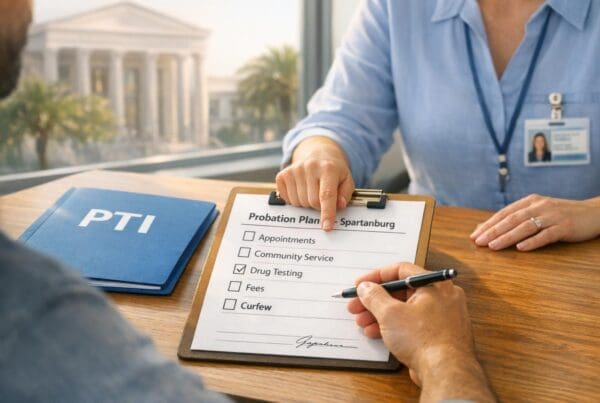
If this is your first offense, you might qualify for Spartanburg County’s Pre-Trial Intervention (PTI) program. This diversion program is similar to probation, requiring you to complete tasks such as community service, drug and alcohol counseling, attending a prison presentation, and undergoing random drug tests. Costs for the program range from $1,000 to $2,500, including a $250 application fee, which can be paid in two installments. Successfully completing the program can lead to your charges being dismissed and potentially expunged from your record. Keep in mind, acceptance into the program can take 4–6 weeks, during which you must still attend all scheduled court appearances.
Filing and Arguing Pre-Trial Motions
Pre-trial motions are legal requests made to address specific issues before the trial begins. Common motions include requests to suppress evidence obtained through procedural or constitutional violations, dismiss charges due to lack of evidence, or obtain additional discovery materials like dashcam footage or maintenance records for chemical testing equipment. These motions can significantly influence the direction of the case.
Timing is crucial. For example, if you’re facing a second or subsequent DUI charge – or a DUI involving injury – you must request a preliminary hearing within 10 days of your bond hearing to challenge the probable cause for your arrest.
These pre-trial steps are essential in shaping the strategies for both the prosecution and the defense as the case moves forward.
Jury Selection in Spartanburg County
After pre-trial motions wrap up, the jury selection process begins with a pool of 50–60 prospective jurors. This step, known as voir dire, is designed to ensure the selection of an impartial jury. Below, we’ll break down how voir dire works and the methods used to exclude biased jurors.
Voir Dire and Questioning Potential Jurors
The judge starts by introducing the case and identifying the involved parties. Then, they question the group and individual jurors to determine whether any of them have connections to the parties, personal stakes in the case, preconceived opinions, or biases that could affect their judgment.
"The questioning process, called the voir dire, is designed to permit the attorneys to become acquainted with the prospective jurors and to determine whether a juror can serve fairly and impartially in the case." – South Carolina Judicial Branch
While the judge leads the initial questioning, attorneys for both sides can propose additional questions to dig deeper into potential biases. These questions often touch on areas like employment background, prior encounters with law enforcement, familiarity with the incident in question, or views on issues like DUI cases and chemical testing. To prepare, attorneys receive a juror list – including names, city of residence, sex, race, and year of birth – up to seven working days before the trial.
Challenges for Cause and Peremptory Strikes
In DUI cases, where public opinion can heavily influence outcomes, ensuring an impartial jury is crucial. Attorneys first remove jurors "for cause" – those who display clear bias or have legal conflicts. There’s no cap on the number of jurors who can be excused for cause.
Once the for-cause challenges are exhausted, attorneys use a set number of peremptory strikes to dismiss jurors without needing to explain their reasoning. In South Carolina criminal cases, this process is highly structured. The clerk calls out each juror’s name, and the juror stands. The prosecutor is asked, "What sayeth the State?" and can respond with "Excuse", "Present", or "Swear." If the juror is presented, the defense attorney is asked the same question and can also choose to "Excuse" or "Swear" the juror.
After this process, a jury of 12 is selected for General Sessions cases, while first-time DUI offenses require a jury of 6. Once chosen, jurors take an oath to "well and truly try" the case and deliver a "true verdict… according to the law and evidence". This rigorous selection process ensures that your constitutional right to a fair and impartial jury is upheld before any evidence is presented.
Prosecution’s Case: Evidence and Testimony
Once the jury is in place, the prosecution has the task of proving the DUI charge beyond a reasonable doubt. Their case typically relies on physical evidence, chemical test results, and witness testimony to establish the defendant’s impairment.
Common Evidence in DUI Cases
DUI evidence generally falls into three main categories: chemical tests, field sobriety tests, and video recordings. Chemical tests – like breath, blood, or urine tests – are often central to the case. In South Carolina, a blood alcohol concentration (BAC) of 0.08% or higher is considered evidence of impairment, though even readings between 0.06% and 0.07% can be presented in court. Under the state’s "per-se" DUAC (Driving with an Unlawful Alcohol Concentration) law, the prosecution only needs to prove that the defendant’s BAC was 0.08% or higher, regardless of visible signs of impairment.
"Under South Carolina law, if you are found to have been driving with a BAC of 0.08 percent or above (if you are over 21), you can be convicted of DUI regardless of whether you were physically or cognitively impaired." – Michael L. Brown, JR., DUI Lawyer
Field sobriety tests, such as the Horizontal Gaze Nystagmus (HGN), the walk-and-turn, and the one-legged stand, are used to highlight physical and cognitive impairment. South Carolina law also mandates that both the location of the incident (starting from the activation of blue lights) and the breathalyzer testing site be recorded on video. Additionally, refusing a breath or blood test can be introduced as evidence, potentially suggesting that the driver was aware of their intoxication.
Testimony from the Arresting Officer
The arresting officer’s testimony is a key part of the prosecution’s case. This testimony often includes details about the traffic stop, the arrest, and any observed signs of impairment. Officers may describe erratic driving behaviors like swerving or speeding, as well as physical indicators such as the smell of alcohol, bloodshot eyes, slurred speech, or unsteady movements. They will also discuss how the defendant performed on field sobriety tests and outline the steps taken during the arrest.
Since South Carolina law requires DUI stops to be recorded using dashcams or body-worn cameras, defense attorneys can cross-examine the officer by comparing their testimony to the video footage. This allows the defense to challenge inconsistencies or inaccuracies in the officer’s account. The prosecution must also ensure that all evidence presented is verified and properly handled.
Chain of Custody and Evidence Challenges
To admit chemical test results as evidence, the prosecution must establish an unbroken chain of custody for blood or urine samples. They must also demonstrate that the breathalyzer was correctly calibrated, the operator was certified, and that the required 20-minute observation period was followed.
"South Carolina law requires that breath tests be recorded, including the observation period." – Seaton & Duncan
Additionally, the prosecution must show compliance with South Carolina’s Implied Consent Law (S.C. Code Ann. § 56‑5‑2950) and confirm that chemical tests were conducted within two hours of the arrest. Any missteps – such as missing calibration records, uncertified operators, or failure to adhere to the observation period – can give the defense grounds to question the reliability of the evidence. These procedural lapses can significantly impact the prosecution’s case if successfully highlighted by the defense.
Defense Strategy: Cross-Examination and Evidence
After the prosecution lays out its case, the defense takes center stage with a strategy aimed at questioning the evidence and presenting its own narrative. The goal is to establish reasonable doubt by highlighting flaws in the prosecution’s arguments and offering alternative explanations for the defendant’s arrest.
Cross-Examining Prosecution Witnesses
Cross-examination is a critical tool for the defense, often used to scrutinize the arresting officer’s testimony and other prosecution witnesses. By comparing their statements with dashcam or body-worn camera footage, the defense can reveal inconsistencies or procedural missteps that cast doubt on the officer’s credibility.
Field sobriety tests often come under fire during cross-examination. For instance, an officer might claim the defendant failed the walk-and-turn test, but the defense could point out external factors – like uneven ground, poor lighting, or even inappropriate footwear – that might explain the performance without implicating alcohol use. Additionally, any deviation from National Highway Transportation Safety Administration (NHTSA) guidelines can undermine the validity of these tests.
"The National Highway Transportation Safety Administration (NHTSA) admits if ‘any of the standardized field sobriety test elements is changed, the validity is compromised.’" – Cromer Law Offices, LLC
Challenging Probable Cause and Test Accuracy
The defense often questions whether the officer had reasonable suspicion or probable cause to make the stop in the first place. If the stop is deemed unlawful, all subsequent evidence – including breathalyzer results and field sobriety test outcomes – could be excluded from the trial.
Breathalyzer results are another common target. The defense might use video evidence to ensure the officer adhered to the required 20-minute observation period, which is crucial for preventing false readings caused by residual mouth alcohol. Maintenance and calibration records for the breath-testing device, such as the DataMaster, may also be scrutinized. These records must show that simulator tests produced results between 0.076% and 0.084% to confirm the machine’s reliability.
Medical conditions like acid reflux (GERD), diabetes, or ketosis from a low-carb diet can also lead to inflated blood alcohol concentration (BAC) readings. In such cases, the defense might introduce medical records or call on experts to explain how these conditions could have impacted the results.
Presenting Defense Evidence and Witnesses
After challenging the prosecution’s case, the defense introduces its own evidence to reinforce doubts. Sobriety witnesses – individuals who were with the defendant before the arrest – can testify about how much alcohol was consumed or whether the defendant showed any signs of impairment.
Expert witnesses play a key role in addressing technical aspects of the case. For example, a forensic toxicologist might explain the "rising blood alcohol" defense, which argues that the defendant’s BAC was below the legal limit while driving but increased by the time the test was administered. Other experts could examine the reliability of the DataMaster machine or point out flaws in how field sobriety tests were conducted.
If the defendant requested an independent breath or blood test, the results can also be introduced. South Carolina law requires officers to provide "affirmative assistance" in facilitating these independent tests. Failure to do so could render the state’s breath test results inadmissible.
The defense might also invoke the Suchenski defense, based on the South Carolina Supreme Court case City of Rock Hill v. Suchenski. If the arresting officer failed to properly record key procedures – such as activating blue lights, conducting field sobriety tests, or capturing the defendant’s feet during physical tests – the defense can argue for a full dismissal of the charges.
"If the officer fails to comply with the videotape law and does not have a valid excuse per the statute, the SC Supreme Court has confirmed… that the remedy is dismissal." – Stuart M. Axelrod, Managing Partner, Axelrod & Associates, P.A.
sbb-itb-ce0cbb0
Closing Arguments and Jury Instructions
Closing Arguments from Both Sides
Once all evidence has been presented and witnesses questioned, both sides deliver their final arguments to the jury. The prosecution takes the lead, summarizing key points such as officer testimony, breathalyzer results, and field sobriety observations. Their objective is to demonstrate that every element of the DUI charge has been proven beyond a reasonable doubt.
The defense follows with its closing argument, highlighting any gaps or inconsistencies in the prosecution’s case. This might involve questioning the reliability of the breathalyzer calibration or pointing out procedural errors during the traffic stop. The defense’s primary aim is to instill reasonable doubt in the minds of the jurors. Every detail, no matter how small, is scrutinized during these critical moments.
"Closing arguments are an opportunity for each party to remind jurors of the main evidence presented and to convince them to adopt an interpretation favorable to their position." – Colton Blechman
In South Carolina, the prosecution is allowed to speak twice – once initially and again in rebuttal after the defense has presented its summary. However, strict rules govern these arguments. Lawyers are prohibited from expressing personal opinions, vouching for witness credibility, or appealing to jurors’ emotions. After the closing arguments, the judge provides instructions to guide the jury in their deliberations.
Judge’s Instructions to the Jury
After closing arguments, the judge gives the jury detailed instructions that act as their legal framework. The judge emphasizes that the prosecution carries the burden of proving every element of the DUI charge and reminds jurors to base their decision solely on the evidence presented during the trial.
The instructions include an explanation of the legal elements required for a DUI conviction in South Carolina. Typically, this involves proving that the defendant was operating a vehicle while under the influence of alcohol or drugs.
"In a DUI trial, the prosecution must prove beyond a reasonable doubt that you were driving under the influence of alcohol or drugs." – The Bateman Law Firm
The judge also reviews the possible verdicts – guilty or not guilty – and reinforces the principle of the presumption of innocence.
Jury Deliberation Process
With the judge’s instructions in hand, the jury retires to deliberate in private. In South Carolina, a unanimous decision is required, meaning all jurors must agree on the verdict, whether guilty or not guilty. If the jury is unable to reach a unanimous decision after thorough discussion, the judge may declare a mistrial, often referred to as a hung jury.
During deliberations, jurors carefully review the evidence, evaluate the credibility of witnesses, and apply the judge’s legal instructions to determine whether the prosecution has met its burden of proof. Unlike bench trials, where a single judge makes the decision, jury trials rely on a diverse group of individuals who bring their collective experiences and perspectives to the process.
"The jury members will come from all walks of life and have all manner of life experiences… most juries tend to see the humanity in each defendant." – Truslow & Truslow PA
Verdict and Sentencing
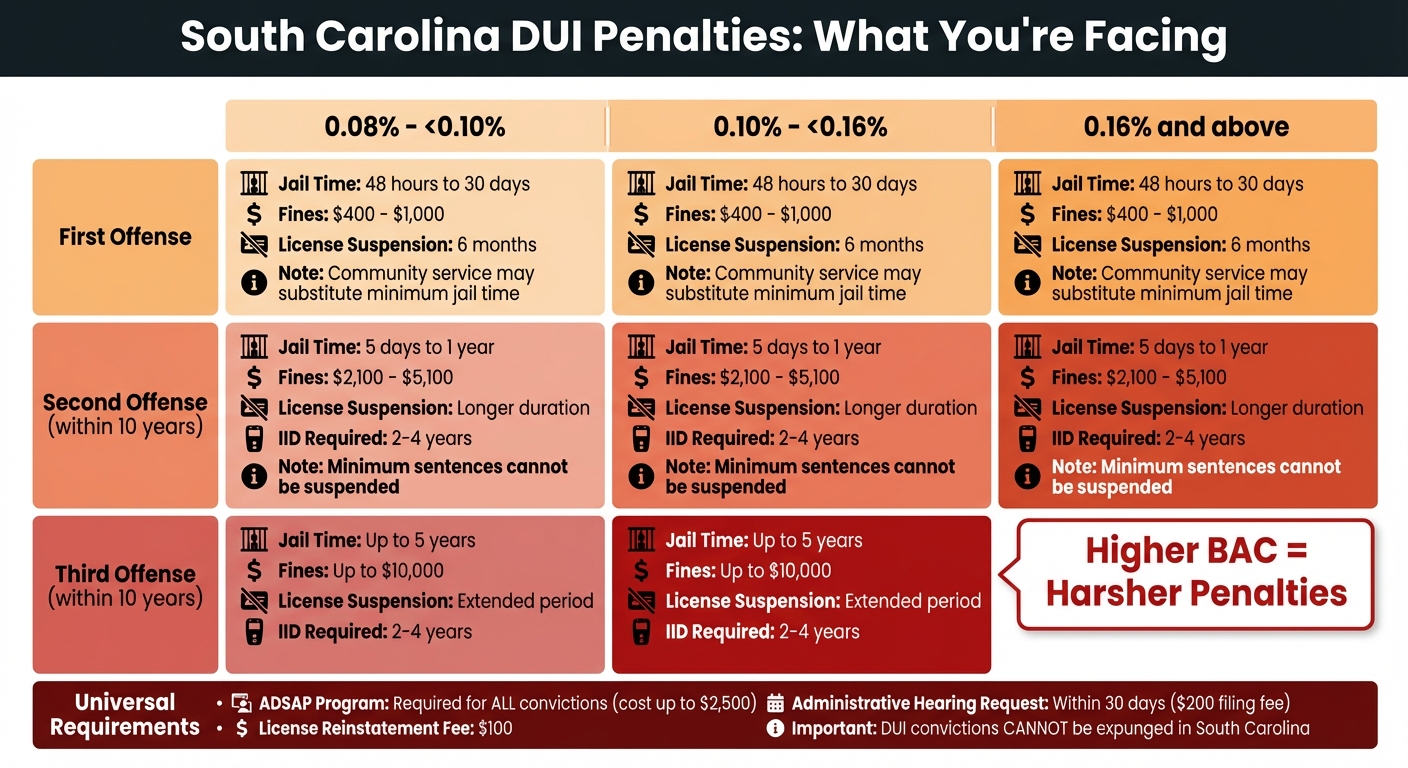
South Carolina DUI Penalties by Offense and BAC Level
Possible Verdicts: Guilty or Not Guilty
After the closing arguments and jury instructions, all eyes turn to the jury for their final decision. The verdict must be unanimous – either "Guilty" or "Not Guilty". A "Not Guilty" verdict leads to an immediate dismissal of the case, with no further penalties.
If the jury finds the defendant guilty, they will also determine the defendant’s Blood Alcohol Content (BAC) level, categorized as 0.08%–<0.10%, 0.10%–<0.16%, or 0.16% and above. In cases where the BAC level is unclear, the penalties default to the lowest tier.
Sentencing for First-Time and Repeat Offenses
Sentencing in Spartanburg County varies based on the defendant’s BAC level and DUI history within the past decade. For a first offense, jail time ranges from 48 hours to 30 days, with fines between $400 and $1,000, depending on the BAC level. Higher BAC levels result in steeper penalties. Repeat offenses lead to significantly harsher consequences. A second offense can result in 5 days to 1 year in jail and fines between $2,100 and $5,100. A third offense may carry up to 5 years of imprisonment and fines as high as $10,000. First-time offenders might have the option to substitute community service for the minimum jail sentence.
For repeat offenses, South Carolina law mandates that minimum sentences cannot be suspended, emphasizing the state’s strict stance on repeated DUI violations.
All individuals convicted of DUI must complete the Alcohol and Drug Safety Action Program (ADSAP), which can cost up to $2,500. For second and subsequent offenses, participation in the Ignition Interlock Device (IID) program is required, typically lasting two to four years, depending on the severity of the offense. License suspensions also apply, starting at six months for a first offense and increasing with each additional conviction.
Despite the sentencing, defendants retain options to challenge these outcomes.
Post-Trial Options for Defendants
Defendants can appeal their case to address procedural errors, which may lead to reduced penalties or shorter suspension periods.
For license suspensions, quick action is essential. If a license was suspended at the time of arrest, defendants must request an Administrative Law Hearing within 30 calendar days and pay a $200 filing fee. While awaiting the hearing, they may apply for a Temporary Alcohol License (TAL) to continue driving. To reinstate a suspended license after conviction, defendants must complete ADSAP, pay all court fines, and submit a $100 reinstatement fee. However, it’s important to note that DUI convictions in South Carolina cannot be expunged.
Conclusion
A DUI trial in Spartanburg County unfolds through several key stages, including pre-trial motions, jury selection, evidence presentation, closing arguments, and sentencing. Each step provides opportunities to contest the prosecution’s case, safeguard your rights, and work toward the best possible outcome. Acting promptly – like requesting an Administrative Law Hearing within 30 days or opting for a jury trial – can significantly influence the direction of your case. This process highlights the importance of every decision and every piece of evidence.
As Matt McGuire, Criminal Defense Lawyer, emphasizes, "Mistakes made in the first 48 hours can determine whether you keep your freedom or lose everything". Securing critical elements like surveillance footage, calibration records, and witness statements as soon as possible is crucial. While the prosecution bears the burden of proving guilt beyond a reasonable doubt, addressing technical evidence, conducting effective cross-examinations, and adhering to procedural requirements require a deep understanding of Spartanburg County’s legal system.
Having skilled legal representation is indispensable. An experienced attorney can question the validity of breathalyzer results, challenge the legality of the traffic stop, negotiate reduced charges, and handle all related hearings. With DUI convictions carrying severe penalties – such as hefty fines, potential jail time, and lasting repercussions – the stakes are incredibly high. Every choice you make matters.
Take immediate action and consult a qualified attorney to protect your rights, maintain your driving privileges, and work toward the best possible resolution.
FAQs
What steps should I take immediately after being charged with a DUI in Spartanburg County?
If you’ve been charged with a DUI in Spartanburg County, time is of the essence to safeguard your rights and driving privileges. For starters, if your license was suspended because you refused a breath test or had a BAC over 0.15%, you’ll need to request an administrative hearing within 30 days of your arrest. This is a separate process from your criminal case and could give you the chance to contest the suspension and potentially regain your driving privileges.
It’s also critical to reach out to a seasoned DUI defense attorney as soon as possible. A lawyer can help you understand your legal options, craft a solid defense, and guide you through the court process. Whether your case involves negotiating a plea, a bench trial, or a jury trial, having professional legal support can greatly improve your chances of achieving a better result. Acting quickly ensures you’re in the best position to navigate the legal challenges ahead.
How does a DUI conviction affect my driver’s license and record in South Carolina?
Getting convicted of a DUI in South Carolina can lead to serious repercussions for your driving privileges and record. One immediate consequence might be the suspension of your driver’s license. If it’s not your first offense, you could face longer suspensions or even permanent revocation of your license. Beyond that, these convictions stick to your driving record, potentially causing higher insurance premiums and limiting future driving opportunities.
The penalties you face often depend on key factors like your blood alcohol concentration (BAC) at the time of the arrest and whether you’ve had prior DUI convictions within the past decade. Given the potential long-term impact, seeking legal advice is essential to understanding your options and handling the situation effectively.
How can a defense attorney challenge DUI evidence in Spartanburg County?
A defense attorney has several tools to challenge DUI evidence and safeguard your rights. One key tactic is to question whether the traffic stop or arrest was conducted lawfully. If law enforcement didn’t follow proper procedures or lacked reasonable suspicion to stop you, any evidence gathered – such as blood alcohol content (BAC) test results or field sobriety test findings – might be thrown out.
Another angle focuses on the reliability of breathalyzer or blood test results. Attorneys often examine whether the testing equipment was correctly calibrated, whether proper protocols were followed, or if external factors – like certain medical conditions or environmental influences – could have skewed the results. Field sobriety tests can also come under scrutiny, especially if they were administered incorrectly or if other factors, like uneven ground or physical impairments, affected performance.
By highlighting procedural mistakes, questioning the reliability of evidence, or creating doubt, a defense attorney can work to weaken the prosecution’s case and protect your rights in court.