




Facing a DUI arrest in Spartanburg County can feel overwhelming, but avoiding key mistakes can make a big difference in the outcome. South Carolina’s DUI laws are strict, with limits like 0.08% BAC for most drivers, 0.04% for commercial drivers, and 0.02% for those under 21. A DUI triggers both criminal charges and an administrative license suspension, so acting quickly is critical.
Here’s what to avoid:
- Assuming a DUI charge equals conviction – you can challenge evidence like breathalyzer accuracy or procedural errors.
- Ignoring implied consent laws – refusing chemical tests leads to automatic license suspension.
- Missing court dates or deadlines – this can result in bench warrants or license suspensions.
- Discussing your case publicly – social media posts or casual remarks can harm your defense.
- Misunderstanding test rules – field sobriety tests are voluntary, but post-arrest chemical tests are mandatory.
- Failing to preserve evidence – dashcam footage or witness accounts can disappear quickly.
- Overlooking license, insurance, and job impacts – license suspensions, higher insurance rates, and job risks are common.
- Violating bond conditions – stay compliant to avoid further legal trouble.
- Delaying legal help – early action is key for preserving evidence and meeting deadlines.
- Ignoring long-term solutions – programs like PTI or ADSAP can reduce penalties or dismiss charges.
Key Deadlines to Remember:
- Request an administrative hearing within 30 days to contest license suspension.
- Apply for a Temporary Alcohol License (TAL) to maintain driving privileges.
- Preserve evidence within 24–72 hours after arrest.
Acting swiftly and consulting an attorney can protect your rights and improve your chances of a better outcome.
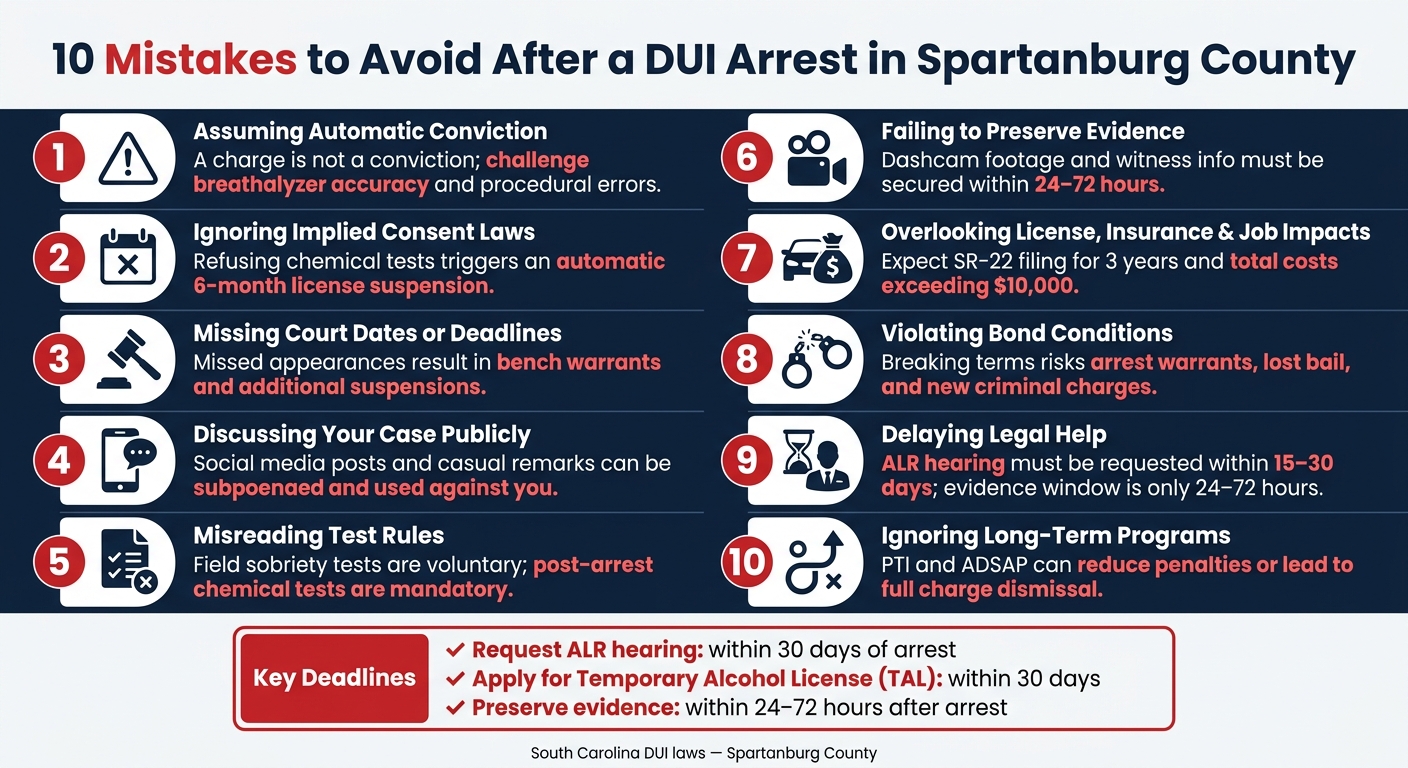
10 Mistakes to Avoid After a DUI Arrest in Spartanburg County
1. Thinking a DUI Charge Is an Automatic Conviction
Getting arrested for a DUI doesn’t automatically mean you’ll be convicted. A DUI charge is just an accusation – the state still has to prove the case beyond a reasonable doubt. This is why procedural errors or legal missteps can play a big role in fighting a DUI charge.
In South Carolina, DUI laws provide specific opportunities to challenge the evidence. One key example is the strict video recording requirements outlined in SC Code §56-5-2953. During a DUI arrest, law enforcement must follow exact protocols for video recordings. If they fail to meet these requirements, the entire charge could be dismissed. As noted by dui.guide:
"Prosecutors in Spartanburg County frequently offer pleas to Driving with an Unlawful Alcohol Concentration (DUAC) to avoid the risk of a judge dismissing a DUI charge over minor video recording violations."
You can also challenge the evidence itself. Breathalyzer results, for instance, might be unreliable if the device wasn’t calibrated properly, the operator wasn’t qualified, or external factors – like uneven ground or poor lighting – interfered with field sobriety tests. Another potential defense is the "rising blood alcohol" argument, which applies if your blood alcohol concentration (BAC) was lower while driving than when it was tested later. These defenses highlight why having an experienced attorney is so important when navigating both the criminal and administrative aspects of a DUI case.
It’s also crucial to understand that your criminal case and the DMV license suspension process are separate matters. Winning one doesn’t automatically resolve the other. Each has its own deadlines and requires a unique approach. Treating them as the same could lead to costly mistakes.
Finally, don’t plead guilty at your arraignment without speaking to an attorney first. As one legal source explains:
"Pleading guilty without consulting an attorney is almost always a mistake. Even on a first offense, a DUI conviction in South Carolina carries up to 90 days in jail."
sbb-itb-ce0cbb0
2. Not Taking Implied Consent Consequences Seriously
Focusing only on criminal charges while ignoring the administrative license process can lead to serious consequences. According to S.C. Code § 56-5-2950, driving in South Carolina means you’ve automatically agreed to chemical testing if an officer reasonably suspects you’re impaired. This "implied consent" sets off a separate administrative process that begins immediately after your arrest, running independently from your criminal case. Ignoring this process could result in costly mistakes.
Dealing with license-related consequences early is just as important as preparing a solid court defense. Attorney Alex Reid highlights this point:
"The administrative process through the South Carolina Department of Motor Vehicles addresses only license status. This process begins immediately after arrest and moves forward regardless of what happens in criminal court."
Once you receive a Notice of Suspension at the scene, you have a strict 30-day window – and a $200 filing fee – to request a contested case hearing with the Office of Motor Vehicle Hearings. If you miss this deadline, your license will be automatically suspended, and you lose the chance to challenge it. By filing within the timeframe, you can also apply for a Temporary Alcohol License (TAL) for $100, which allows unrestricted driving while awaiting your hearing.
The suspension periods depend on the violation and your prior record. For first-time offenders, here’s a breakdown of typical administrative penalties:
| Violation Type | Suspension Period | BAC/Threshold |
|---|---|---|
| Refusing chemical testing | 6 months | N/A |
| BAC of 0.15% or higher | 1 month | 0.15% or higher |
| Criminal DUI conviction | 6 months | 0.08% or higher |
These penalties can significantly increase the overall impact of a DUI, making it crucial to understand all aspects of implied consent.
Refusing a chemical test doesn’t mean avoiding consequences. Prosecutors can argue that a refusal shows a "consciousness of guilt" in court. Plus, if you lose the administrative hearing, you’ll be required to install an Ignition Interlock Device (IID) for at least 90 days before your driving privileges can be reinstated.
3. Missing Court Dates or Ignoring Traffic Court Notices
When you’re arrested for a DUI, the paperwork you receive will include a scheduled court date. Missing this date can result in a bench warrant being issued, which means you could be arrested the next time you’re stopped by law enforcement.
Your case will be assigned to either the Spartanburg County Magistrate Court or the City of Spartanburg Municipal Court, depending on the agency that made the arrest. It’s crucial to determine which court is handling your case. All official notices will be sent there, so keeping an eye on the court docket is essential.
To avoid accidental defaults, consult an attorney who can clarify the type of court appearance required – whether it’s a plea hearing or a bench trial.
Another critical deadline to remember: the South Carolina Department of Motor Vehicles (SCDMV) gives you only 30 days from the date of your arrest to request an administrative hearing. Missing this deadline leads to an automatic suspension of your license. Ignoring either your court date or the SCDMV deadline can significantly worsen your legal situation, limiting your options in both criminal and administrative matters.
"If the hearing is not requested within this timeframe, your suspension goes into effect automatically." – Lawyer Lori, Law Offices of Lori S. Murray
Lastly, double-check that your driver’s license address is up to date. This ensures you receive all notifications from both the court and the SCDMV. Up next, find out how talking openly about your case could harm your defense.
4. Discussing Your Case on Social Media or With Friends
After a DUI arrest, it’s crucial to avoid talking about your case with anyone other than your attorney. Even casual conversations or social media posts can unintentionally strengthen the prosecution’s case against you. These common mistakes after a DUI arrest can be just as damaging as procedural errors.
In South Carolina, prosecutors have broad subpoena power. This means private text messages, direct messages, and social media activity can all be subpoenaed during legal proceedings. A single comment about the night in question could be interpreted as an admission of impairment, especially since South Carolina law defines DUI as operating a vehicle while "materially and appreciably impaired". Even personal conversations lack legal privilege, so friends and family members could be questioned or even compelled to testify about what you’ve shared with them. Every offhand remark has the potential to create problems.
"South Carolina officers and prosecutors can subpoena messages, social media posts, or statements you make to others. Unfortunately, those casual conversations may be used as evidence in ways you do not expect." – Truslow & Truslow, PA
Law enforcement in South Carolina is proactive, and public comments are often scrutinized closely. This makes it even more important to manage your communications carefully.
The best approach is to remain silent about your case. Avoid posting anything online, venting on social media, or discussing the incident with anyone other than your lawyer. If someone asks about it, a simple response like, "My attorney advised me not to talk about it", is enough. Instead, focus on documenting the details of the stop – such as the timing, the officer’s behavior, and the conditions at the scene – while your memory is still fresh. These notes should only be shared with your attorney. Being cautious with your words is an essential part of protecting yourself and minimizing the consequences of a DUI arrest.
5. Misreading South Carolina Field Sobriety and Chemical Test Rules
One frequent mistake after a DUI stop in South Carolina is misunderstanding the difference between field sobriety tests (FSTs) and chemical tests. These are two separate types of evaluations, and confusing them can lead to choices that might harm your case.
Field sobriety tests – like the Walk-and-Turn, One-Leg Stand, and Horizontal Gaze Nystagmus (HGN) – are usually voluntary. You can politely decline them without facing an automatic license suspension. However, these tests aren’t as reliable as many people believe, with accuracy rates ranging between 65% and 77%. Results can also be influenced by factors like the officer’s training or external conditions, such as uneven road surfaces. If you have any medical conditions, injuries, or balance issues, it’s important to inform the officer, as these could affect your performance. While declining FSTs carries no immediate penalties, chemical tests are a different story.
"The accuracy of field sobriety tests also depends on the officer’s training and ability to administer the tests correctly. Additionally, the results are subjective." – Seaton & Duncan
Chemical tests, which include breath, blood, or urine tests conducted after an arrest, are mandatory under South Carolina’s Implied Consent law (S.C. Code § 56-5-2950). Refusing one of these tests results in an automatic six-month license suspension for a first offense, regardless of how your criminal case unfolds. This suspension is an administrative action handled by the DMV, meaning even if you win in court, your license won’t be automatically reinstated.
If your license is suspended for refusing a chemical test, you have 30 days to request a contested case hearing. Additionally, if you take the state-administered test, you’re entitled to an independent test. The arresting officer must transport you to a medical facility for this purpose.
| Test Type | Voluntary? | Refusal Penalty | Purpose |
|---|---|---|---|
| Field Sobriety Tests (FSTs) | Yes | None (no automatic suspension) | Establish probable cause for arrest |
| Portable Breath Test (PBT) | Yes | None | Roadside screening |
| Post-Arrest Chemical Test | No | Refusal penalty applies | Evidence for criminal prosecution |
Grasping the difference between these tests is key to making informed decisions that won’t jeopardize your legal standing.
6. Failing to Preserve Evidence From the Night of the Arrest
After a DUI arrest, evidence can disappear fast. Dashcam footage might get overwritten, and witness memories can fade, making it harder to build your defense. Securing both personal and physical evidence right away is just as important as questioning the police’s version of events.
As soon as you’re released, write down every detail you can remember. Record what the officer said, the conditions at the scene, and the sequence of events. Include specifics like the exact location of the stop, lighting, road conditions, and weather. A DUI attorney emphasizes:
"Your recollection is vital evidence. Write it down." – DUI Lawyer Greenville
This personal account can strengthen the physical evidence you collect.
South Carolina law (S.C. Code Ann. §56-5-2953) requires police to record critical aspects of a DUI stop. This includes activating blue lights, conducting field sobriety tests, making the arrest, and reading Miranda rights. Additionally, the 20-minute observation period before a breath test at the testing site must be captured on video. Your lawyer can request this footage through discovery, and any missing or incomplete recordings could work in your favor.
Beyond video evidence, make sure to keep all physical documents and items: citations, bond paperwork, breath test results, and your Notice of Suspension. If your car was impounded, contact the Spartanburg County Sheriff’s Office at 864-503-4500 immediately to locate it. Spartanburg County uses a "Wrecker Rotation List" rather than a central impound lot. Keep in mind that storage fees are about $47 per day. Items inside your vehicle, like receipts or personal belongings, could help establish a timeline and support your case.
| Evidence Category | What to Preserve |
|---|---|
| Police Recordings | Blue light activation, field sobriety tests, Miranda rights, 20-minute breath test waiting period |
| Scene Evidence | Photos of road conditions, lighting, weather, and vehicle positioning |
| Witness Data | Names and contact info for passengers, bystanders, and officers (including badge numbers) |
| Personal Records | A written account of the officer’s reason for the stop and the entire sequence of events |
| Administrative Paperwork | Citations, suspension notices, chemical test forms, and bond documents |
Gathering and preserving this evidence is essential to building a strong defense. The sooner you act, the better your chances of protecting your rights.
7. Neglecting the Impact on Your License, Insurance, and Job
A DUI arrest isn’t just a legal issue – it brings a cascade of administrative, employment, and financial challenges that many people don’t fully anticipate. While most focus on the criminal case, they often overlook the separate administrative process, which can have immediate and long-lasting effects. In South Carolina, for example, the criminal and DMV processes move forward at the same time, and the DMV acts quickly. As Alex Reid, Attorney and Founding Partner of Fedalei & Reid Law, points out:
"DUI license suspension in South Carolina begins long before a criminal court date arrives. Many drivers assume their license status depends on the outcome of their DUI case, but the state operates two entirely separate processes."
To protect your driving privileges, you need to act fast. File a request for an ALR hearing with the OMVH within 15–30 days of your arrest, pay the $200 filing fee, and apply for a Temporary Alcohol License. In Spartanburg, local advice suggests acting within 15 days to stay ahead of the strict administrative deadlines.
Employment and Professional Risks
The consequences of a DUI go beyond your driving privileges. In South Carolina, a first offense carries a mandatory minimum of 48 hours in jail. This can lead to unexcused absences from work, putting your job at risk. For professionals with licenses in fields like healthcare, education, or law, the stakes are even higher – licensing boards often conduct their own reviews, which could jeopardize your career. Commercial drivers face even stricter standards, with a BAC limit of 0.04%. A DUI conviction under these conditions could end a driving career entirely.
Financial and Insurance Challenges
A DUI conviction also hits hard financially. Expect higher insurance premiums, as South Carolina requires an SR-22 filing for at least three years. Any lapse in coverage during this period results in an immediate license suspension. Between fines, legal fees, ADSAP enrollment costs, and increased insurance rates, the total financial burden can easily exceed $10,000.
ADSAP and License Reinstatement
Enrolling in the Alcohol and Drug Safety Action Program (ADSAP) is essential for getting your license reinstated. Delaying this process only extends the time you’ll be without a valid license. Acting promptly is key to minimizing the impact of these administrative and financial pressures.
| Consequence | Details | Timeline |
|---|---|---|
| Administrative License Suspension | 6 months (for a first-offense conviction) | Begins before the criminal case resolves |
| ALR Hearing Request Deadline | 15–30 days from arrest | Act within 15 days in Spartanburg |
| SR-22 Insurance Filing | Mandatory high-risk coverage | Required for 3 years post-conviction |
| ADSAP Enrollment | Required for license reinstatement | Must be completed before reinstatement |
| License Reinstatement Fee | $100 | Paid to SCDMV after each suspension |
The administrative and financial consequences of a DUI demand immediate attention. Ignoring these issues can lead to prolonged hardships that affect your daily life, career, and finances.
8. Not Understanding Spartanburg County Bond Conditions and No-Contact Terms
After being released, taking the time to carefully review your bond paperwork is crucial. Skipping this step can lead to unnecessary legal trouble. This paperwork outlines the rules and obligations set during your bond hearing, acting as a guide to help you stay on track legally.
In South Carolina, bond hearings happen quickly – usually within 24 hours of an arrest. During this hearing, a magistrate judge sets your bail amount and attaches specific conditions to your release. These conditions often include requirements like avoiding alcohol or drugs, maintaining employment, attending counseling, and showing up for all court dates. If your DUI involved an accident or another person, the judge might also issue a no-contact order, prohibiting any communication with the alleged victim.
Breaking these conditions can have serious consequences. You could face an arrest warrant, lose any bail money you’ve posted, and even face new criminal charges. If someone co-signed your bail bond, they could be held responsible for the full bail amount if you fail to comply with the terms.
When it comes to paying bail, there are several options, each with its own costs and risks:
| Bond Type | Mechanism | Cost |
|---|---|---|
| Cash Bond | Pay the full amount to the court | About 90% refunded after the case concludes |
| Bail Bond | Pay a bondsman 10–15% of the bail | Fee is non-refundable and may require collateral |
| Property Bond | Use real estate as collateral | Property value must be 150–200% of the bail amount |
| PR Bond | Released on a promise to appear | No upfront money required; rarely granted for DUI charges |
As soon as you’re released, go through your paperwork thoroughly. It will include key details like your court dates, activities you must avoid, and any restrictions on where you can go. Knowing and following these terms is essential to staying compliant while your case moves forward. If anything in the paperwork is unclear, reach out to a DUI attorney for guidance.
9. Waiting Too Long to Get Legal Help
Once your bond conditions and restrictions are clear, the next step is to act quickly and secure an attorney. Time is of the essence here, and delays can have serious consequences.
For starters, you need to file your Administrative License Revocation (ALR) hearing request with the Office of Motor Vehicle Hearings (OMVH) within 15–30 days of your arrest. If you miss this deadline, your license will be automatically suspended – regardless of the outcome in criminal court – even if you’re later acquitted. Filing on time also allows you to apply for a Temporary Alcohol License (TAL), which can help you maintain driving privileges for work or school while your case is pending.
Evidence doesn’t wait around. By law, video recordings and other critical evidence can be overwritten quickly. Your attorney has a window of just 24–72 hours to secure footage that could be crucial to your defense. This urgency also extends to gathering witness statements and requesting calibration records for breathalyzer devices.
"The first 72 hours after a DUI arrest are critical. Actions taken immediately can affect your driving privileges, fines, potential jail time, and overall defense strategy." – The Bateman Law Firm
Financial strain adds up fast, too. If your vehicle has been impounded, Spartanburg County charges approximately $47 per day in storage fees. Acting quickly to retrieve your vehicle can save you from racking up these daily costs.
| Action | Deadline | Consequence of Delay |
|---|---|---|
| ALR Hearing Request | 15–30 days from arrest | Automatic license suspension; loss of TAL eligibility |
| Evidence Preservation | 24–72 hours | Lost opportunity to secure key evidence |
| Vehicle Retrieval | As soon as possible | Accumulating impound fees (~$47/day) |
| Legal Consultation | Immediately | Missed chances to challenge testing procedures |
Delaying legal action not only increases costs but also limits your defense options. For instance, in Spartanburg County, prosecutors may sometimes offer plea deals for Driving with an Unlawful Alcohol Concentration (DUAC) to address procedural missteps or missing evidence, such as video recordings. However, these opportunities are often time-sensitive and require early involvement from an attorney.
10. Ignoring Long-Term Options for Reducing Consequences and Seeking Rehabilitation
Once you’ve secured legal representation and addressed your immediate obligations, it’s crucial not to stop there. Many overlook long-term programs that can help reduce DUI consequences and even improve the overall outcome of their case. Programs like Pre-Trial Intervention (PTI) and DUI Diversion can make a significant difference in shaping your future.
If you’re a first-time offender in Spartanburg County, you might qualify for the PTI program or a DUI Diversion Program. These programs allow your sentence to be temporarily suspended while you complete alcohol and drug treatment, as well as community service. The reward? Successful completion can lead to your charges being dismissed entirely. Afterward, you can apply for expungement, though this process takes an additional 10 to 12 weeks and requires a separate fee.
Building on the swift legal actions discussed earlier in Section 9, enrolling in the Alcohol and Drug Safety Action Program (ADSAP) is mandatory for anyone convicted of a DUI in South Carolina. Starting ADSAP early can do more than just shorten your license suspension – it can also act as compelling evidence of your commitment to rehabilitation. If you hold a Commercial Driver’s License (CDL), your treatment must also comply with Department of Transportation (DOT) standards.
Engaging in treatment programs boosts your defense. Attending counseling sessions or Alcoholics Anonymous (AA) or Narcotics Anonymous (NA) meetings can help reduce penalties in General Sessions court. Beyond legal benefits, these steps address the root causes of the arrest, which is critical since repeat DUI offenses in South Carolina come with much stricter mandatory minimum penalties.
Incorporating these long-term strategies into your defense plan not only improves your chances in court but also sets you up for a better path forward.
Conclusion
A DUI arrest in Spartanburg County triggers two parallel processes: a criminal case in court and an administrative license suspension through the DMV. Both progress swiftly, and the choices you make within the first 24 to 48 hours can heavily influence the outcome. Waiting too long limits your options and increases the challenges you’ll face.
The mistakes highlighted in this article – like assuming guilt, missing the crucial 15-to-30-day window to request an Administrative License Revocation (ALR) hearing, or sharing case details on social media – can significantly reduce your chances of a favorable resolution. Delays and oversights often lead to greater legal and financial consequences.
This underscores the importance of acting without hesitation.
"The days immediately following a DUI arrest determine whether drivers maintain any ability to drive legally." – Alex Reid, Attorney
Take immediate steps: request your ALR hearing, apply for a Temporary Alcohol License (TAL), recover your vehicle, and document every detail of the arrest. Hiring an attorney right away ensures evidence is preserved and provides the best chance to build a strong defense.
FAQs
What should I do in the first 72 hours after a DUI arrest?
After being arrested for a DUI in Spartanburg County, it’s crucial to prioritize safeguarding your rights and getting ready for the legal process ahead. The first step? Stay quiet. Don’t discuss your case with anyone except your attorney.
Reach out to a DUI attorney as soon as possible – they’ll help you navigate the complex legal system and ensure you’re taking the right steps. Also, take the time to jot down everything you remember about the arrest while it’s still fresh in your mind. Details like how the officer acted and the conditions during any field sobriety tests can play a key role in building your defense.
How do I keep my license after a DUI in Spartanburg County?
If you’ve been arrested for a DUI in Spartanburg County and want to keep your license, you need to act fast. If your license was suspended because you either refused a breath test or had a BAC of 0.15% or higher, you only have 30 days to request an administrative hearing with the Office of Motor Vehicle Hearings (OMVH).
To do this, you’ll need to complete the form provided by the officer at the time of your arrest and send it, along with a $200 fee, via certified mail. Once you’ve done that, you can apply for a Temporary Alcohol License (TAL) for $100. This license will allow you to continue driving legally while waiting for your hearing.
Can my DUI charge be dismissed for video or testing errors?
In South Carolina, including Spartanburg County, a DUI charge can be dismissed due to video or testing errors – but the outcome hinges on the specifics of the case and whether the State can justify any discrepancies. According to S.C. Code § 56-5-2953, law enforcement officers are required to record specific events during a DUI stop. However, certain failures can be excused if supported by a valid sworn affidavit. In some situations, instead of dismissing the charge entirely, the court may opt to exclude certain pieces of evidence.