


Facing domestic violence charges in Spartanburg can lead to serious consequences, both legally and socially. Here’s what you need to know:
- Immediate Impact: Arrests create public records, even without a conviction. Employers, landlords, and licensing boards can access this information.
- Legal Penalties: Charges range from misdemeanors (up to 90 days in jail) to felonies (up to 20 years in prison). Firearm bans are enforced immediately and vary by charge severity.
- Long-Term Effects: Convictions affect employment, housing, and reputation. Expungement is limited to third-degree charges after five years without further convictions.
- Options to Mitigate Damage: Dismissals, diversion programs, or pardons can help. Legal representation and compliance with court orders are critical.
Understanding these challenges and acting quickly can help protect your future. Below, we break down the details of domestic violence charges, penalties, and steps to address their impact.
Domestic Violence Charges in South Carolina: What You Need to Know
South Carolina Domestic Violence Charges: Degrees, Penalties, and Firearm Restrictions
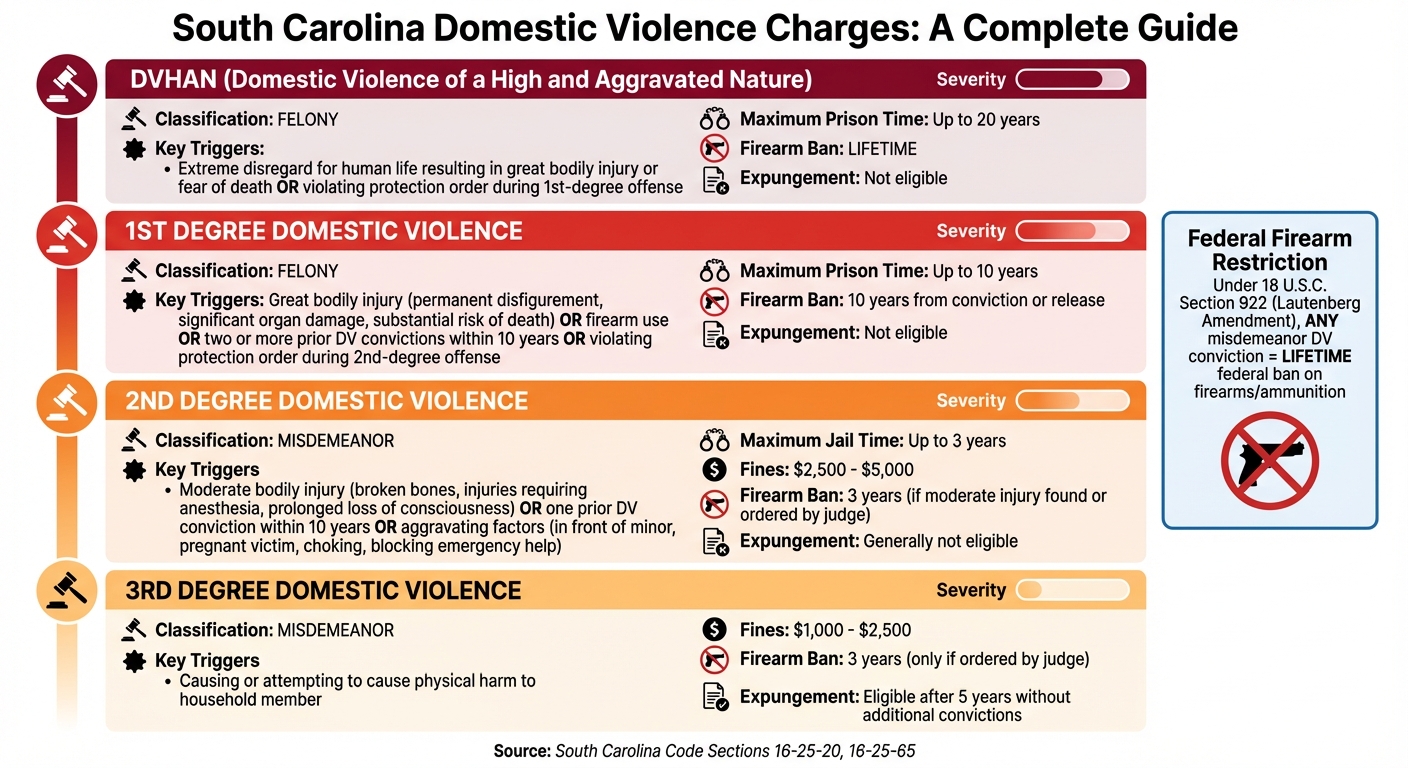
In South Carolina, domestic violence is defined as causing or attempting to cause physical harm to a household member in a way that creates fear of harm. The state breaks these charges into four levels, ranging from misdemeanors to felonies. These classifications depend on factors like the severity of injuries, aggravating circumstances, and prior offenses. The level of the charge determines the penalties, which can include jail time and fines. Situations like committing the act in front of a minor, using a firearm, or violating a protection order can escalate the charges to a more serious degree. Below is a breakdown of the four charge levels in South Carolina.
The 4 Types of Domestic Violence Charges
South Carolina divides domestic violence offenses into four degrees, starting with a basic misdemeanor and escalating to a serious felony.
Third-Degree Domestic Violence is the least severe charge and is classified as a misdemeanor. It applies when someone causes or attempts to cause physical harm to a household member. A conviction can lead to up to 90 days in jail and fines ranging from $1,000 to $2,500. However, even this level of conviction results in a permanent criminal record that shows up on background checks.
Second-Degree Domestic Violence is still a misdemeanor but involves more serious circumstances. This charge applies if moderate bodily injury occurs – such as broken bones, injuries requiring anesthesia, or a prolonged loss of consciousness. It can also apply if the accused has a prior domestic violence conviction within the past 10 years or if the offense includes aggravating factors. These factors might include committing the act in front of a child, targeting a pregnant person, choking, or blocking access to emergency help. Penalties include up to three years in jail and fines between $2,500 and $5,000.
First-Degree Domestic Violence is a felony and carries much harsher consequences. This charge applies when great bodily injury occurs, such as permanent disfigurement, significant organ damage, or injuries posing a substantial risk of death. Other triggers include using a firearm during the offense, having two or more domestic violence convictions within 10 years, or violating a protection order while committing a second-degree offense. A conviction can result in up to 10 years in prison and a 10-year ban on owning firearms.
Domestic Violence of a High and Aggravated Nature (DVHAN) is the most severe charge and is also a felony. This applies when the offender shows extreme disregard for human life, resulting in great bodily harm or fear of death. Violating a protection order while committing first-degree domestic violence can also lead to this charge. A DVHAN conviction carries penalties of up to 20 years in prison and a lifetime ban on firearm and ammunition possession.
The table below provides a quick overview of the key aspects of each charge level:
| Charge Degree | Classification | Key Triggers | Maximum Penalty |
|---|---|---|---|
| 3rd Degree | Misdemeanor | Causing or attempting to cause physical harm | Up to 90 days in jail; $1,000–$2,500 fine |
| 2nd Degree | Misdemeanor | Moderate bodily injury; one prior conviction; or aggravating factors (e.g., in front of a minor, against a pregnant person, choking, or blocking emergency help) | Up to 3 years in jail; $2,500–$5,000 fine |
| 1st Degree | Felony | Great bodily injury; firearm use; two or more prior convictions; or violating a protection order during a second-degree offense | Up to 10 years in prison |
| DVHAN | Felony | Extreme disregard for human life resulting in great bodily injury or fear of death; or violating a protection order during a first-degree offense | Up to 20 years in prison |
Who Can Face Domestic Violence Charges?
Domestic violence charges in South Carolina apply specifically to disputes involving household members. The law defines a "household member" as a current or former spouse, someone with whom you share a child, or an individual you currently or previously lived with.
In 2017, the South Carolina Supreme Court ruled in Jane Doe v. State of South Carolina that same-sex relationships are also protected under domestic violence laws and eligible for orders of protection.
The law generally excludes non-cohabiting relatives unless they meet the cohabitation criteria. It also typically does not apply to "dating violence" cases where the individuals have never lived together and do not share a child. For these situations, other charges may be pursued instead of domestic violence.
How Domestic Violence Charges Affect Your Record Right Away
A domestic violence arrest in South Carolina creates an immediate public record, even if no conviction follows. This record is easily accessible and can have far-reaching consequences.
Background Checks and Public Records
"All information regarding arrests, current criminal cases, and convictions, are public records in South Carolina."
– Law Office of James R. Snell, Jr., LLC
South Carolina’s legal system ensures that arrest and prosecution details are publicly available through various channels. For instance, SLED (South Carolina Law Enforcement Division) maintains RAP sheets – Records of Arrests and Prosecutions – which are frequently used in background checks for employment and licensing. Additionally, Spartanburg County court dockets can be searched by name via the South Carolina Judicial Branch Public Index. However, starting January 1, 2026, home addresses will no longer be included in these listings.
Once arrested, your record is entered into multiple state systems. Employers and landlords often use SLED CATCH, the state’s criminal records check system, to access this information. Police reports, including mugshots and witness statements, are also public records. These records can tarnish your reputation and may lead to further legal complications.
The only ways to clear such public records are through dismissal of charges, a "not guilty" verdict, successful completion of a pre-trial diversion program, or formal expungement. For a third-degree domestic violence conviction, you must wait five years without any additional convictions to qualify for expungement.
Public records carry lasting consequences, and legal restrictions – such as those on firearm possession – are enforced immediately.
Gun Ownership Restrictions and Other Legal Limits
A domestic violence conviction triggers immediate and strict firearm restrictions. The length of these bans depends on the severity of the charge, as outlined below:
| Conviction Level | Firearm Ban Duration | Violation Penalty |
|---|---|---|
| DV High & Aggravated (DVHAN) | Lifetime | Felony (Up to 5 years) |
| DV 1st Degree | 10 years from conviction or release | Felony (Up to 5 years) |
| DV 2nd Degree | 3 years (if moderate injury found or ordered by judge) | Misdemeanor (Up to 3 years) |
| DV 3rd Degree | 3 years (only if ordered by judge at sentencing) | Misdemeanor (Up to 3 years) |
Federal law adds another layer of restriction. Under 18 U.S.C. Section 922 – commonly referred to as the Lautenberg Amendment – anyone convicted of a misdemeanor domestic violence offense faces a lifetime ban on possessing firearms or ammunition, even if state law would otherwise allow rights to be restored after the ban period ends.
"Pursuant to 18 U.S.C. Section 922, it is unlawful for a person convicted of a violation of Section 16-25-20 or 16-25-65… to ship, transport, possess, or receive a firearm or ammunition."
– South Carolina Code Section 16-25-30
Courts are required to provide written notice at the time of conviction, clarifying the federal prohibition on firearm possession. Even after state-level restrictions expire, you must submit a written request to SLED to update the National Instant Criminal Background Check System (NICS). However, the federal lifetime ban remains in effect.
Additionally, a family court judge can impose immediate firearm restrictions through an Order of Protection if they find evidence of physical harm or attempted harm. Violating such an order is a misdemeanor, punishable by up to 30 days in jail.
Long-Term Effects of a Domestic Violence Conviction
A domestic violence conviction doesn’t just end with legal penalties – it can ripple through nearly every aspect of your daily life. Even after your case is resolved, the conviction stays on your record indefinitely, creating challenges in finding employment, securing housing, and maintaining your reputation in the Spartanburg community.
Employment and Professional License Challenges
A domestic violence conviction can severely limit job opportunities, especially if expungement isn’t an option. In South Carolina, expungement is only available for third-degree convictions and only after five years without any additional convictions. Employers often conduct background checks, and these convictions will usually appear, making it harder to secure a job.
For those with felony convictions, the barriers are even higher. For example, a conviction for Domestic Violence in the First Degree – a felony punishable by up to 10 years in prison – can block access to professional licenses and high-level positions. Additionally, federal firearm restrictions mean jobs requiring firearm possession are entirely off the table.
Convictions for second- and first-degree domestic violence remain permanently visible to employers unless handled under the Youthful Offender Act. These employment hurdles often go hand-in-hand with struggles to find stable housing.
Housing Obstacles and Reputation Damage
When it comes to housing, background checks conducted by landlords and mortgage lenders can reveal domestic violence convictions, making it difficult to rent or buy a home. In South Carolina, Public Housing Authorities and Section 8 landlords can legally bifurcate a lease, allowing them to evict the offender while letting the victim remain in the residence. Without protections designed for victims, property managers may be more likely to deny housing applications or terminate leases.
A conviction can also tarnish your reputation in the community. With 78.7% of domestic violence incidents in South Carolina occurring within the home, neighbors or local property managers might become aware of your charges. Court-ordered participation in batterer treatment programs often becomes part of the public record, and protective orders may restrict you from accessing shared spaces like your home, workplace, or even a domestic violence shelter where a household member resides.
For higher-degree convictions, the impact is lasting. While third-degree convictions may be expunged after five years, convictions for Domestic Violence in the First Degree or DVHAN (Domestic Violence of a High and Aggravated Nature) are generally permanent. This means landlords, employers, and other members of the community can access this information indefinitely, limiting your opportunities for housing, employment, and social connections well into the future. Recognizing these long-term effects highlights the importance of taking steps to minimize the impact on your record and safeguard your future.
sbb-itb-ce0cbb0
Removing Domestic Violence Charges from Your Record
Expungement can clear certain domestic violence charges from your record, but South Carolina has strict laws in place. Understanding the requirements is crucial to determine if you qualify and to ensure the process is handled correctly.
Who Qualifies for Expungement
In South Carolina, Domestic Violence 3rd Degree convictions are the only domestic violence charges eligible for expungement under SC Code § 22-5-910. To qualify, you must meet these conditions:
- Wait five years from the date of conviction.
- Have no additional convictions during that time, including out-of-state offenses.
- Note that South Carolina generally allows just one conviction expungement in a lifetime under this statute.
Convictions for more severe charges, such as Domestic Violence 1st Degree, 2nd Degree, or Domestic Violence of a High and Aggravated Nature (DVHAN), cannot be expunged if they resulted in a conviction. However, charges that were dismissed, nolle prossed, or ended in a "not guilty" verdict are eligible for expungement immediately, with no waiting period. Similarly, charges dismissed after completing a diversion program like Pre-Trial Intervention (PTI) also qualify.
You must not have any pending criminal charges, except those pending for over five years. If your domestic violence charge doesn’t qualify for expungement, you may consider seeking a pardon. While a pardon doesn’t erase the record, it can improve prospects for jobs and housing.
Once you’ve confirmed eligibility, you can move forward with the filing process.
How to File for Expungement
If you meet the eligibility criteria, here’s how to file for expungement. In Spartanburg, the process is managed by the Pre-Trial Intervention (PTI) Office, located at 180 Library St. in the basement of the building that houses Probation, Pardon Services, and Parole. Begin by completing an application at the PTI office, where staff will review your criminal record to confirm your eligibility.
For a Domestic Violence 3rd Degree conviction, the following fees apply:
- $250.00 administrative fee to the Solicitor’s Office
- $25.00 verification fee to the South Carolina Law Enforcement Division (SLED)
- $35.00 filing fee to the County Clerk of Court
These fees must be paid with separate certified checks or money orders. If your charge was dismissed or nolle prossed and wasn’t part of a plea deal, you’re typically exempt from the $250.00 administrative fee.
"Once the expungement process is started, it takes 6-8 weeks before the charges are removed from the applicant’s record." – Spartanburg County Solicitor’s Office
The Solicitor’s Office will send your application to SLED for verification. If eligible, the Solicitor will secure signatures from the PTI Director, summary court judge, and circuit court judge. The signed order is then filed with the Clerk of Court, and copies are sent to you and the relevant government agencies. If your case was dismissed in summary court and you were fingerprinted, an automatic expungement order might be issued. Otherwise, you’ll need to apply directly to the summary court.
| Charge Status | Eligibility | Waiting Period |
|---|---|---|
| DV 3rd Degree Conviction | Eligible | 5 Years |
| DV 1st or 2nd Degree Conviction | Generally Ineligible | N/A |
| Dismissed / Not Guilty | Eligible | None (Immediate) |
| Diversion Program (e.g., PTI) | Eligible | Upon Completion |
How to Reduce the Impact of Domestic Violence Charges
Facing domestic violence charges can feel overwhelming, but there are steps you can take to protect your future. Acting quickly and having a solid legal strategy are essential.
Why You Need an Attorney
A skilled criminal defense attorney in Spartanburg can examine the evidence from every angle, offer alternative explanations (like self-defense or the context of prior complaints), and challenge the designation of "primary physical aggressor." These strategies aim to prevent a permanent criminal record.
For Domestic Violence 3rd Degree charges, your lawyer might help you explore diversion programs such as Pre-Trial Intervention (PTI). They can also negotiate suspended sentences, where jail time is replaced by completing a court-approved batterer treatment program. This option is especially useful for 1st and 2nd-degree charges, as courts have discretion to suspend sentences unless mandatory minimums apply.
"There are programs that exist that can seek to totally eliminate the criminal penalties associated with a CDV charge through successful completion."
– James R. Snell, Jr., Criminal Defense Attorney
Additionally, your attorney can work to protect your firearm rights. For lower-level offenses, restrictions may involve a three-year ban, while more severe charges like Domestic Violence of a High and Aggravated Nature can result in a lifetime ban.
Beyond legal defense, participating in rehabilitation programs can help reduce the long-term effects of your charges.
Counseling Programs and Alternative Sentencing
Alternative sentencing programs can play a significant role in showing accountability and commitment to change. Starting a counseling or intervention program as soon as possible demonstrates to the court and prosecution that you are taking responsibility. Defense attorneys in Spartanburg often recommend enrolling in these programs early.
For first-time offenders facing DV 3rd Degree charges, completing a program through PTI often results in the charges being dismissed or "nol prossed" (not prosecuted). Once dismissed, you may be eligible to pursue expungement.
Court-approved batterer treatment programs must be verified by the Circuit Solicitor or the Department of Social Services to meet sentencing requirements. If substance abuse or mental health issues played a role in the incident, judges may require participation in programs run by the Department of Alcohol and Other Drug Abuse Services or mental health facilities.
Compliance is critical. Following all bond conditions and no-contact orders while participating in these programs is essential. Any violation can result in immediate bond revocation and disqualification from the program.
Protecting Your Future After Domestic Violence Charges
Facing domestic violence charges can feel overwhelming, but these charges don’t have to dictate your future. By understanding your legal options and taking proactive steps, you can protect your record, career, and reputation in Spartanburg.
If your charges were dismissed or you successfully completed a diversion program, you might be eligible for expungement immediately. For those with a Domestic Violence 3rd Degree conviction, check out the "Removing Domestic Violence Charges from Your Record" section for detailed information on eligibility, waiting periods, and how to file.
When expungement isn’t an option, there’s another route to consider. You can apply for a pardon through the South Carolina Department of Probation, Parole and Pardon Services. While a pardon won’t erase your record, it serves as an official acknowledgment of rehabilitation, which can positively influence how employers and landlords view you. The application fee for a pardon is $100.
Having an experienced criminal defense attorney by your side can make a significant difference. The Brendan M. Delaney Law Firm LLC, with over 24 years of experience, can assist in navigating the expungement process, confirming your eligibility, and exploring the best options to safeguard your future. These steps can help you regain opportunities that might otherwise be out of reach.
FAQs
Can I get a domestic violence charge removed from my record in Spartanburg?
In Spartanburg, it’s possible to have a domestic violence charge removed from your record through expungement, but this option comes with specific requirements. According to South Carolina law, you may qualify for expungement if your conviction was for third-degree misdemeanor domestic violence, at least five years have passed since the conviction, and you’ve had no other convictions during that time.
To initiate the process, head to the Pre-Trial Intervention (PTI) Office located at 180 Library Street and complete an expungement application. If you meet the criteria, you’ll need to pay a total of $310 in fees, which includes the PTI fee, clerk-of-court fee, and SLED verification fee. After submitting your application, the solicitor’s office will review your case, and the entire process generally takes about 6–8 weeks.
If you’re uncertain about your eligibility or want guidance, reaching out to an experienced criminal defense attorney can help ensure you meet the requirements and navigate the process smoothly.
What are the legal consequences of domestic violence charges in South Carolina?
South Carolina classifies domestic violence charges into three degrees, along with a separate category for "high and aggravated" cases. Each level comes with increasingly severe penalties. Third-degree domestic violence, a misdemeanor, can result in up to 90 days in jail and fines. Second-degree domestic violence, also a misdemeanor, carries stiffer penalties, including up to 3 years in prison and fines. First-degree domestic violence, a felony, involves serious circumstances like inflicting great bodily harm or violating a protective order and can lead to a prison sentence of up to 10 years. The most severe charge, Domestic Violence of a High and Aggravated Nature (DVHAN), is a felony punishable by up to 20 years in prison.
The consequences extend far beyond jail time and fines. Felony convictions can strip individuals of certain civil rights, impose stricter parole conditions, and create significant hurdles when seeking employment, housing, or professional licenses. Even misdemeanor convictions, which remain on your record permanently, can limit opportunities, though the restrictions are generally less severe compared to felonies. Fully understanding the specific charge is critical to recognizing both the immediate penalties and the long-term effects it can have on your life in Spartanburg and throughout South Carolina.
Can a domestic violence charge affect my right to own firearms?
Yes, a domestic violence charge can have a major effect on your ability to own firearms. Federal law imposes a permanent ban on possessing, shipping, transporting, or receiving firearms if you have any domestic violence conviction. In South Carolina, the length of this restriction depends on the severity of the offense: a three-year ban applies for misdemeanors, ten years for felonies, and a lifetime prohibition for aggravated offenses.
These restrictions are taken very seriously and violating them can lead to significant legal trouble. If you’re dealing with such charges, working with an experienced attorney is crucial. They can guide you through the legal process, help you understand your rights, and explore ways to reduce the long-term effects on your record.