



If you’re accused of assault in Spartanburg County, acting quickly and wisely is key to protecting your rights and building a defense. Assault charges in South Carolina carry serious consequences, ranging from 30 days in jail for third-degree assault to up to 20 years for more severe offenses like Assault and Battery of a High and Aggravated Nature (ABHAN). Here’s what you need to know:
- Stay Silent: Do not speak to law enforcement without a lawyer. Anything you say can be used against you.
- Get Legal Help Immediately: Contact an experienced defense attorney to guide you through the process.
- Preserve Evidence: Secure any relevant documents, photos, or videos that could support your case. Surveillance footage can be overwritten quickly.
- Avoid Contact with the Victim: Do not attempt to communicate with the alleged victim or witnesses, as this could lead to additional charges.
- Understand the Legal Process: Assault cases in Spartanburg County follow specific procedures, including bond hearings, preliminary hearings, and court appearances.
The penalties for assault convictions can go beyond jail time, affecting your employment, housing, and reputation. A skilled attorney can help you navigate the legal system, challenge the prosecution’s case, and explore defenses like self-defense or mistaken identity. Start by consulting a lawyer to protect your rights and build a strong case.
Assault Charges in Spartanburg County Explained
South Carolina Assault and Battery Charges: Degrees, Penalties, and Classification
Understanding the legal definitions of assault charges is crucial when preparing a defense. According to South Carolina Code Section 16-3-600, assault and battery are treated as a single offense with four degrees. The charge depends on the severity of the injury, the method used, and any aggravating factors, such as committing the assault during another crime like robbery or kidnapping.
"In SC the statute titled South Carolina Code Section 16-3-600 (‘Assault and Battery’) defines multiple degrees of ‘assault and battery’ and does not separate ‘assault’ and ‘battery’ into distinct crimes." – Joseph Kaiser, Attorney at Law
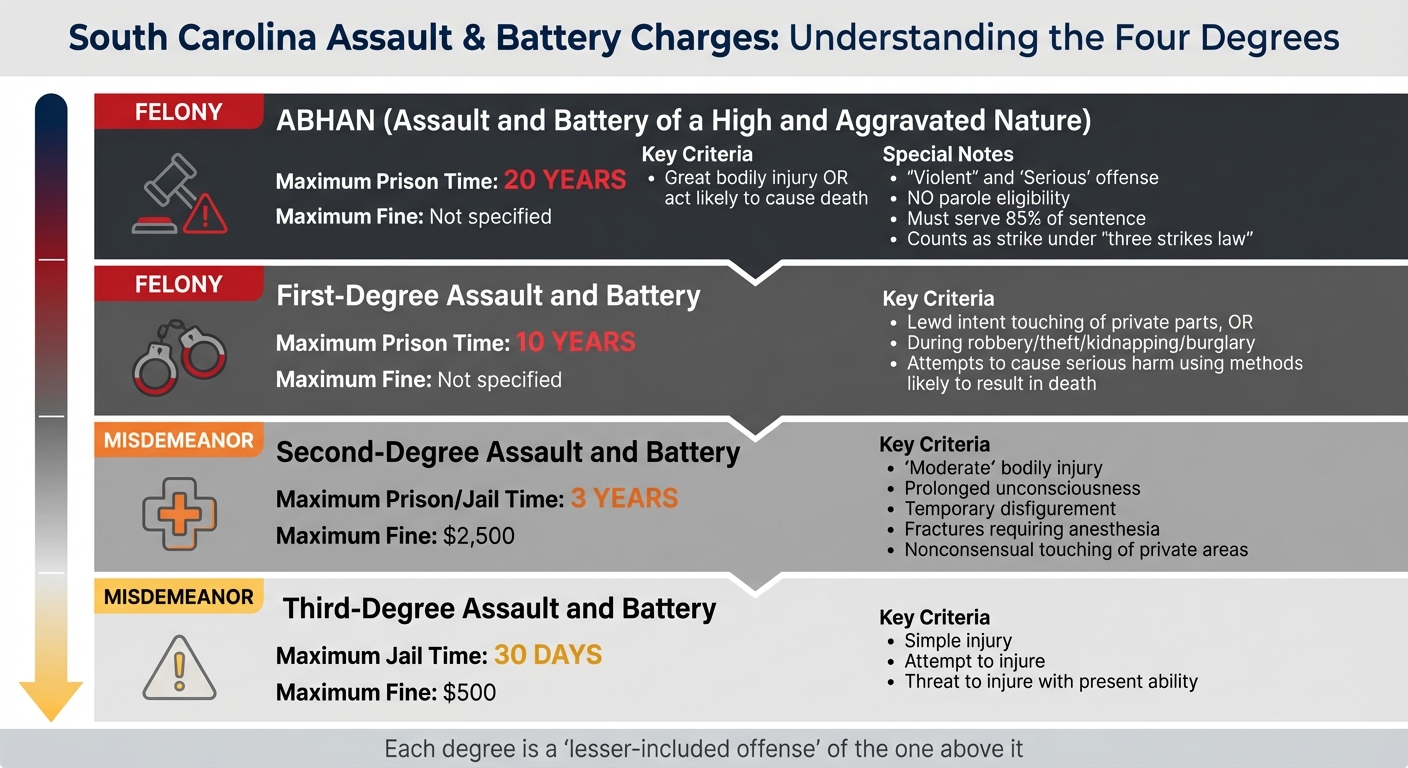
The penalties for these charges range from 30 days in jail to 20 years in prison. Each degree is considered a "lesser-included offense" of the one above it, meaning a jury could convict on a lower charge if the prosecution fails to prove the elements of the higher charge.
Degrees of Assault and Battery in South Carolina
Third-Degree Assault and Battery is the least severe charge. It involves unlawfully injuring, attempting to injure, or threatening to injure someone when the ability to do so is present. This misdemeanor carries a maximum penalty of 30 days in jail and a fine of up to $500.
Second-Degree Assault and Battery is more serious and applies when injuries are considered "moderate." This includes injuries causing prolonged unconsciousness, temporary disfigurement, fractures, or those requiring anesthesia. It also covers nonconsensual touching of private areas (genital area, buttocks, or female breasts). The maximum penalty is 3 years in prison and a fine of up to $2,500.
First-Degree Assault and Battery is a felony charge. It applies if the injury occurs during crimes like robbery, burglary, or kidnapping; involves nonconsensual touching of private parts with lewd intent; or includes attempts to cause serious harm using methods likely to result in death or severe injury. For instance, in State v. Robinson (2022), a first-degree conviction was upheld for lewd intent touching. The maximum penalty is 10 years in prison.
Assault and Battery of a High and Aggravated Nature (ABHAN) is the most severe form of this offense. It applies when injuries result in "great bodily injury", meaning there’s a substantial risk of death, permanent disfigurement, or prolonged loss of a bodily function. It also includes acts likely to cause such injuries. This felony carries a maximum sentence of 20 years in prison.
| Charge Degree | Classification | Maximum Prison/Jail Time | Maximum Fine | Key Criteria |
|---|---|---|---|---|
| ABHAN | Felony | 20 years | N/A | Great bodily injury or act likely to cause death |
| 1st Degree | Felony | 10 years | N/A | Lewd intent touching; or during robbery/theft/kidnapping |
| 2nd Degree | Misdemeanor | 3 years | $2,500 | Moderate bodily injury or touching private parts |
| 3rd Degree | Misdemeanor | 30 days | $500 | Simple injury or threat with present ability |
These degrees outline the potential penalties, but the consequences often go beyond fines or jail time.
Penalties for Assault Convictions
The penalties for assault convictions vary widely, with long-term implications. For instance, ABHAN is classified as a "violent" and "serious" offense in South Carolina. A conviction means no parole eligibility and serving at least 85% of the sentence before release. It also counts as a strike under the state’s "three strikes law".
"Assault and battery of a high and aggravated nature is a violent and serious offense… a person convicted of ABHAN will not be eligible for parole and will have to serve 85% of the prison sentence before being released." – Pirtle Law Firm
Certain circumstances lead to harsher penalties. For example, if the assault involves a "mob" (two or more individuals) and results in death, the mandatory minimum sentence is 30 years. Assaults tied to domestic violence – where the victim is a household member – are governed by separate statutes that often involve stricter procedures and mandatory arrest policies.
sbb-itb-ce0cbb0
What to Do Immediately After Being Accused
Your immediate actions after being accused can heavily influence your defense. The smartest first move? Stay silent. The Fifth Amendment and Article 1, Section 12 of the South Carolina Constitution protect you from self-incrimination during police questioning. Even if you’re convinced that explaining yourself will help, anything you say can – and likely will – be used against you in court.
"The right to remain silent – also known as the right against self-incrimination – protects individuals arrested or charged with criminal offenses in the U.S. This fundamental legal right ensures individuals aren’t compelled to speak in police custody or incriminate themselves."
– Lauren Taylor, South Carolina Attorney
When approached by any law enforcement agency, including the Spartanburg County Sheriff’s Office, request a lawyer immediately. Avoid attempting to explain or defend yourself without legal guidance. If you waive your rights and speak freely, your words could become evidence for the prosecution. The priority should always be to remain silent and secure legal representation.
Stay Silent and Request a Lawyer
Invoke your right to remain silent and ask for an attorney right away. Be polite but firm in refusing to answer any questions until your lawyer is present. This applies whether you’re being questioned at the scene, at the station, or even during a phone call. Law enforcement officers are required to inform you of your Miranda rights, which include the right to remain silent and the right to an attorney. If these rights are violated, any evidence gathered could be excluded from court proceedings.
Remaining calm is just as important. Losing your temper or acting aggressively can escalate the situation and may be used against you later. Even friendly officers are working to build a case, so let your attorney take the lead in all communications. In Spartanburg County, a skilled defense lawyer can also assist with bail applications and start crafting a defense strategy to counter the prosecution’s claims.
Avoid Contact With the Alleged Victim or Witnesses
Steer clear of any interaction with the alleged victim or witnesses to avoid potential misinterpretations of your actions. In Spartanburg County, victims are legally protected from intimidation, harassment, or abuse throughout the legal process.
"As a victim, you have the right to: Be treated with fairness, respect, and dignity, and to be free from intimidation, harassment, or abuse throughout the criminal and juvenile justice process."
– Spartanburg County Sheriff’s Office
If released on bond, you’ll likely face a no-contact order. Violating this order can lead to additional charges, with reports sent to both the Magistrate’s Office and the Solicitor’s Office. Even well-meaning attempts at contact can be misinterpreted, so leave all communication to your lawyer. Additionally, make it a priority to preserve any evidence that supports your version of events.
Preserve Evidence and Document What Happened
Act quickly to secure any evidence that could support your defense. Surveillance footage, such as doorbell cameras or business recordings, can be overwritten in as little as 30 days. Timing is crucial. Spartanburg attorney Rob Usry emphasizes that delays can result in permanent loss of key evidence. Your attorney can send a "spoliation of evidence" letter to ensure critical footage is preserved.
Collect and save all relevant digital communications – text messages, emails, and screenshots of social media interactions. Store these in at least two secure locations, like your phone and an email account. Identify any witnesses who were present and gather their contact information. Write down your account of the events while the details are still fresh, but share this documentation exclusively with your attorney. Importantly, never delete or alter any evidence, as tampering can lead to serious legal repercussions. Preserving evidence promptly can be a game-changer when it comes to challenging the charges in court.
How Spartanburg County Courts Handle Assault Cases
Navigating the way Spartanburg County handles assault cases can give you a clearer picture of what to expect. The county deals with around 8,000 pending cases and adds approximately 200 new criminal cases every week, so each case progresses through specific, time-sensitive stages.
General Sessions Court Procedures
Serious assault cases are tried in the Court of General Sessions, led by Solicitor Barry Barnette of the 7th Judicial Circuit, which serves Spartanburg and Cherokee counties. After the preliminary hearing, a Grand Jury of 18 members must determine if the evidence warrants an indictment. At least 12 jurors must agree to issue a "true bill" before the case advances.
"The Solicitor is an elected official responsible for overseeing the prosecution of all General Sessions and Family Court criminal cases."
– Spartanburg County Solicitor’s Office
The First Appearance typically happens 30–60 days after an arrest. During this stage, you’ll inform the court whether you’ve hired an attorney or plan to represent yourself. The judge will also assign a "tract" to your case, which sets a timeline for resolution – usually six months to a year. The Second Appearance, scheduled within six months of the arrest, allows your defense attorney to indicate whether the case will be resolved through a plea deal or proceed to trial. By this point, most evidence should already be shared with your lawyer.
For less severe assault charges – those carrying penalties of up to one year in prison or a $5,000 fine – cases may be moved to a Magistrate Judge through Transfer Court, which can speed up the process. Having a lawyer early on can be critical to navigating these stages effectively. Next, let’s look at how bond and preliminary hearings can influence your case.
Bond Hearings and Preliminary Hearings
A bond hearing determines the amount of money or property needed for release from jail. Factors like your criminal history, ties to the community, case details, and whether you’re a flight risk or a danger to others are considered.
"A preliminary hearing is the right of the person charged with the crime. It is their chance to hear the evidence that the state has against them."
– Solicitor Barry Barnette, 7th Judicial Circuit
During the preliminary hearing, a magistrate judge decides if there’s enough probable cause to continue with the case. If you’re charged with a bailable offense, you can request this hearing – usually announced during the bond hearing – within 10 days of receiving notice. Once requested, the hearing should take place within 10 days unless you waive it or a grand jury indicts you first. If the judge doesn’t find probable cause, you’ll be discharged, but the state may still pursue prosecution later. Staying updated on your case details is essential, and online tools can help.
Looking Up Your Case Information Online
The South Carolina Judicial Branch Public Index is your go-to resource for tracking your Spartanburg County case. You can search by defendant name, case number, or filing date. The records show your name, charges, hearing dates, arrest date, and assigned attorney and judge. Starting January 1, 2026, home addresses will no longer appear in the public index for both new and existing cases.
For certified records or full documents, you’ll need to visit the Spartanburg County Clerk of Court at 180 Magnolia Street, 2nd Floor, Suite 2100. Copies cost $0.20 per page, and certification fees are $10 per document. The Clerk of Court also manages plea and trial dockets, which you can monitor through legal records systems. Be sure to update your contact information with the Solicitor’s Office and the Department of Probation, Parole, and Pardon Services to ensure you receive all court notifications.
Legal Defenses for Assault Charges
Once you’ve taken steps to protect your rights, the next focus is building a defense that challenges the prosecution’s case. A well-prepared defense can make all the difference as your case progresses through the courts in Spartanburg County.
Common Defenses to Assault Charges
One of the most frequently used defenses in assault cases is self-defense. South Carolina’s Stand Your Ground law allows you to use force, even deadly force, if you’re in a place where you have a legal right to be and reasonably believe it’s necessary to prevent death or serious injury. Similarly, the Castle Doctrine presumes you acted out of fear for your life or safety if someone unlawfully entered your home.
"In South Carolina, you have the right to use reasonable force, including deadly force, to protect yourself or another person from unlawful force if you reasonably believe it is necessary to prevent death or great bodily injury."
– Baldwin Criminal Lawyer
Other potential defenses include showing no intent, which argues that the act was accidental rather than deliberate. In cases where physical contact was consensual – such as during a contact sport – consent may also serve as a defense. Additionally, proving mistaken identity or providing an alibi, supported by credible evidence or witnesses, can completely dismantle the prosecution’s case. Defense strategies may also involve highlighting constitutional violations, such as unlawful searches or Miranda rights violations, which could lead to evidence being excluded.
These strategies form the backbone of a strong defense, setting the stage for the next critical step: gathering and analyzing evidence.
Using Evidence and Witness Testimony
The strength of your defense often depends on the evidence at hand. During the discovery phase, your attorney will thoroughly examine the prosecution’s materials, such as police reports, 911 call recordings, surveillance footage, medical records, and victim statements. This process helps identify inconsistencies or gaps that could weaken the state’s case.
Discrediting witnesses is another key tactic. This might involve pointing out prior inconsistent statements, uncovering criminal records tied to dishonesty, or exposing motives that could lead to fabricated testimony. Physical evidence, like photos of injuries or property damage, can support claims of self-defense or accidental harm. Witnesses who can confirm your whereabouts or challenge the alleged victim’s account may also prove crucial.
"An attorney can review relevant portions of your case such as oral/written witness statements, police reports, 911 call recordings, video/audio footage, etc. and advise you on your possible defenses."
– swilliamslaw
Act quickly to secure digital evidence, such as surveillance footage, as it may be overwritten in a matter of days or weeks. Any gaps in the prosecution’s evidence can be used to argue that the state hasn’t met its burden of proof beyond a reasonable doubt. This detailed preparation not only strengthens your defense but also opens the door to productive negotiations with prosecutors.
Negotiating With Prosecutors
An experienced defense attorney can often negotiate with prosecutors to reduce charges or even have them dismissed before trial. Plea negotiations might result in charges being downgraded – for example, reducing a second-degree assault charge to third-degree assault, which carries a maximum penalty of 30 days in jail and a $500 fine in South Carolina.
Your attorney may pinpoint weaknesses in the prosecution’s case, such as insufficient evidence of intent or injuries that don’t meet the legal threshold. If the alleged victim is willing to cooperate or has credibility issues, this can be leveraged to secure a dismissal or a favorable plea deal.
"In some cases, if the victim is cooperative and the facts support it, an attorney may be able to secure a dismissal or other favorable outcome."
– Baldwin Criminal Lawyer
Mitigating factors, such as provocation or acting in the heat of the moment, can also be presented to argue for reduced penalties. In some cases, attorneys may negotiate a plea to a non-violent charge, like "disturbing the peace", to avoid the long-term consequences of a violent crime conviction. Early legal intervention is key to identifying weaknesses in the prosecution’s case and achieving the best outcome.
Common Mistakes to Avoid During Your Case
When navigating a legal case, avoiding certain missteps can be just as important as taking the right steps. Here are some common errors that can seriously hurt your defense.
Talking Without a Lawyer Present
Engaging with law enforcement without an attorney by your side is one of the biggest mistakes you can make. Under the Fifth Amendment and the South Carolina Constitution, you have the right to remain silent to protect yourself from self-incrimination. If you choose to speak without legal representation, any statements you make can be used against you in court.
"If you waive your rights and freely provide information, that information can be used against you during criminal prosecution."
– Lauren Taylor Law
To safeguard your rights, always invoke your right to remain silent and request an attorney before answering any questions.
Breaking Bond Conditions or Court Orders
Violating bond conditions comes with serious consequences, including the possibility of immediate arrest and bond revocation. For instance, if you’re out on bond for a violent charge and commit another violent crime or a felony involving a firearm, your bond will be revoked automatically by law.
Some common violations include leaving South Carolina without court approval, failing to maintain "good behavior" toward the alleged victim, or tampering with electronic monitoring devices. If you’re on electronic monitoring, it’s crucial to report any device issues within two hours to either the monitoring agency or law enforcement. In Spartanburg County, such reports should be made to the Magistrate’s Office at 864-596-2564 and the Solicitor’s Office at 864-596-2575. Violating bond conditions can lead to stricter terms or higher bond amounts in future hearings.
Losing or Destroying Evidence
Preserving evidence is essential for building a strong defense. Losing or destroying key documents or records can make your situation far more challenging. Always keep both physical and digital copies of legal notices, incident reports, and any other case-related communications. Sending important documents via certified mail with a return receipt ensures there’s a record of delivery.
If bond conditions are breached or new incidents arise, file a police report immediately to create an official record. For copies of incident reports in Spartanburg County, contact the Spartanburg County Sheriff’s Office Records Department at 864-503-4553 or visit their office at 8045 Howard St., Spartanburg. You can also use the South Carolina Judicial Branch Case Records Search to monitor court filings in Spartanburg County (Circuit Number 7) and ensure no critical documents are missed.
Why You Need an Experienced Defense Attorney
Facing assault charges without legal representation can put your rights at serious risk. An experienced defense attorney can scrutinize the prosecution’s evidence, identify violations of your constitutional rights, and work to negotiate reduced charges or alternative sentencing options like diversion programs. They can also build strong defenses based on arguments such as self-defense, Stand Your Ground laws, or protecting others.
Having an attorney familiar with Spartanburg County’s legal system is invaluable. With direct access to key offices – such as the Sheriff’s Office (8045 Howard St.), Magistrate’s Office (864-596-2564), and Solicitor’s Office (864-596-2575) – a local attorney can navigate the system more effectively and advocate for you with precision.
How Brendan M. Delaney Law Firm LLC Can Help

With over 24 years of experience in handling assault defense cases, Brendan M. Delaney provides seasoned legal expertise and a deep understanding of the Upstate region’s courts. His firm has successfully managed high-stakes cases, including multiple murder trials with favorable jury outcomes. Conveniently located at 184 N. Daniel Morgan Ave. in Spartanburg, the firm is well-positioned to directly engage with the local court system.
The firm’s approach is centered around the client. This means listening to your concerns, meticulously examining every detail of your case, and crafting a defense strategy tailored to your specific needs. Brendan M. Delaney Law Firm LLC serves a broad area, including Spartanburg, Greenville, Anderson, Cherokee, Laurens, Union, Pickens, Greenwood, and Oconee counties.
"Brendan M. Delaney will diligently fight for your rights in obtaining the most favorable outcome in your matter depending upon the unique circumstances of your case."
– Brendan M. Delaney Law Firm LLC
The firm is built on the principle that every individual is presumed innocent until proven guilty. Their focus is on challenging the prosecution’s case, ensuring legal procedures are followed, and safeguarding your constitutional rights. This commitment results in a defense strategy designed specifically for your situation. To take the first step, schedule a free consultation.
Free Consultation and Custom Legal Plans
Brendan M. Delaney Law Firm LLC offers a free initial consultation to discuss your case and create a tailored legal strategy. During this meeting, you’ll have the opportunity to share your story in a welcoming environment designed to make you feel confident and supported.
Every assault case is different. Whether you’re facing third-degree or first-degree felony charges, the firm will develop a custom legal plan that aligns with your goals and circumstances. Take advantage of the free consultation to explore your options and start building your defense.
Conclusion
Facing assault accusations in Spartanburg County requires immediate and well-thought-out action. A third-degree assault conviction can result in up to 30 days in jail and a $500 fine, while ABHAN charges carry the possibility of up to 20 years in prison. Beyond legal penalties, these charges can threaten your job, housing, and personal rights.
Taking the right steps quickly is crucial. Protect your rights by remaining silent, seeking legal representation immediately, and documenting every detail while the evidence is still fresh. Avoid mistakes like speaking to law enforcement without an attorney or contacting the alleged victim. These actions are critical for building a strong defense.
"The sooner you consult an attorney, the better your chances. Delays risk losing crucial evidence and witness recollection." – McCutchen Vaught Geddie & Hucks, P.A.
A skilled defense attorney familiar with Spartanburg County’s legal processes can thoroughly analyze the prosecution’s case, negotiate for reduced charges, or explore alternatives like Pre-Trial Intervention programs. They can also craft defenses based on self-defense laws or Stand Your Ground principles. Identifying procedural errors, such as unlawful searches or Miranda rights violations, can even lead to evidence being excluded.
Don’t wait to start building your defense. Tailor your approach to the specifics of your case for the best possible outcome. Contact Brendan M. Delaney Law Firm LLC for a free consultation to understand your options and work with a team that knows the Spartanburg County legal system inside and out.
FAQs
What should I do if I’m accused of assault in Spartanburg County?
If you’re facing an assault accusation in Spartanburg County, taking the right steps immediately is crucial. The first thing you should do is contact a skilled criminal defense attorney who knows South Carolina law inside and out. Having a knowledgeable legal advocate can help safeguard your rights and lay the groundwork for your defense.
It’s also important to understand the specific charges you’re up against – whether it’s simple assault or aggravated assault – since the penalties can vary significantly. Gather and preserve any evidence that might support your case, such as witness information or relevant documents. And remember, avoid discussing the details of the case with anyone except your attorney.
Lastly, take time to get familiar with the local court process, especially your initial hearing. This is where the charges will be formally presented, and bail options will be determined. Acting swiftly and responsibly can have a big impact on how your case unfolds.
What steps should I take to preserve evidence if I’m accused of assault in Spartanburg County?
Facing an assault accusation in Spartanburg County? One of the most important steps you can take is to gather and preserve evidence that supports your defense. Start by documenting everything you can. Photograph the scene, note any visible injuries, and hold onto items like clothing or objects involved in the incident. Avoid altering or throwing away anything that might later serve as evidence.
It’s also essential to connect with potential witnesses as soon as possible. Ask them for statements while the details are still fresh in their minds. Keep track of any communication related to the incident, as these records could be valuable later.
Finally, consult with a legal professional right away. An attorney can guide you on how to handle evidence properly and help you request access to anything the prosecution plans to use against you. Acting promptly and carefully can play a key role in protecting your rights and building a strong defense.
What are the possible defenses for assault charges in South Carolina?
In South Carolina, defending against assault charges hinges on the specifics of the situation. Two of the most common defenses are self-defense and defense of others. To argue self-defense, you need to demonstrate that you genuinely believed you were in immediate danger and only used as much force as was necessary to protect yourself or someone else.
Other possible defenses might include showing that the act was accidental, disputing the reliability of the evidence, or questioning the trustworthiness of witnesses. There are also cases where the act could be considered justified – for example, during lawful resistance – or situations where the conduct has been incorrectly categorized under the law.
Because South Carolina law outlines different degrees of assault and battery, each with its own legal consequences, seeking guidance from a skilled criminal defense attorney is essential. They can assess your case and craft a defense strategy tailored to your unique situation.