




Need a criminal defense attorney in Spartanburg County? Here’s what you should know:
- Top Attorneys: Andrew J. Johnston, Brendan M. Delaney, and Mary Shealy stand out for their extensive experience (19–40+ years) in handling DUI, drug offenses, violent crimes, and more.
- Local Expertise: These attorneys understand the Seventh Judicial Circuit’s procedures, from bond hearings to trial strategies.
- Credentials Matter: Look for South Carolina Bar certification, trial experience, and specialized training (e.g., field sobriety, toxicology).
- Free Consultations: Many firms offer free consultations – use this time to assess their experience, communication, and fee structure.
- Fee Structures: Options include flat fees, per-appearance fees, or monthly retainers, depending on case complexity.
Quick Tip: Acting fast after an arrest ensures evidence preservation and timely filing for hearings. Choose an attorney who knows Spartanburg County’s legal system inside out.
Criminal Defense in Spartanburg County
Spartanburg County operates within the Seventh Judicial Circuit, with the Court of General Sessions handling adult felonies and serious misdemeanors. These cases involve penalties exceeding 30 days in jail or fines over $500. Meanwhile, Municipal and Magistrate courts deal with minor offenses. Most significant proceedings now take place at the new Spartanburg County Courthouse, located at 180 Magnolia Street, which opened in 2023.
Knowing how local procedures work can make a significant difference in the outcome of your case. For example, if you’re arrested in Spartanburg County, state law (South Carolina Code Section 22-5-510) guarantees you a bond hearing within 24 hours. Once bond is posted, authorities are required to release you within four hours. These procedural details underline the importance of having a defense attorney who understands the local system.
What a Criminal Defense Attorney Does
A criminal defense attorney plays a critical role in protecting your constitutional rights. They challenge the evidence presented by prosecutors, negotiate to reduce charges, and craft defense strategies tailored to your situation. For instance, in DUI cases, details like the maintenance records of breath test devices or the proper execution of field sobriety tests can greatly influence the outcome.
Defense attorneys also guide you through early-stage proceedings, such as preliminary hearings, where a judge determines if there’s enough evidence for the case to move forward. As the Ellis Hinton Law Firm explains:
"The preliminary hearing does not determine innocence or guilt; the court only decides whether there is enough evidence to proceed with the case".
If the evidence presented at this stage is insufficient, charges may be dismissed before the case even goes to trial.
Common Legal Challenges in Spartanburg County
Attorneys in Spartanburg County face a range of local legal challenges. The most common charges include DUI/DUAC, drug offenses, violent crimes, property crimes, and white-collar crimes. Each type of charge comes with unique procedures and penalties, depending on which court handles the case. For individuals dealing with substance abuse, Spartanburg County offers a Drug Court program. This 14-month alternative to traditional sentencing focuses on treatment, requiring mandatory testing and therapy.
Local expertise is crucial because Spartanburg County has specific procedures that sometimes allow cases to be transferred from General Sessions to Municipal Court, where they can often be resolved with a fine. Attorneys who are familiar with the local prosecution’s policies and the dynamics of court personnel can navigate these nuances effectively, often securing better outcomes for their clients.
sbb-itb-ce0cbb0
What to Look for in a Criminal Defense Attorney
Choosing the right criminal defense attorney is crucial. Look for someone with verified credentials, extensive trial experience, and a proven track record. These qualities are essential for navigating the specific legal challenges in Spartanburg County.
Required Credentials and Certifications
To practice law in Spartanburg County, every attorney must hold an active South Carolina Bar membership. Always verify their Bar Number before proceeding. Beyond this basic requirement, prioritize attorneys with significant trial experience. Many of the area’s top professionals have handled a range of cases, from minor offenses to serious felonies, including murder.
For DUI cases, specialized training can make a big difference. Attorneys with expertise in field sobriety tests and toxicology can challenge the prosecution’s evidence effectively. This technical knowledge often plays a critical role in such cases.
Appellate experience is another important factor. Lawyers who have argued cases before courts like the South Carolina Court of Appeals, the South Carolina Supreme Court, or even federal courts such as the U.S. Fourth Circuit demonstrate a high level of legal skill. Additionally, experience as an Assistant Public Defender or involvement in programs like Drug Court or DUI Court provides valuable insights into the local judicial system.
Membership in professional organizations also reflects an attorney’s dedication to their field. Affiliations with groups like the South Carolina Association of Criminal Defense Lawyers (SCACDL) and the National Trial Lawyers Association indicate a commitment to staying informed about legal developments and maintaining high professional standards.
| Qualification/Credential | Why It Matters |
|---|---|
| SC Bar Certification | Required for practicing law in Spartanburg County. |
| 40+ Years Experience | Reflects expertise in handling complex cases like murder trials. |
| Toxicology Training | Essential for contesting evidence in DUI and drug-related cases. |
| SCACDL Membership | Highlights dedication to criminal defense advocacy. |
| Drug/DUI Court Leadership | Demonstrates specialized knowledge in alternative sentencing options. |
While credentials are critical, client feedback offers a glimpse into how attorneys perform in real-world situations.
Client Reviews and Case Results
Client testimonials can reveal an attorney’s communication skills and effectiveness. For example, Barbara T., a former client of John Crangle, shared:
"His communication was huge – he always kept me informed, which provided a grounding structure when everything else felt chaotic".
Clear and consistent communication is invaluable during stressful legal proceedings.
Reviewing case outcomes can also provide insight. Look for examples of charge reductions, dismissals, or "Not Guilty" verdicts. One client, Chris Winstead, praised his attorney’s results, saying:
"I had a case and I don’t know how he did it but he got it dropped to transfer court with just a fine… I recommend him to everyone".
Numbers can further reinforce an attorney’s reliability. For instance, John Crangle has represented over 1,000 clients and received more than 250 five-star reviews. Testimonials highlighting creative approaches to defense can be particularly telling. Josh Greene remarked:
"To say I was impressed by Mr. Johnston is an understatement. He’s very professional and very creative in his approach".
When researching attorneys, check their ratings on respected legal directories like Martindale-Hubbell, Super Lawyers, Avvo, and Justia. If online reviews are limited, ask for direct references. Firms like The Shealy Law Firm, for example, back their services with a "Lawful Guarantee" for quality and professionalism.
Top Criminal Defense Attorneys in Spartanburg County
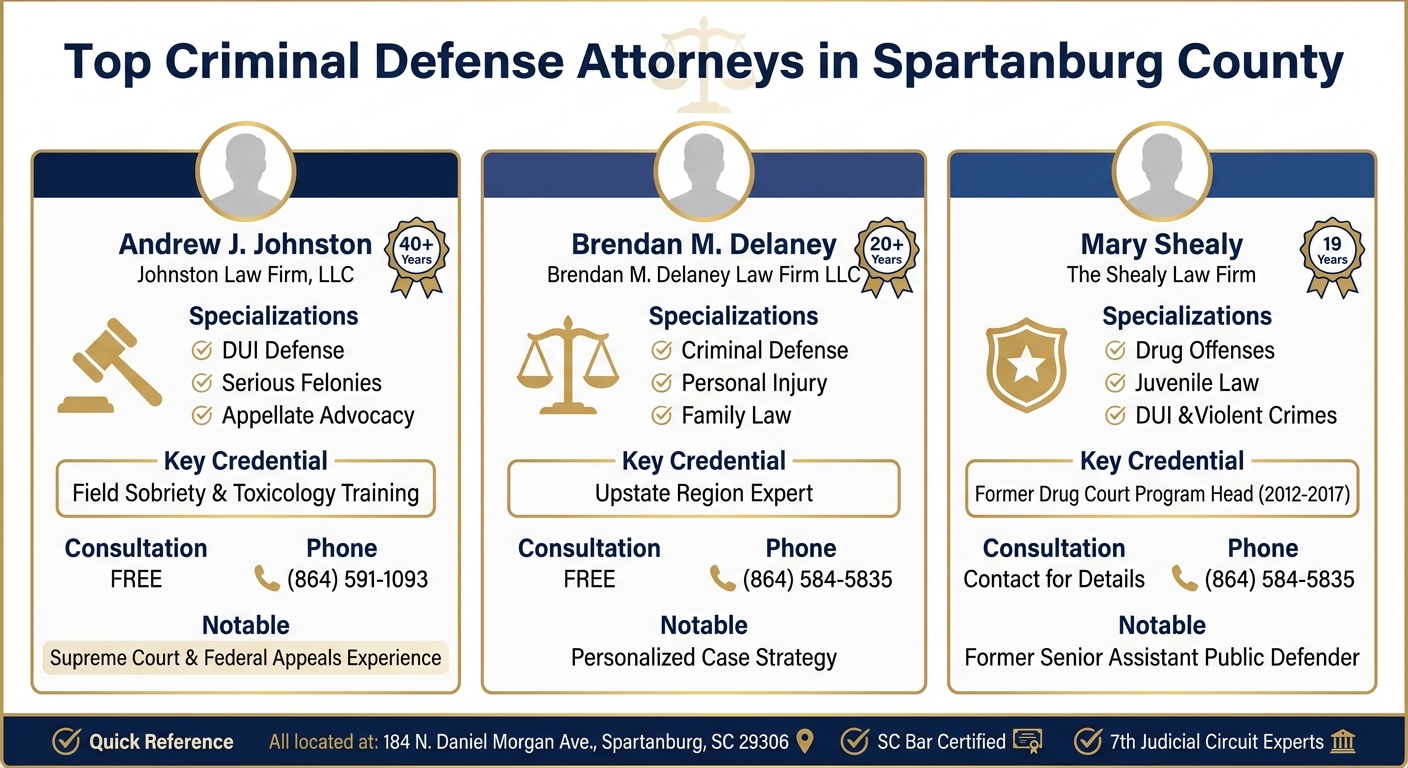
Top Spartanburg County Criminal Defense Attorneys Comparison 2026
This section features attorneys with extensive experience in criminal defense, spanning both state and federal courts. Their dedication, specialized skills, and notable case outcomes set them apart within the Spartanburg County legal community.
Attorney Profiles
Andrew J. Johnston – Johnston Law Firm, LLC
Andrew J. Johnston brings over 40 years of trial experience to the table, having handled high-stakes cases such as murder trials and serious felonies. His appellate work includes appearances before the South Carolina Supreme Court, the South Carolina Court of Appeals, and the U.S. Fourth Circuit Court of Appeals.
Johnston’s DUI defense practice stands out due to his technical training. He completed the same Field Sobriety and toxicology courses as law enforcement officers, giving him the tools to challenge evidence like breath tests and toxicology reports with precision. One client, Chris Winstead, shared his experience:
"I had a case and I don’t know how he did it but he got it dropped to transfer court with just a fine… I would choose anyone else with my freedom."
The Johnston Law Firm provides free initial consultations and maintains a strong presence on platforms like Super Lawyers, Martindale-Hubbell, and Avvo.
Brendan M. Delaney – Brendan M. Delaney Law Firm LLC
With over 20 years of experience, Brendan M. Delaney focuses on criminal defense, personal injury, and family law cases across the Upstate region. His approach centers on protecting his clients’ rights through tailored strategies that address each case’s specific needs.
Delaney offers free initial consultations, taking the time to ask detailed questions and build a solid plan for representation. His extensive knowledge of South Carolina’s legal system has made him adept at handling complex criminal cases, as well as personal injury and family law disputes.
Mary Shealy – The Shealy Law Firm
Mary Shealy has 19 years of legal experience and founded The Shealy Law Firm in 2007. Her background as a former Senior Assistant Public Defender is a testament to her deep understanding of the local legal landscape. From 2012 to 2017, she served as the Head of the Drug Court Program for the 7th Judicial Circuit Public Defender’s Office, gaining significant expertise in drug-related cases and alternative sentencing options.
Shealy’s practice covers a wide array of criminal charges, including drug possession, DUI, domestic violence, juvenile law, and violent crimes. She is a member of the South Carolina Association of Criminal Defense Lawyers and the National Trial Lawyers Association, reflecting her dedication to criminal defense. The Shealy Law Firm also offers flexible payment options, accepting cash, checks, and credit cards.
Contact Information:
- Johnston Law Firm, LLC: 184 N. Daniel Morgan Ave., Spartanburg, SC 29306 | (864) 591-1093
- Brendan M. Delaney Law Firm LLC: 184 N. Daniel Morgan Ave., Spartanburg, SC 29306 | (864) 584-5835
- The Shealy Law Firm: 184 N. Daniel Morgan Ave., Spartanburg, SC 29306 | (864) 584-5835
Attorney Comparison Table
| Attorney | Firm | Years of Experience | Primary Specializations | Consultation Fee | Contact |
|---|---|---|---|---|---|
| Andrew J. Johnston | Johnston Law Firm, LLC | 40+ | DUI Defense, Serious Felonies, Appellate Advocacy | Free | (864) 591-1093 |
| Brendan M. Delaney | Brendan M. Delaney Law Firm LLC | 20+ | Criminal Defense, Personal Injury, Family Law | Free | (864) 584-5835 |
| Mary Shealy | The Shealy Law Firm | 19 | Drug Offenses, Juvenile Law, DUI, Violent Crimes | Contact for Details | (864) 584-5835 |
Criminal Defense Practice Areas
In Spartanburg County, crafting a defense tailored to the specific charge is critical. Each type of case requires a unique approach, and understanding these areas can help you find an attorney with the right expertise for your situation.
DUI/DUAC Defense
Defending against DUI (Driving Under the Influence) and DUAC (Driving with Unlawful Alcohol Concentration) charges requires a deep understanding of the technical aspects of these cases. Skilled attorneys scrutinize breath test devices and field sobriety procedures to uncover potential flaws in the evidence. For example, South Carolina law requires officers to observe a suspect for 15 uninterrupted minutes before administering a breath test to ensure accuracy and prevent "mouth alcohol" from skewing results.
Attorneys also challenge field sobriety tests, factoring in local conditions like uneven pavement, poor lighting, or weather – common issues in Spartanburg County. While the National Highway Traffic Safety Administration reports that driving patterns predict impaired driving only 35% of the time, standardized field sobriety tests are 91% accurate when performed correctly by trained officers. Additionally, physical signs such as red eyes or an unsteady gait can often be attributed to non-alcohol-related causes like fatigue, allergies, or medical conditions such as GERD. As DUI Defense Attorney John Murray explains:
"There is nothing illegal about drinking before driving. What is illegal is being impaired at the time you drive".
Drug Offense Defense
Drug charges, which can range from possession to trafficking, require a defense strategy tailored to the severity of the charge. Attorneys frequently focus on whether law enforcement followed proper search and seizure protocols. Missteps in these procedures can lead to evidence being excluded, significantly weakening the prosecution’s case.
Former prosecutors bring valuable insights into how the other side builds its case, helping defense attorneys anticipate strategies and spot weaknesses. For instance, Mary Shealy’s experience as Head of the Drug Court Program for the 7th Judicial Circuit (2012–2017) showcases how specialized knowledge can guide clients toward alternative sentencing options when appropriate. These approaches are especially important when facing serious charges like drug trafficking or distribution.
Felony and Misdemeanor Defense
Felony charges, which include violent crimes and property offenses, require meticulous preparation and aggressive representation. Preliminary hearings play a crucial role, as attorneys use this opportunity to challenge whether the prosecution has enough evidence to establish probable cause.
| Practice Area | Common Case Types | Key Defense Strategies |
|---|---|---|
| DUI/DUAC | Misdemeanor DUI, Felony DUI | Challenging breath tests, field sobriety tests, toxicology |
| Drug Offenses | Possession, Distribution, Trafficking | Challenging search and seizure, evidence handling |
| Violent Crimes | Murder, Assault, Battery | Jury trial advocacy, self-defense claims, witness testimony challenges |
| Property Crimes | Theft, Burglary, Larceny | Contesting intent, negotiating plea deals |
| White Collar | Fraud, Embezzlement, Money Laundering | Forensic accounting, reviewing complex documents |
Even misdemeanor charges, though less severe than felonies, can have lasting effects on your employment, housing, and reputation. Attorneys work to protect your rights and negotiate with prosecutors to minimize these impacts. As Ellis Hinton puts it:
"Our role is to defend your rights, challenge the evidence against you, and negotiate with the prosecution on your behalf".
Each type of criminal charge demands a precise legal approach, underscoring the importance of working with an attorney who specializes in the specific area of law relevant to your case.
How to Select Your Criminal Defense Attorney
Choosing the right attorney means finding someone whose experience, communication style, and fee structure align with your needs. By carefully evaluating these factors, you can secure a lawyer who will effectively protect your rights and navigate the specifics of your case.
Making the Most of Consultations
The initial consultation is your chance to determine if an attorney is the best fit for your situation. Many attorneys in Spartanburg County offer free consultations, providing an opportunity to discuss your case without financial commitment. During this meeting, pay close attention to whether the attorney asks thoughtful, detailed questions about your case. For example, the Brendan M. Delaney Law Firm LLC emphasizes this approach:
"Brendan initiates the journey by asking insightful questions about your case, fostering an environment where you feel comfortable and supported, laying the foundation for effective legal representation".
This level of engagement demonstrates the attorney’s focus on understanding the specifics of your case. Be prepared to share as much detail as possible, including timelines, witness information, and any relevant documentation. Use this time to confirm whether the attorney has experience with cases similar to yours, such as DUI, drug-related charges, or felony vs misdemeanor cases.
Be on the lookout for warning signs, like an inability to explain their strategy, missed deadlines, or a lack of familiarity with relevant laws. By the end of the consultation, you should feel confident that the attorney understands your case and the specific workings of the Spartanburg County court system.
After assessing the attorney’s fit, make sure to clarify their financial terms to avoid any confusion later.
Attorney Fee Structures Explained
Understanding an attorney’s fee structure is crucial for avoiding unexpected costs. Criminal defense cases typically use one of three payment models, unlike personal injury cases that often rely on contingency fees:
| Fee Structure | How It Works | Best For |
|---|---|---|
| Flat Fee | A single price covers the entire case | Straightforward cases like misdemeanors or DUIs |
| Per-Appearance Fee | Payment for each court date or hearing attended | Cases with unpredictable timelines or multiple appearances |
| Monthly Retainer | Ongoing advisory services billed monthly | Complex, long-term cases or corporate criminal matters |
The cost of representation depends on several factors, including the attorney’s experience, reputation, and the complexity of your case. For example, a felony case requiring extensive trial preparation will generally cost more than a misdemeanor case focused on negotiation. The court handling your case also plays a role – District Court cases often differ in scope and cost compared to those in higher courts. Local court procedures may further influence pricing, so it’s important to get clarity on fees early on.
During the consultation, ask the attorney to explain their fee structure and what services are included. Transparency about billing ensures there are no surprises later on. Some attorneys may require full payment upfront, while others might offer payment plans. Understanding these terms before signing an engagement letter helps you manage costs and avoid financial stress as your case progresses.
Your First Attorney Consultation
When you’re dealing with legal matters in Spartanburg County, that first meeting with your attorney is crucial. It’s your chance to tap into their expertise and set the stage for your case. The more prepared you are, the better your attorney can understand your situation and develop a strategy. Here’s how to make the most of it.
How to Prepare for Your Consultation
Start by gathering all the paperwork related to your arrest. This includes warrants, police reports, citations, and tickets. These documents give your attorney a clear picture of the case and might even reveal procedural errors. If you’ve already had a bond hearing, bring any documentation from it, including the court’s conditions for your release.
Next, collect any evidence you have that could support your case. Think photos, videos, or contact information for witnesses. For DUI or drug-related charges, bring results from breathalyzer or blood tests, along with any notes about field sobriety tests conducted by the police. Writing a detailed, step-by-step account of what happened during your arrest can also be incredibly helpful. This timeline can highlight weaknesses in the prosecution’s case.
If your bond hearing has already taken place, remember that in South Carolina, you only have 10 days to file a request for a preliminary hearing. This hearing can challenge whether there was probable cause for the charges and could even result in charges being reduced or dismissed before trial.
Once you’ve organized your documents and evidence, focus on preparing questions to evaluate your attorney’s experience and approach.
Questions to Ask Your Attorney
Your consultation is also a chance to assess whether the attorney is the right fit for you. Ask about their experience as a former prosecutor, either at the state or federal level. This background can give them unique insight into how the other side builds its case. It’s also important to find out if they’ve handled cases like yours in Spartanburg County, as local knowledge can make a big difference. Don’t forget to ask them to explain how bond and preliminary hearings work in South Carolina.
You should also request an outline of their defense strategy. Specifically, ask how they plan to challenge the evidence and negotiate with the prosecution. Discuss how they prefer to communicate – whether by phone, email, or in-person meetings – and how often you can expect updates. Finally, make sure you understand their fee structure. Do they charge a flat fee, bill by the hour, or require a retainer? Get clarity on this upfront.
Pay attention to how deeply the attorney engages with your case during the consultation. Their level of inquiry can reveal how committed they are to building a strong defense. Many attorneys in Spartanburg County offer free initial consultations, so take advantage of this opportunity to find the right legal representation.
Conclusion
Selecting the right criminal defense attorney in Spartanburg County is a key step in safeguarding your freedom, finances, and future. The attorneys featured in this guide bring decades of experience – ranging from 19 to over 40 years – in handling cases that span from DUI charges to serious felonies in both state and federal courts [1–3]. Their extensive backgrounds give them an edge when navigating the unique aspects of the local judicial system. Acting quickly is essential to preserve evidence and address procedural errors. Many of these attorneys have specialized training, such as in Field Sobriety Testing, which allows them to challenge breathalyzer results and other prosecution evidence effectively.
Make use of free initial consultations to evaluate an attorney’s qualifications. During this process, ask about their experience within the 7th Judicial Circuit, their history with trials and appeals, and their track record with cases similar to yours. A skilled attorney will not only provide clear answers but also ask detailed questions about your case, offering a defense strategy tailored to your specific needs.
Facing criminal charges is a serious matter, and having the right legal advocate can make all the difference. A knowledgeable attorney will understand the intricacies of local court procedures, anticipate how prosecutors build their cases, and work tirelessly to achieve the best possible outcome for you. Use this guide to choose a defense attorney who can help protect your future.
FAQs
How quickly should I hire a defense attorney after an arrest?
Hiring a defense attorney immediately after an arrest is crucial. Early legal representation not only safeguards your rights but also gives your attorney sufficient time to build a strong case. This proactive step can significantly impact the outcome, ensuring you have the guidance and support necessary to handle the complexities of the legal process.
What should I bring to my first consultation with a lawyer?
When heading to your first consultation, it’s crucial to bring along all relevant documents and details about your case. This might include legal paperwork, evidence, or records that back up your situation. Take the time to prepare a clear summary of the most important facts, key dates, and any specific questions or concerns you want addressed. Staying organized will allow your attorney to grasp your case quickly and offer more targeted legal guidance.
How do criminal defense lawyers usually charge for a case?
Criminal defense lawyers typically offer two main fee structures: flat fees and hourly rates. A flat fee means clients pay a predetermined amount for specific legal services, while hourly rates involve paying for the actual time the attorney spends working on the case. The cost can vary depending on factors like the complexity of the case and the lawyer’s level of experience.
Many law firms, such as Brendan M. Delaney Law Firm LLC, provide flexibility in payment options. They often accept various methods, including cash, checks, and credit cards. Additionally, initial consultations are commonly offered, giving clients a chance to discuss fees and get an estimate of potential costs upfront.