



If you’re dealing with a bench warrant in South Carolina, acting quickly can save you from serious consequences like jail time or additional charges. A bench warrant is issued when someone fails to follow a court order – common reasons include missing court, unpaid fines, or violating bond terms. These warrants don’t expire and are accessible nationwide through the NCIC database, meaning you could be arrested during a routine traffic stop.
Here’s the good news: With the help of a lawyer, you can often resolve a bench warrant without being arrested. Attorneys can file a motion to lift the warrant, negotiate with prosecutors, or present evidence to explain missed court dates. In some cases, they can resolve the warrant in as little as 24–48 hours.
Key Takeaways
- Don’t ignore a bench warrant. Delays can lead to jail time and additional penalties.
- Work with a lawyer. They can handle court communications, protect your rights, and avoid self-incrimination.
- Act fast. Early action improves your chances of avoiding arrest and resolving the issue.
- Prepare evidence. Documents like medical records, proof of address changes, or accident reports can support your case.
The fastest resolution often involves securing prosecutor consent to lift the warrant. If that’s not possible, a court hearing may be required. Either way, addressing the issue promptly with legal assistance is the best way to protect your freedom and resolve the underlying charges.
How a South Carolina Bench Warrant Lawyer Can Help
When facing a bench warrant, acting quickly is essential, but navigating the legal system without help can be risky. Trying to resolve the issue yourself – like contacting the Solicitor’s Office or Clerk of Court – might unintentionally lead to self-incrimination or even immediate arrest. This is where an experienced attorney steps in, acting as a protective barrier between you and the legal system. They manage the entire process, ensuring each step is handled efficiently and correctly.
Reviewing Your Case and Legal Options
The first thing a lawyer does is confirm the details of your warrant and determine the best course of action. This includes identifying the issuing court and carefully reviewing the charges against you. For example, warrants from General Sessions often require discussions with the Solicitor’s Office, while Magistrate Court warrants are typically resolved directly with the court. Getting these details right is critical for crafting an effective legal strategy. Once everything is reviewed, the attorney can begin taking formal steps to address the warrant.
Filing a Motion to Lift or Rescind the Warrant
One common approach is filing a motion to lift or rescind the warrant. This formal request asks the court to vacate the warrant and is usually supported by evidence explaining why you missed your court date. Supporting documents might include medical records, proof of a hospital visit, or evidence of a valid address change. After preparing the motion, your attorney schedules a hearing to present the evidence directly to the judge. From there, the focus shifts to negotiating favorable terms with the prosecution.
Negotiating with the Prosecutor
"The fastest way to resolve a bench warrant is with prosecutor consent." – Law Office of James R. Snell, Jr., LLC
In many cases, your attorney will work directly with the prosecutor to seek consent for lifting the warrant. This negotiation aims to avoid further complications or potential jail time. If the prosecutor agrees, your lawyer drafts a consent order to vacate the warrant and submits it to a judge for approval. In some situations, this process can resolve the issue in a single day. This method is especially effective for non-violent charges, drug-related cases without victims, or instances where there’s no risk of flight.
sbb-itb-ce0cbb0
Steps to Clear an Active Bench Warrant
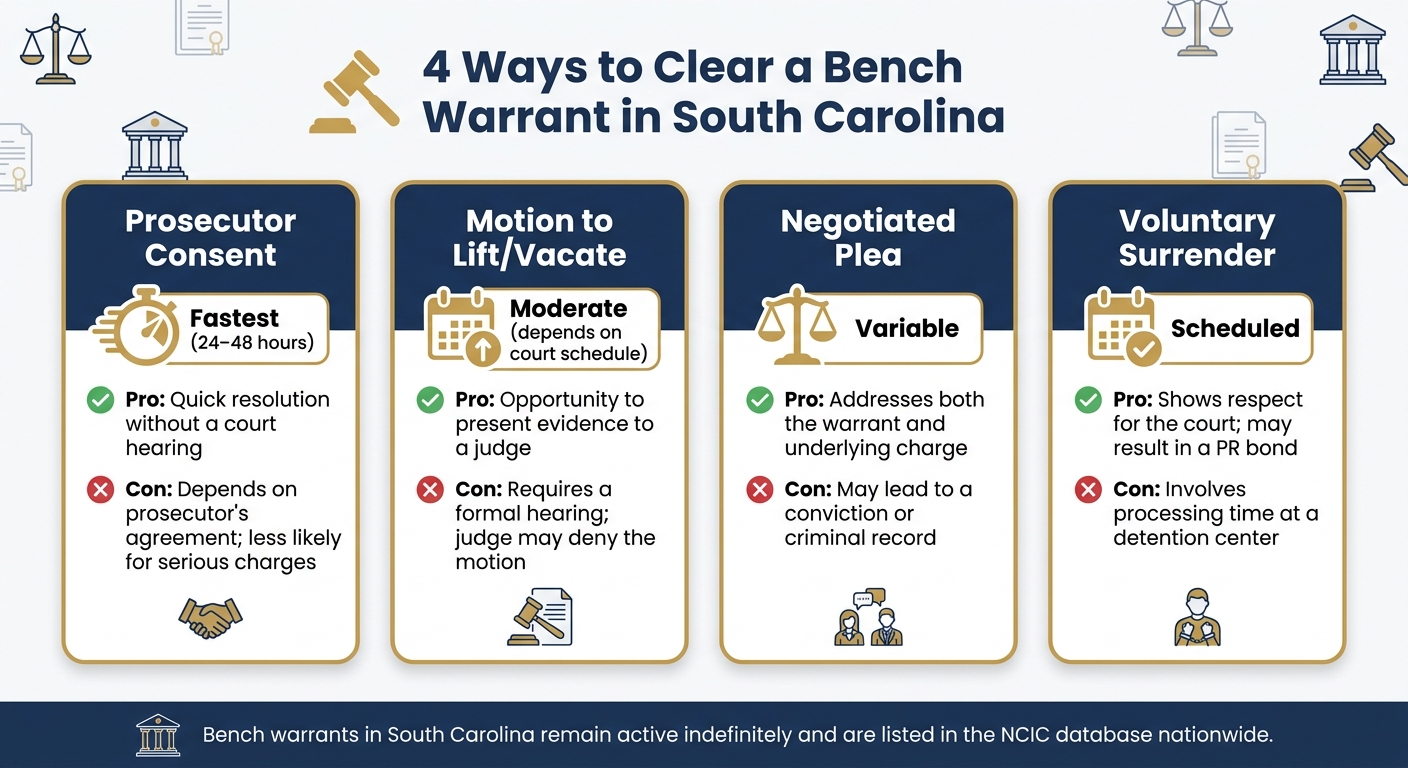
4 Ways to Clear a Bench Warrant in South Carolina
If you’re facing an active bench warrant, the steps to resolve it depend largely on your situation. Factors like the charges against you, the prosecutor’s cooperation, and how quickly you need the matter resolved all play a role. Here’s what you need to know.
The Fastest Ways to Resolve a Bench Warrant
The quickest way to handle a bench warrant is by securing the prosecutor’s consent. In this approach, your attorney contacts the prosecutor, explains the circumstances, and requests the warrant’s removal. This process can often be completed within 24–48 hours, requiring only a judge’s signature on a consent order – no court hearing needed.
However, if the prosecutor doesn’t agree, the next step is filing a motion and scheduling a court hearing. As Charleston criminal defense attorney Dale Savage explains:
"If the prosecutor or the clerk of court is not willing to [consent], then the only other option that you have available is to have your attorney file a motion, and then the court will set that hearing."
Here’s a breakdown of four common resolution methods:
| Method | Speed | Pros | Cons |
|---|---|---|---|
| Prosecutor Consent | Fastest (24–48 hours) | Quick resolution without a court hearing | Depends on prosecutor’s agreement; less likely for serious charges |
| Motion to Lift/Vacate | Moderate (depends on court schedule) | Opportunity to present evidence to a judge | Requires a formal hearing; judge may deny the motion |
| Negotiated Plea | Variable | Addresses both the warrant and underlying charge | May lead to a conviction or criminal record |
| Voluntary Surrender | Scheduled | Shows respect for the court; may result in a PR bond | Involves processing time at a detention center |
It’s important to note that bench warrants in South Carolina remain active indefinitely until revoked by a judge. They’re listed in the NCIC database, which means a warrant issued years ago can still lead to an arrest during a routine traffic stop.
Once a resolution method is chosen, the next step is preparing strong evidence to support your case.
Preparing Evidence for Court
Having solid evidence is critical when explaining why you missed your court appearance. Whether your attorney files a motion or negotiates a plea, documentation is key to convincing the court.
"Your attorney may be able to get you excused from your court appearance, but we also may need written documentation – confirmation that you are in the hospital or a doctor’s note showing that you are COVID positive, for example." – Kent Collins, Criminal Defense Lawyer
Here are some of the most helpful documents you can provide:
- Medical records or hospital discharge papers if a health emergency prevented your appearance.
- Proof of address change to show court notices were sent to an outdated location.
- Detention records from another jurisdiction if you were in custody elsewhere on your court date.
- Accident reports or emergency documentation for unexpected events.
- Proof of payment or financial hardship records if the warrant is tied to unpaid fines.
Gathering these documents before meeting with your attorney can streamline the process and improve your chances of resolving the warrant without jail time. Strong preparation is essential to moving forward effectively.
What Happens After the Warrant Is Lifted
Once you’ve gathered your evidence, the focus shifts to resolving the case and ensuring you don’t face similar issues again. Keep in mind, lifting a bench warrant only cancels the arrest order – it doesn’t erase the original charges.
Resolving the Original Case
After the warrant is lifted, the court will set a new hearing date. Missing this rescheduled date can lead to another warrant, putting you right back where you started. Additionally, if there’s a Failure to Appear (FTA) charge, that must be addressed separately. According to S.C. Code § 17-15-90, intentionally missing court is considered a criminal offense. A misdemeanor FTA could mean fines up to $1,000 and up to a year in jail, while a felony FTA could carry fines up to $5,000 and as much as five years in jail.
The case tied to the original charges remains unresolved until it’s dealt with through a plea agreement, dismissal, or trial. The judge might also require you to take steps like paying overdue fines, attending a program (e.g., a driving safety course or AA meetings), or proving that an issue – like a suspended license – has been fixed.
"Resolving the root cause of the warrant is essential to avoid future issues." – James R. Snell, Jr., Criminal Defense Attorney
Once your current case is handled, taking steps to prevent future warrants becomes your next priority.
How to Avoid Future Warrants
The best way to avoid future warrants is to maintain regular communication with your attorney. Courts in South Carolina can be tricky to navigate. For instance, Lexington County has more independent criminal courts than any other county in the state. This means showing up in one court doesn’t necessarily fulfill your obligations in another. Your attorney will keep track of these details so you don’t have to.
Another key step is to update your mailing address with both the Clerk of Court and your attorney as soon as you move. Many warrants are issued simply because defendants never received court notices. Make sure to track all court dates – whether it’s a roll call, arraignment, or sentencing hearing – and set multiple reminders. If an emergency prevents you from attending, contact your attorney immediately so they can request a continuance on your behalf. Don’t rely on verbal confirmations that a court date has been canceled; always get written confirmation through your lawyer.
"Your attorney is your lifeline. The clerk of court’s loyalty is to the court, not you. The prosecutor is there to prosecute you and will not hesitate to put you in jail." – Templeton Mims & Ward
Conclusion: Protecting Your Rights and Freedom
Bench warrants don’t expire – they stay active indefinitely in the NCIC database, making them accessible to law enforcement across the country. Ignoring one only worsens the situation. Delays can be seen as intentional avoidance, which may make judges or prosecutors less inclined to lift the warrant.
Partnering with a skilled South Carolina bench warrant lawyer can make a big difference. An attorney can confirm which court issued the warrant and negotiate with the prosecutor to have it vacated. This proactive legal strategy ensures your future court appearances are handled properly.
"Without a lawyer taking action, someone can remain in jail for weeks, months, or longer with no progress in their case." – Law Office of James R. Snell, Jr., LLC
It’s crucial to avoid contacting the court yourself. By allowing your attorney to handle all communications, you protect your rights and set the stage for a smoother resolution.
FAQs
How can I find out if I have a bench warrant in South Carolina?
To find out if there’s an active bench warrant in South Carolina, you can start by checking online databases. Some county sheriff’s offices provide this information, and the South Carolina Judicial Branch also offers a case records search. Another option is to contact the local Clerk of Court or sheriff’s department directly for assistance. However, the most secure route is consulting a criminal defense attorney. They can verify the warrant and advise you on how to proceed without exposing you to the risk of immediate arrest.
Will a bench warrant show up on a background check or affect my job?
A bench warrant is a legal order that authorizes law enforcement to arrest you at any time, even at your workplace. While it might not show up on every standard background check, it is a public record that police can access. This means you face a higher chance of being arrested during routine interactions with law enforcement, which could put both your job and personal freedom at risk.
What should I avoid doing if I think I have an active warrant?
If you think there’s an active bench warrant against you, it’s critical not to ignore it – it won’t just disappear over time. Avoid reaching out to the Clerk of Court or Solicitor’s Office directly, as this could result in an immediate arrest. Also, don’t rely on assumptions about court date changes unless they’ve been officially confirmed. Your best course of action? Reach out to a criminal defense attorney as soon as possible. They can handle communication on your behalf and help create a solid legal plan.