


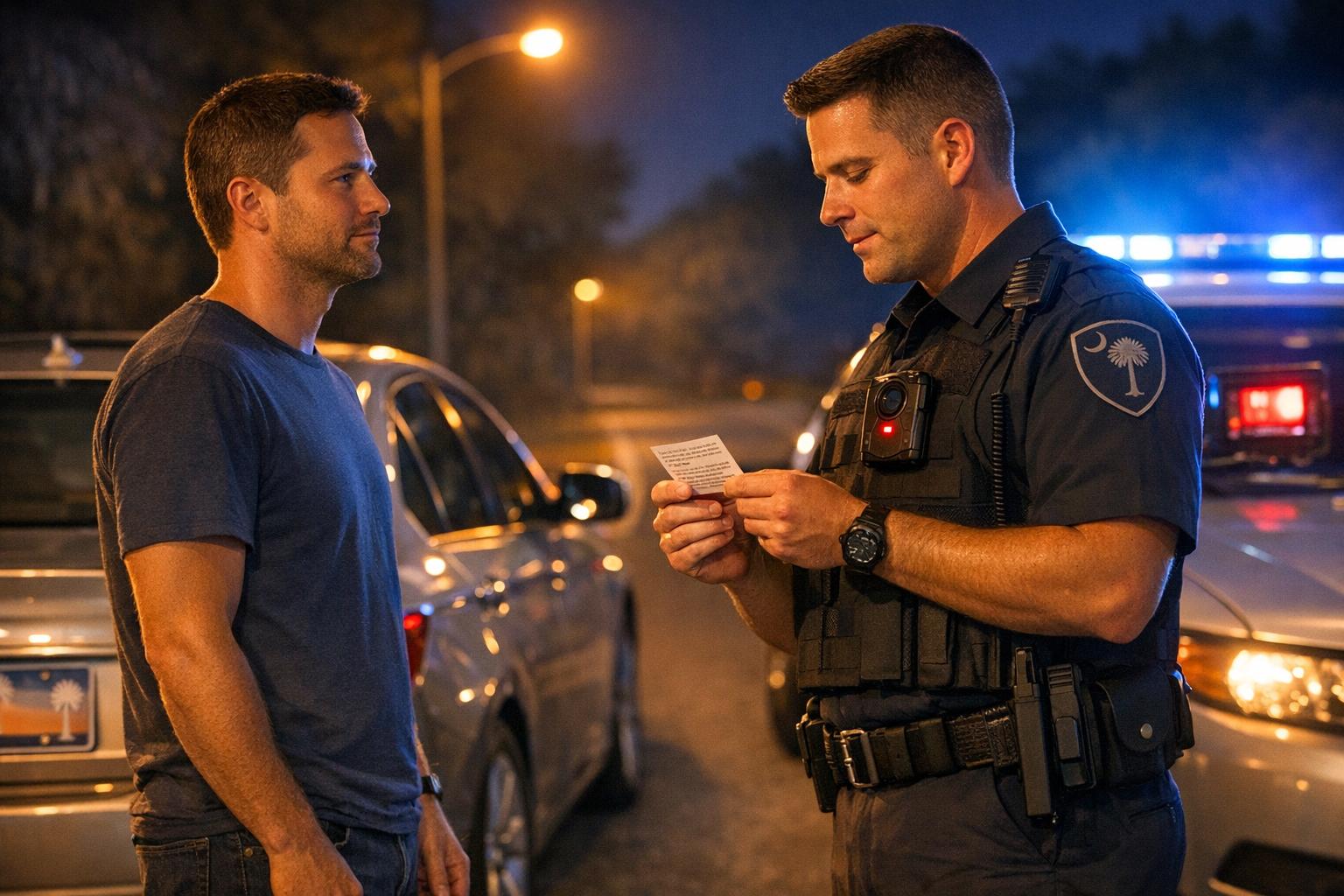
When you’re arrested, knowing your Miranda Rights is critical. These rights protect you from self-incrimination and ensure access to legal counsel during police questioning. Originating from the 1966 Supreme Court case Miranda v. Arizona, they include:
- The right to remain silent: You don’t have to answer questions, and anything you say can be used against you.
- The right to an attorney: You can request a lawyer, and if you can’t afford one, the court may appoint one.
- Protections during interrogation: Police must stop questioning if you invoke your rights.
In South Carolina, Miranda Rights apply during custodial interrogation – when you’re in custody and being questioned. Violations can lead to suppression of your statements in court, but other evidence may still be used. Always ask, “Am I free to go?” to clarify your status, and if in doubt, invoke your rights by stating, “I want my attorney.”
The 4 Parts of Miranda Rights

The 4 Parts of Miranda Rights Explained
When law enforcement reads your Miranda Rights, the warning is meant to safeguard your constitutional protections during police questioning. It covers four key elements.
The Right to Remain Silent
This right, based on the Fifth Amendment, shields you from self-incrimination. You are not obligated to answer questions from law enforcement, aside from providing basic identifying details like your name. Choosing to remain silent ensures that your words cannot be twisted or used against you. Skilled interrogators might attempt to manipulate even minor errors to suggest guilt.
Bobby Frederick, a criminal defense attorney at Axelrod & Associates, offers a straightforward way to invoke this right:
I want my attorney
Once you clearly state this, officers must stop questioning immediately. You can assert this right at any time, even if you’ve already started answering questions. Exercising your right to remain silent is a legal protection, not an indication of guilt.
Anything You Say Can Be Used Against You
This warning emphasizes the consequences of speaking during an interrogation. Anything you say – whether it’s a formal statement or an offhand remark – can be presented as evidence against you in court. Even small inconsistencies, nervous missteps, or casual comments can be scrutinized.
Rad S. Deaton, a criminal defense lawyer in North Charleston, explains:
Once you make a statement having waived your Miranda rights, you cannot take it back. The cat is already out of the bag…
In South Carolina, police are allowed to use deceptive tactics, such as pretending they have evidence against you, to encourage you to talk. Additionally, if you volunteer information without prompting, those statements may still be admissible – even if you haven’t been read your Miranda Rights. Many DUI cases, for example, involve roadside interactions that are recorded on video, making any remarks part of the official evidence.
The Right to an Attorney
Another crucial protection is your right to legal counsel. You are entitled to consult with an attorney and have them present during any custodial questioning. To invoke this right, clearly state, "I choose to remain silent and want a lawyer." Once you do, police must stop questioning until your attorney is present. Avoid further conversation, as anything you say could be seen as waiving your rights.
If you’re taken into custody, you also have the right to contact a lawyer and access legal counsel while detained. However, the Miranda warning doesn’t guarantee an attorney will be immediately available during questioning – it simply ensures that questioning stops until you can consult one. If you’re unsure whether you’re officially "in custody", ask the officer, "Am I free to go?"
Free Attorney if You Cannot Afford One
In South Carolina, your right to legal counsel extends to those who cannot afford it, but court-appointed attorneys are not automatically provided for every charge. Free legal representation is only available if the charges could result in jail time and you lack the financial means to hire a private attorney. The Shealey Law Firm explains:
For the right to appointed counsel, the case must be likely to result in jail time, and you must be unable to afford your own attorney
If you don’t have an attorney at your first court appearance or arraignment, inform the judge that you cannot afford one and need a court-appointed attorney. For offenses eligible for bail, you’ll typically appear in court within 24 hours of your arrest, providing an important opportunity to request legal representation. While you can always hire a private lawyer, a free attorney will only be provided if you meet specific financial criteria and the charges carry potential jail time.
sbb-itb-ce0cbb0
When Police Must Read Miranda Rights in South Carolina
What Is Custodial Interrogation?
In South Carolina, police are only required to read your Miranda Rights when two conditions are met: you are in custody and you are being interrogated. This situation is referred to as custodial interrogation. Rad S. Deaton, a criminal defense attorney based in North Charleston, explains:
In order for you to be in custody, the circumstances must be such that you reasonably believe you are not free to leave. In order for questioning to constitute an interrogation, the questions must be targeted toward investigating an alleged crime.
Essentially, interrogation involves police questioning aimed at gathering evidence or eliciting incriminating responses – not routine inquiries like asking for your name or address. Importantly, officers are not obligated to read your rights at the moment of arrest. Miranda Rights come into play only when they plan to question you while you’re in custody. Bobby Frederick, a criminal defense lawyer at Axelrod & Associates, highlights this distinction:
Miranda has nothing to do with arrest and is only required when law enforcement intends to question a suspect while the suspect is in custody.
This distinction clarifies the difference between custodial questioning and voluntary interactions, which is essential for understanding your rights.
Custody vs. Voluntary Police Encounters
Determining whether you’re in custody is crucial when assessing if Miranda Rights apply. You’re considered in custody when your freedom is restricted to the point where it feels like an arrest. For example, being handcuffed or placed in a jail cell clearly qualifies as custody. On the other hand, speaking with an officer at your front door or voluntarily visiting the police station for questioning typically does not.
If you’re uncertain about your status, ask the officer directly: "Am I free to go?" If they say yes, you can leave; if they say no, you’re likely in custody, and Miranda warnings should be provided before any questioning. In contrast, voluntary interactions – where you can end the conversation at any time – don’t require Miranda warnings. Additionally, if you offer information without being prompted, those statements can still be used against you, even if you weren’t read your rights.
How South Carolina Applies Miranda Rights
South Carolina uses the same basic two-part test for Miranda as the rest of the country but has specific rules for DUI cases. According to South Carolina Code § 56-5-2953, officers must video record DUI arrests, ensuring the recording includes both audio and video of the suspect receiving their Miranda warning at the roadside. Historically, South Carolina courts dismissed DUI charges if officers failed to meet this requirement.
However, in February 2022, the South Carolina Supreme Court altered this approach in State v. Kenneth Taylor. The Court ruled that while the statute requires Miranda warnings to be recorded on video, failure to do so no longer automatically leads to dismissal of the DUI charge. Instead, any statements obtained illegally may be suppressed as evidence. For other criminal cases in South Carolina, a violation of Miranda typically results in the exclusion of statements made during the improper interrogation. However, evidence gathered independently of those statements may still be admissible.
These state-specific practices demonstrate how Miranda Rights operate as a safeguard under South Carolina law while also reflecting the nuances of local legal procedures.
How to Invoke or Waive Your Miranda Rights
How to Clearly Assert Your Rights
If you’re in custody and being questioned, it’s crucial to clearly state your rights. Rad S. Deaton, a South Carolina criminal defense attorney, stresses that your assertion must be crystal clear. Courts might interpret vague statements – or silence – as consent to continue speaking.
Use straightforward phrases like "I want my attorney" or "I am exercising my right to remain silent." Bobby Frederick from Axelrod & Associates advises:
You should say nothing more or less than, ‘I want my attorney’.
Avoid uncertain phrases such as "Maybe I should talk to a lawyer" or "I don’t think I should say anything." These can be seen as unclear and may not activate the legal protections you need.
You can invoke your rights at any time – even if you’ve already started answering questions or signed a waiver. The moment you clearly state that you want an attorney or choose to remain silent, law enforcement must immediately stop questioning you. After asserting your rights, stop talking altogether. Futeral & Nelson, LLC reminds individuals:
Remember, this is your legal right, and there is NOTHING uncooperative about using it!
Asserting your rights is critical to protecting yourself, while waiving them can lead to serious consequences.
What Happens When You Waive Your Rights
Waiving your Miranda Rights means agreeing to speak with the police without an attorney, which can expose you to serious risks. In South Carolina, a valid waiver must be made "knowingly and voluntarily". "Knowingly" means you fully understand your rights and the implications of giving them up, while "voluntarily" means your choice wasn’t influenced by coercion, threats, or deception from law enforcement. Courts in South Carolina evaluate this using a "totality of the circumstances" test, which considers factors like your age, education, mental state, and how the police conducted the interrogation.
Once you waive your rights, anything you say can – and likely will – be used against you in court. Rad S. Deaton explains:
The cat is already out of the bag, and, if you said something, the prosecutor’s office could use against you, it most likely would be used against you at trial.
Even comments that aren’t outright confessions can still provide evidence, lead to new investigative paths, or be used to challenge your credibility later. This makes your defense attorney’s job much harder. Futeral & Nelson, LLC cautions:
Talking to law enforcement will only get you into more trouble.
The best course of action? Ask for an attorney immediately and let them handle any communication with the police.
What Happens When Police Violate Miranda Rights in South Carolina
Excluding Statements Obtained Illegally
When police violate your Miranda rights in South Carolina, the main legal response is the suppression of any statements you made during the violation. In other words, those statements can’t be used as evidence in court. This highlights the critical role Miranda protections play in safeguarding your constitutional rights. However, it’s important to note that suppressing statements doesn’t automatically mean your case is dismissed. Prosecutors can still proceed if they have other evidence, such as witness accounts, physical items, or video footage of your actions.
South Carolina courts take Miranda violations seriously, particularly when deceptive tactics are involved. For instance, in April 2024, the South Carolina Supreme Court overturned Randy Collins’s arson conviction. This decision came after SLED Senior Agent Scott Hardee falsely assured Collins during an interrogation, saying, "Whatever you tell me, it ain’t gonna leave this room." Even though Collins had been read his Miranda rights, the false promise made his statement involuntary and inadmissible. Chief Justice Beatty explained:
A false assurance of confidentiality from law enforcement is inherently coercive because it interferes with a layperson’s ability to make a fully informed decision whether to engage in an interview.
South Carolina Court Cases on Miranda Violations
South Carolina courts have established firm guidelines for handling Miranda violations, emphasizing the importance of clear warnings and proper procedures during interrogations. A noteworthy case is State v. Kenneth Taylor, decided in February 2022. This DUI case from Spartanburg County involved Lance Corporal R.B. Thornton, who recorded the audio of Miranda warnings but failed to activate his in-car camera to visually capture the exchange. The state Supreme Court clarified that South Carolina’s DUI videotape law (SC Code § 56-5-2953) requires Miranda warnings to be both audible and visible on video.
The Court ruled that the appropriate remedy for such violations is suppression of the statements, not automatic dismissal of charges. Justice James explained:
Just as is proper when there is a Miranda violation in any other kind of case, suppression of tainted evidence – not per se dismissal of the DUI charge – is the proper remedy.
South Carolina also adheres to the precedent set by Missouri v. Seibert, which prohibits police from questioning a suspect without Miranda warnings, obtaining a confession, and then reading the rights later to get the suspect to repeat the earlier statements. In State v. Hill, officers violated this rule by securing a confession without Miranda warnings and then moving the suspect to another room to record a second confession after reading the rights. The court suppressed both statements and overturned Hill’s convictions.
When Other Evidence Can Still Be Used
Even if your statements are suppressed due to a Miranda violation, prosecutors can still rely on independent evidence, such as physical items, witness testimony, or surveillance footage, as long as it wasn’t obtained through the violation. For example, spontaneous statements you make without police prompting remain admissible because they aren’t considered part of a custodial interrogation. Similarly, Miranda protections don’t apply if you weren’t actually in custody during the questioning.
In DUI cases, South Carolina law mandates that officers record specific events, including the activation of blue lights, field sobriety tests, the arrest, and Miranda warnings. In State v. Gregg Gerald Henkel (July 2015), the Supreme Court upheld a DUI conviction despite the initial absence of recorded Miranda warnings. The suspect had been in an ambulance receiving treatment, and the court ruled that under SC Code § 56-5-2953(B), recording must begin as soon as it becomes "practicable".
While Miranda violations can lead to the exclusion of your statements, prosecutors will use any remaining admissible evidence to build their case and pursue a conviction.
South Carolina Miranda Rights Rules and Case Examples
Police Deception and Forced Confessions
South Carolina courts set clear boundaries on what police can and cannot say during interrogations. For instance, officers are allowed to falsely claim they have evidence – like fingerprints, DNA, or eyewitness accounts. However, they are strictly prohibited from misleading individuals about the law or their constitutional rights. One key example is when officers make false promises of confidentiality, such as assuring someone that their statements will remain private. This tactic is treated differently from other forms of deception because it undermines a person’s ability to make an informed decision about whether to speak up during questioning.
When evaluating whether a confession was coerced, South Carolina courts look at several factors, including a person’s age, education, mental capacity, physical condition, and the length of the interrogation. The central question is whether these circumstances compromised the individual’s ability to make a voluntary decision.
This nuanced approach highlights how South Carolina’s standards differ from the broader federal framework.
Federal vs. South Carolina Miranda Standards
Although South Carolina follows the federal Miranda framework, the state imposes additional requirements, especially in DUI cases. A major distinction is the state’s video recording mandate. According to SC Code § 56-5-2953, officers must ensure that both themselves and the suspect are clearly visible and audible on camera while reading Miranda rights during a DUI arrest. Simply recording audio is not enough – both the officer and suspect must be seen and heard during the advisement.
Here’s a breakdown of how South Carolina’s rules compare to federal standards:
| Feature | Federal Miranda Standard | South Carolina Specific Rule |
|---|---|---|
| DUI Video Requirement | No federal requirement for video recording. | Officers must record both video and audio showing the reading of rights per SC Code § 56-5-2953. |
| Police Deception | Permitted, such as lying about evidence, as long as the statement is voluntary. | False promises of confidentiality are considered coercive and invalidate Miranda warnings. |
| Remedy for Miranda Violation | Statements or evidence may be suppressed. | Statements are suppressed; for DUI video violations, remedies align with federal standards. |
| Waiver Standard | Must be "knowing and voluntary" based on all circumstances. | Must be "knowing and voluntary"; misleading legal assurances violate due process. |
Chief Justice Beatty emphasized the danger of false assurances of confidentiality, stating:
A false assurance of confidentiality from law enforcement is inherently coercive because it interferes with a layperson’s ability to make a fully informed decision whether to engage in an interview.
Conclusion
Knowing your Miranda Rights is essential for protecting yourself from self-incrimination during encounters with law enforcement. The words you say can quickly become evidence against you in court.
Choosing to remain silent isn’t about being uncooperative – it’s about using a constitutional right designed to protect you from coercive interrogation. As Futeral & Nelson, LLC puts it:
There is NOTHING uncooperative about using [your legal right to remain silent]
It’s important to note that a Miranda violation doesn’t mean your case will automatically be dismissed. Instead, any statements obtained illegally may be suppressed, but prosecutors can still pursue charges using other evidence.
Interrogations are often designed to elicit confessions. Even innocent mistakes or nervous comments can be twisted and used against you in court. Having legal representation early on can sometimes stop charges from being filed altogether or help challenge improper interrogation tactics before trial.
These rights exist to protect you during what can be one of the most intimidating interactions with law enforcement. As discussed earlier, Miranda Rights aim to address the power imbalance inherent in custodial interrogations, ensuring your constitutional protections remain intact.
Using these rights isn’t an admission of guilt – it’s a smart legal move, one that judges and law enforcement understand. If you’re arrested in South Carolina, your best course of action is to stay silent and immediately ask for an attorney.
FAQs
Should I talk to police before my lawyer arrives?
It’s always a good idea to wait for your lawyer before talking to the police. Using your right to remain silent and having legal counsel by your side can help safeguard your rights and prevent you from saying something that could hurt your case. Make sure to lean on these protections to stay on solid ground during any questioning.
What counts as “custody” for Miranda in South Carolina?
In South Carolina, "custody" for Miranda purposes refers to either being formally arrested or being restrained in a manner that resembles an arrest. If a reasonable person in the same circumstances would not feel free to leave, law enforcement is required to read Miranda rights before conducting any interrogation.
What should I do if police didn’t read my rights?
If the police didn’t read you your Miranda rights, don’t panic – you still have legal protections. You’re under no obligation to answer questions or speak without an attorney present. If the police neglected to inform you of these rights during a custodial interrogation, any statements you made could potentially be ruled inadmissible in court. It’s crucial to consult a criminal defense attorney who can review your situation and determine if your rights were violated, as well as how it might impact your case.