



Facing theft charges in Spartanburg County can significantly impact your life. In South Carolina, theft is classified as larceny, with penalties depending on the value of the stolen property. Here’s what you need to know:
- Petit Larceny (Misdemeanor): For property valued at $2,000 or less. Penalties include up to 30 days in jail and fines up to $1,000.
- Grand Larceny (Felony): For property over $2,000. Sentences range from 5 to 10 years in prison, depending on the value.
- Types of Offenses: Includes shoplifting, receiving stolen goods, breach of trust, and obtaining property by false pretenses.
- Court Process: Misdemeanors are handled in Magistrate or Municipal Courts, while felonies go to General Sessions Court.
- Long-Term Effects: A conviction can limit job opportunities, housing, and professional licenses and may carry other restrictions like firearm ownership or immigration consequences.
Defense strategies focus on challenging intent, mistaken identity, or evidence collection. Acting quickly and consulting an attorney can help reduce charges or explore alternatives like pretrial diversion programs. Juvenile cases are handled differently, often emphasizing rehabilitation over punishment.
For legal assistance, contact Brendan M. Delaney Law Firm LLC for a free consultation and tailored defense strategies.
How South Carolina Law Defines Theft Charges

What Counts as Theft in South Carolina
In South Carolina, theft is legally referred to as "larceny".
"unlawful taking of property that belongs to another person, done with the intent to permanently deprive that person of the property." – David R. Price, Jr., Attorney
The key point here is intent. Prosecutors must demonstrate that the accused planned to permanently take the property away from its rightful owner – not simply borrow it.
Common Types of Theft Offenses
South Carolina law recognizes several theft-related crimes, each with distinct legal criteria.
- Shoplifting: This involves more than just taking items from a retail store. Actions like changing price tags or swapping containers also count as shoplifting.
- Receiving Stolen Goods: Knowingly possessing stolen property can lead to charges under this offense.
- Breach of Trust with Fraudulent Intent: Similar to embezzlement, this occurs when someone in a position of trust misuses funds or property they were entrusted with.
- Obtaining Property by False Pretenses: This involves using deception to acquire someone else’s property.
Each type of offense has specific legal requirements and plays a role in determining how a case is classified and prosecuted.
How Theft Cases Move Through Spartanburg County Courts
The classification of a theft charge determines how it progresses through the court system in Spartanburg County. Law enforcement files charges based on the value of the property involved.
- Magistrate or Municipal Courts: These courts handle misdemeanor cases, such as petit larceny or minor shoplifting offenses, where the property value is $2,000 or less. Cases here are typically resolved faster and come with lighter penalties.
- General Sessions Court: Felony cases, including grand larceny and serious shoplifting offenses, are heard here. This court handles cases involving property valued above $2,000. Proceedings are more formal and may include grand jury reviews, with the potential for more severe sentences.
The classification of theft offenses not only determines the court process but also impacts the penalties, which are explored in the next section.
Penalties for Theft Convictions
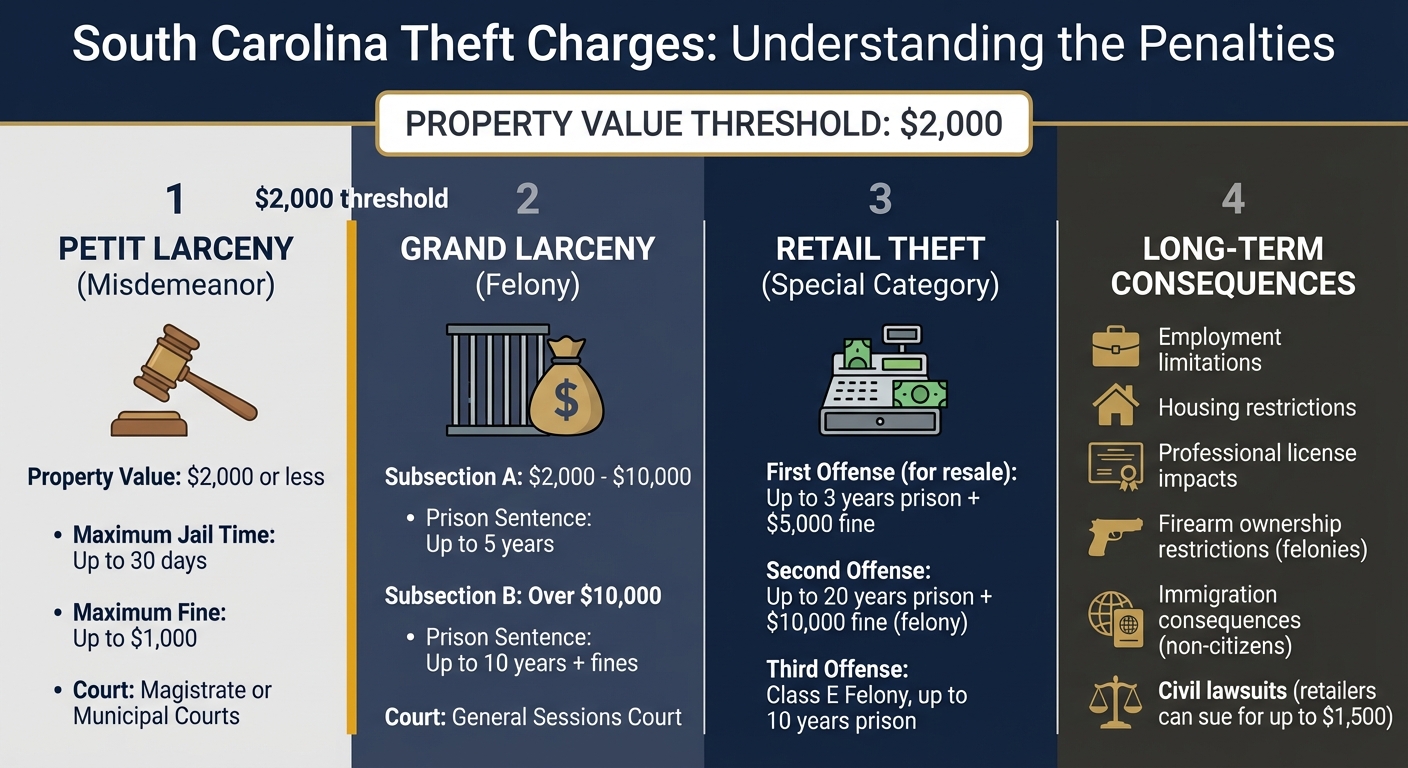
South Carolina Theft Charges: Penalties by Property Value
Misdemeanor vs. Felony Theft Charges
In South Carolina, theft charges are determined by the value of the stolen property. If the property is worth $2,000 or less, the offense is classified as petit larceny, a misdemeanor punishable by up to 30 days in jail and fines of up to $1,000. However, theft of property valued over $2,000 is considered grand larceny, which is a felony with much stricter penalties. According to the South Carolina Code:
"Larceny of goods, chattels, instruments, or other personalty valued in excess of two thousand dollars is grand larceny. Upon conviction, the person is guilty of a felony."
How Property Value Affects Your Sentence
The specific value of the stolen property plays a key role in determining the severity of the punishment. For property valued between $2,000 and $10,000, a grand larceny conviction can lead to a prison sentence of up to 5 years. If the value exceeds $10,000, the potential prison term increases to 10 years, along with possible fines.
Retail theft has its own set of rules: If someone steals items for the purpose of resale, even a first-offense misdemeanor can result in up to 3 years in prison and fines as high as $5,000. For a repeat offense, the charge is typically upgraded to a felony, carrying penalties of up to 20 years in prison and fines reaching $10,000. A third conviction is treated as a Class E felony, with enhanced consequences and a maximum prison term of 10 years.
Long-Term Effects of a Theft Conviction
The consequences of a theft conviction extend far beyond the immediate penalties. A criminal record can permanently affect employment opportunities, housing options, and even the ability to volunteer. Felony convictions come with additional restrictions, such as losing the right to own firearms or, in some cases, to vote. Non-citizens may face immigration-related challenges, including deportation, as a result of a theft conviction.
Moreover, civil lawsuits can add another layer of financial burden. Retailers may sue to recover the value of the stolen goods, often capped at $1,500, along with possible additional penalties. For cases involving minors, parents or guardians may be held accountable for these damages. These long-term repercussions highlight the importance of understanding your rights and the potential impact of a theft conviction in Spartanburg County.
How to Defend Against Theft Charges in Spartanburg County
When facing theft charges, understanding the potential penalties is just the beginning. Crafting a solid defense strategy is essential to protecting your rights and ensuring the best possible outcome.
Defense Strategies That Work in Theft Cases
A strong defense in theft cases hinges on the prosecution’s burden of proof. In South Carolina, prosecutors must show that you intended to permanently deprive the owner of their property. This intent is a key element of theft charges, and challenging it can be a powerful defense. For instance, if the situation involved accidental taking, a misunderstanding at checkout, or plans to return the items, these circumstances could undermine the claim of intent. As attorney David R. Price, Jr. explains:
"If you can prove you took property from someone with the intent of returning it, you will not be convicted of larceny." – David R. Price, Jr., Attorney, David R. Price, Jr., P.A.
Another common defense is mistaken identity. Surveillance footage can be grainy or unclear, and eyewitness accounts are often unreliable. Your attorney can scrutinize the evidence to determine whether it truly identifies you as the person responsible. Additionally, the legality of evidence collection matters. If the police violated your constitutional rights during the investigation – such as conducting an illegal search – your attorney can argue to have that evidence excluded.
The value of the property is another critical factor. Whether the charge is a misdemeanor or a felony depends on the property’s worth. If you can prove the item’s value was less than $2,000, you may face reduced charges. Similarly, showing that you had permission or authorization to use or move the property – or that the alleged victim lacked a valid claim to it – can also weaken the prosecution’s case. Pairing these strategies with a strong understanding of your legal rights can make a significant difference in your defense.
Your Legal Rights When Accused of Theft
When you’re accused of theft in Spartanburg County, several constitutional protections are in place to ensure a fair legal process.
- You have the right to remain silent. Anything you say can be used against you, so it’s often best to wait until you’ve consulted an attorney before speaking to law enforcement.
- You have the right to an attorney. If you cannot afford one, the court will appoint a public defender to represent you.
- You have the right to a jury trial. The prosecution must prove every part of the theft charge beyond a reasonable doubt.
- You have the right to challenge evidence and witnesses. This includes questioning witness credibility, pointing out inconsistencies in testimony, and identifying issues with how evidence was handled.
The prosecution must establish both your intent to steal and the specific value of the property in question. By working with a defense attorney early, you can identify procedural errors or weaknesses in the state’s case, potentially leading to reduced charges or even dismissal. While these rights apply primarily to adults, the process is different for minors.
How Juvenile Theft Cases Are Handled Differently
In Spartanburg County, minors accused of theft are typically dealt with in Family Court, which focuses on rehabilitation rather than punishment. Juvenile cases are handled through "delinquency proceedings", where the court determines whether the minor is "delinquent" instead of "guilty." A key difference from adult cases is that juveniles do not have the right to a jury trial; instead, a Family Court judge decides the case.
The South Carolina Department of Juvenile Justice (DJJ) evaluates each case and provides recommendations. Family Court often emphasizes rehabilitation, offering diversion programs that can result in dismissed charges upon successful completion. Juvenile records are not public and may be eligible for expungement after penalties are fulfilled. Additionally, parents are kept informed of the proceedings and may need to participate in counseling or reimburse the state for legal representation.
Understanding these differences is crucial for navigating the legal system effectively, whether the accused is an adult or a minor. Working closely with an attorney ensures the best chance of a favorable outcome.
sbb-itb-ce0cbb0
Why Choose Brendan M. Delaney Law Firm LLC

Experience with Spartanburg County Courts
When dealing with larceny charges in Spartanburg County, having an attorney who understands the local legal system can make all the difference. Brendan M. Delaney has been practicing law since 2000, bringing over two decades of experience to clients throughout the Upstate region. Conveniently located at 184 N. Daniel Morgan Ave., the firm is just steps away from the courthouse. This proximity reflects a deep familiarity with court processes, including bond hearings, preliminary hearings, arraignments, and plea negotiations.
Local expertise isn’t just a convenience – it’s a critical part of building a strong defense.
Defense Plans Built Around Your Case
Brendan M. Delaney doesn’t rely on cookie-cutter strategies. Instead, he develops a defense plan tailored to the unique details of your case. This starts with a thorough review of your situation, using detailed questioning to uncover every relevant fact.
"Brendan initiates the journey by asking insightful questions about your case, fostering an environment where you feel comfortable and supported, laying the foundation for effective legal representation." – Brendan M. Delaney Law Firm LLC
This personalized approach ensures that every defense strategy is centered on the presumption of innocence. Whether it’s challenging evidence, questioning witness reliability, or exposing weaknesses in the state’s case, every angle is explored. Depending on the specifics, the defense might focus on proving a lack of intent, mistaken identity, or other key factors. The firm also addresses practical concerns, such as how a larceny charge could impact your employment or appear on SLED background checks.
What to Bring to Your First Meeting
To make the most of your initial consultation, bring all relevant documents, including court paperwork (arrest records, bond hearing notices, preliminary hearing documents, police reports) and detailed information about the incident – dates, times, locations, and circumstances. If the charge could affect your job or professional licensing, include related employment or licensing documents.
The firm provides a free initial consultation, offering a supportive space to discuss your case. Arriving prepared not only helps streamline the meeting but also strengthens the foundation for building your defense.
Conclusion
Theft charges in Spartanburg County come with harsh consequences that can ripple through every aspect of your life. Beyond fines and potential jail time, a conviction can leave a lasting mark on your record, affecting job opportunities, professional licenses, and even certain constitutional rights.
It’s important to note that prosecutors can pursue charges even if the alleged victim decides they no longer want to move forward with the case. Acting early by seeking legal help can make a big difference. Early intervention enables a detailed review of the evidence, uncovers possible procedural mistakes, and helps craft strategies that could lead to dismissal or participation in a pretrial diversion program.
South Carolina’s larceny laws can be complex, and tackling them without skilled legal guidance can be overwhelming. Knowing your rights and understanding the options available to you is essential for protecting your future.
For a free consultation and a defense plan tailored to your situation, contact Brendan M. Delaney Law Firm LLC.
Don’t wait – take the first step to protect your rights and explore all possible defense strategies. Call Brendan M. Delaney Law Firm LLC today.
FAQs
Can my theft charge be reduced from a felony to a misdemeanor?
Yes, in South Carolina, it’s possible for theft charges to be reduced from a felony to a misdemeanor in certain situations. The key factor is often the value of the stolen property. For instance, if the property is valued at less than $2,000, the charge is generally classified as a misdemeanor. Additionally, the specifics of the case and any mitigating circumstances can play a role in negotiating a lesser charge. Working with an experienced attorney can help you understand your options and ensure your rights are protected.
What should I do right after a theft arrest in Spartanburg County?
If you’re arrested for theft in Spartanburg County, your first step should be to reach out to an experienced criminal defense attorney. They can help safeguard your rights and start building a solid defense strategy. It’s crucial to exercise your right to remain silent – don’t discuss the case with law enforcement until you have legal representation. Share any details or evidence you have with your attorney and follow their advice closely throughout the legal process to give yourself the best chance at a favorable outcome.
Can a theft charge be dismissed if the victim drops it?
In South Carolina, a theft charge doesn’t simply vanish if the victim decides to drop it. The authority to pursue or dismiss charges rests with the prosecutor, not the victim. Prosecutors review the case on its own merits and can choose to move forward with prosecution, even if the victim no longer wants to be involved.