




Facing criminal charges in Spartanburg County? Here’s what you need to know: the criminal process involves several stages, each crucial to the outcome of your case. These include:
- Investigation and Arrest: Law enforcement gathers evidence and establishes probable cause.
- Bond Hearing: Determines if you stay in jail or are released before trial.
- Preliminary Hearing: A judge reviews if there’s enough evidence to proceed.
- Initial Appearance: Sets the timeline for your case and confirms legal representation.
- Pretrial Negotiations and Arraignment: Includes plea discussions and formal responses to charges.
- Trial and Sentencing: If unresolved, the case moves to trial, where guilt must be proven beyond a reasonable doubt.
Over 95% of cases resolve through guilty pleas, making early legal advice essential. With a heavy caseload in Spartanburg County’s system, preparation and timely decisions are key to protecting your rights.
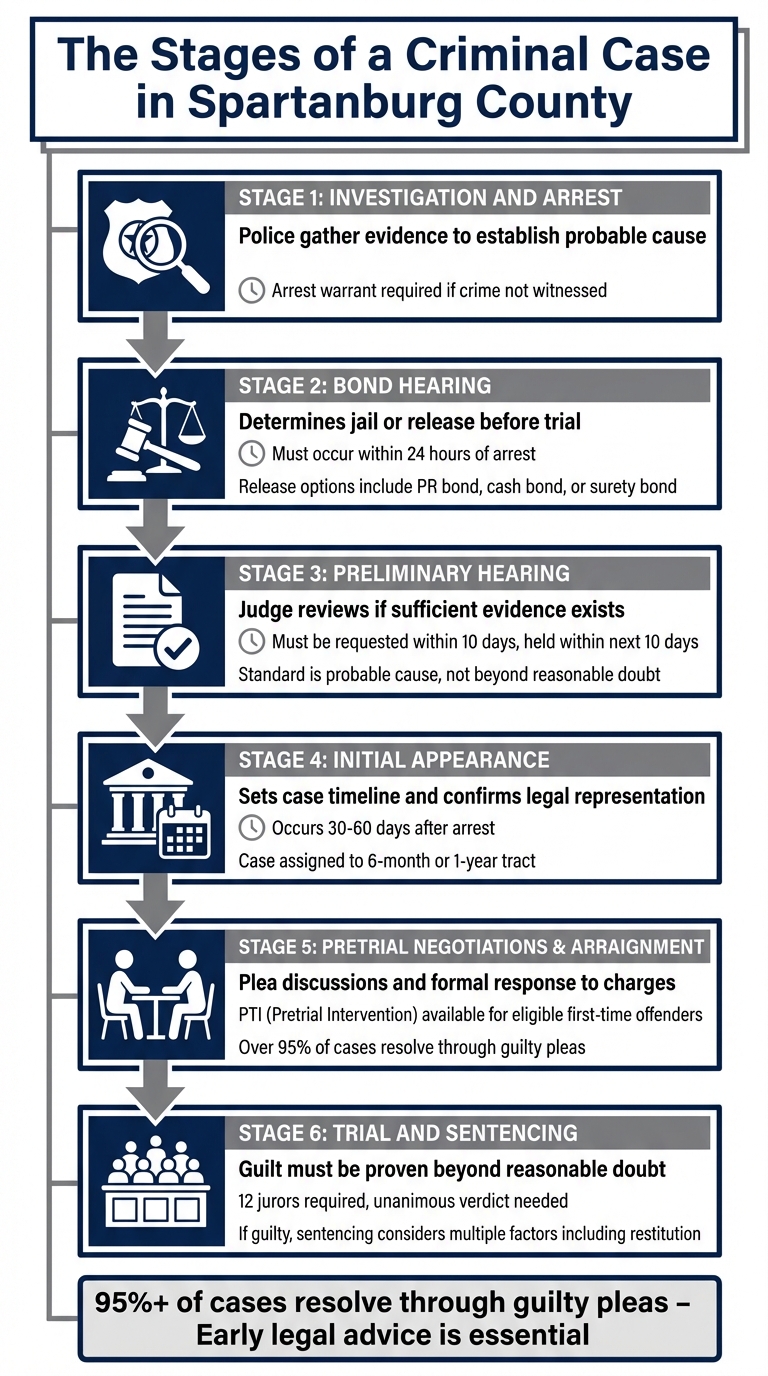
Criminal Case Process in Spartanburg County: 6 Key Stages from Arrest to Sentencing
Investigation and Arrest
Police Investigations
In Spartanburg County, criminal investigations kick off when someone reports a crime to local law enforcement. From there, the police take charge of gathering evidence and building a case. This process can include collecting evidence from the scene, conducting surveillance, and using digital forensics like retrieving cellphone data. Much of this evidence is then sent to the State Law Enforcement Division (SLED) for lab testing and analysis. The primary goal? To establish probable cause – enough factual evidence for a reasonable person to believe the suspect likely committed the crime.
"This threshold [probable cause], while higher than mere suspicion, is lower than ‘beyond a reasonable doubt,’ which is the standard the Solicitor’s Office must meet to earn a conviction in court." – 14th Circuit Solicitor’s Office
If no one directly witnesses the crime, the investigating officer must present the gathered facts to a magistrate to secure an arrest warrant based on probable cause. Once this threshold is met, the case progresses to the arrest stage.
Arrest and Booking Process
When probable cause is confirmed, law enforcement can move forward with taking a suspect into custody. In South Carolina, officers have the authority to arrest someone without a warrant if they personally witness the crime. Interestingly, private citizens can also make arrests without a warrant if they witness a felony or theft in progress.
After an arrest, it’s critical that the suspect is informed of the reason for their detention. If an officer either refuses to provide this information or knowingly gives false details, it’s considered a misdemeanor under Section 17-13-50. Following the arrest, the booking process begins at a local facility. This involves recording personal details, taking fingerprints, and capturing photographs. Typically, the suspect is entitled to a bond hearing within 24 hours of being taken into custody.
sbb-itb-ce0cbb0
Bond Hearing
Once someone is booked, the focus quickly shifts to the bond hearing. This hearing is crucial because it determines whether the defendant will remain in jail or be released while waiting for trial. Under the law, the defendant must have this hearing within 24 hours of their arrest. At this stage, the court sets a bond amount meant to ensure the defendant shows up for future court dates.
"Bond is not punishment. In fact, state law requires the release of every defendant on his or her own recognizance pending trial, unless the judge determines the defendant is a flight risk or a threat to public safety." – 14th Circuit Solicitor’s Office
Setting Bond
During the bond hearing, a magistrate or municipal judge reviews several factors to decide whether the defendant can be released. These factors include the defendant’s criminal history, ties to the community (such as family and employment), the details of the current charges, any pending cases, and incident reports tied to the offense. The judge also checks whether the defendant is already out on bond for another case or appears in the state gang database.
For most cases, magistrates handle bond decisions. However, if the charges carry the possibility of life imprisonment or the death penalty, only a Circuit Court judge can set bond. Victims also have a voice in this process – they are notified of the hearing and can share their safety concerns with the judge regarding the defendant’s release.
Release Options
South Carolina law generally leans toward releasing defendants unless there’s a strong reason to keep them detained. Several release options are available:
- A personal recognizance (PR) bond allows the defendant to be released based solely on a written promise to appear in court – no upfront payment is required.
- A cash bond requires the defendant to pay the full bond amount to the court. In some cases, judges may permit a 10% deposit instead.
- A surety bond involves hiring a bail bondsman, who charges a non-refundable fee of 10% of the total bond amount.
In addition to financial considerations, judges may impose conditions like electronic monitoring, curfews, or travel restrictions. Defendants who are released must also keep the Solicitor’s Office updated on any changes to their mailing address or phone number to ensure they receive court notices.
From here, the case moves on to the preliminary hearing, where formal charges are addressed.
Preliminary Hearing and Initial Appearance
After the bond hearing, the case moves into a phase where the court evaluates whether there’s enough evidence to proceed. In Spartanburg County, this involves two key steps: the preliminary hearing and the initial appearance. Each plays a distinct role in shaping the case’s direction.
Purpose of Preliminary Hearings
The preliminary hearing is a chance for the defendant to question whether the state has sufficient evidence to move forward. Here, a magistrate judge examines the prosecution’s case to decide if there’s probable cause – a lower standard than the "beyond a reasonable doubt" required at trial.
"A preliminary hearing is the right of the person charged with the crime. It is their chance to hear the evidence that the state has against them." – Spartanburg County Solicitor’s Office
However, this hearing isn’t automatic. Defendants must request it within 10 days of being notified at their bond hearing. Once requested, the hearing must occur within another 10 days – unless a grand jury indicts the defendant before the scheduled date, in which case the hearing is canceled.
During the hearing, defendants cannot present personal testimony or evidence. Instead, their attorney may cross-examine the prosecution’s witnesses. If the magistrate finds probable cause, the case moves to the Court of General Sessions for trial. If not, the defendant is released, though the state can still pursue charges later.
Once probable cause is established, the case advances to the next step: the initial court appearance.
Initial Appearance in Court
After probable cause is confirmed, the court schedules the initial appearance, often referred to as the "first appearance." This typically takes place 30 to 60 days after the arrest. The purpose of this proceeding is to help manage Spartanburg County’s criminal court docket.
"First and second appearances are tools to organize the General Sessions criminal court docket. First appearances generally occur 30-60 days after the arrest. Hundreds of defendants are summoned at the same time to answer basic questions about how their case is going to proceed." – Spartanburg County Solicitor’s Office
At this stage, defendants must indicate whether they plan to hire an attorney, represent themselves, or request a public defender. The judge then assigns the case to a specific timeline for resolution – typically six months for standard cases or up to a year for more complex charges like murder or sex crimes.
It’s also crucial for defendants to keep the Solicitor’s Office updated with any changes to their contact information to ensure they receive all court notifications.
Pretrial Negotiations and Arraignment
Between the initial court appearance and the trial, the defense and prosecution engage in critical plea negotiations that often determine the direction of a case. These pretrial steps serve as the bridge between early discussions and the formal arraignment process.
Plea Negotiations
Defense attorneys work closely with the Solicitor’s Office to negotiate favorable outcomes. This can include seeking dismissals due to insufficient evidence, reducing charges, or arranging plea deals to minimize penalties. During the second appearance – typically within six months of the arrest – both sides assess whether to proceed to trial or resolve the case through a plea agreement. In some instances, the prosecutor may decide to dismiss charges entirely by invoking nolle prosequi.
Arraignment Process
After negotiations, the arraignment marks a formal step where the defendant responds to the charges. During this hearing, the judge reads the charges aloud, and the defendant enters a plea. In Spartanburg County, this usually takes place during the first or second appearance, within 30 to 60 days of the arrest. The judge will also inform the defendant of their constitutional rights and confirm whether they have legal representation. At this stage, defendants must plead either not guilty, guilty, or no contest, each carrying different consequences. Legal experts strongly advise against pleading guilty at this point without proper negotiation and guidance from an attorney.
Pretrial Intervention Programs
For individuals facing their first offense or charged with non-violent crimes, Pretrial Intervention (PTI) offers a chance to avoid traditional prosecution. Managed by the Spartanburg County Solicitor’s Office at 180 Library St., PTI provides eligible defendants an opportunity to bypass trial and avoid a criminal record. Admission into the program depends on factors like the nature of the offense, the defendant’s criminal history, and input from law enforcement or victims. The Solicitor has sole discretion over acceptance.
The application process includes a $100 non-refundable fee. Once accepted – typically within four to six weeks – participants pay $250 in two installments and must complete requirements such as community service, counseling, drug testing, and restitution over a minimum of 90 days. Successfully completing PTI leads to dismissed charges and eligibility for expungement, which involves additional fees totaling $310 ($250, $35, and $25 paid to different agencies). However, PTI is a one-time option; individuals who have participated before are not eligible.
Strong pretrial negotiations and a well-understood arraignment process play a crucial role in shaping the outcome of a case, whether through plea agreements, diversion programs, or trial preparation.
Trial and Sentencing
After pretrial negotiations and arraignment, the case moves to its final stage – trial and sentencing. If plea negotiations fail or the defendant chooses to challenge the charges, the case proceeds to trial. Judges typically assign cases to a timeline or "tract" based on complexity, aiming for resolution within six months or a year. Serious cases, like murder or sex crimes, are usually placed on the one-year tract.
Jury Selection and Trial Proceedings
Criminal trials begin with a pool of 50 to 60 potential jurors in the courtroom. During voir dire, the judge and attorneys assess these individuals to determine their impartiality. Attorneys can propose specific questions to help uncover any biases or prior knowledge about the case. Jurors can be dismissed "for cause" without limit – such as those with ties to the parties involved – but both the Solicitor and defense attorney have a limited number of peremptory challenges, which allow them to excuse jurors without giving a reason.
"The questioning process, called the voir dire, is designed to permit the attorneys to become acquainted with the prospective jurors and to determine whether a juror can serve fairly and impartially in the case." – South Carolina Judicial Branch
Most trials in General Sessions Court require twelve jurors, though some cases may proceed with six.
Once a jury is seated, the trial begins with the prosecution presenting its case. The prosecution must meet the standard of proving guilt beyond a reasonable doubt. The defense has the right to cross-examine all prosecution witnesses. Importantly, the defendant is not required to testify or offer evidence, as the presumption of innocence remains intact. After both sides conclude their cases and closing arguments, the judge gives the jury instructions, clarifying the legal standards they must follow. Jury deliberations take place in private, and in South Carolina, the verdict must be unanimous. If the jury cannot reach a unanimous decision, it results in a hung jury and a mistrial. Once a unanimous verdict is reached, the case proceeds to sentencing.
Verdict and Sentencing
If the defendant is found guilty, sentencing may occur immediately or at a separate hearing. The judge considers several factors, including the nature of the plea, the defendant’s cooperation with law enforcement, their ability to pay restitution, and the statutory limits for the crime. A guilty plea is treated as a jury recommendation of mercy for sentencing purposes.
"The judge will use the [Victim Impact Statement] form to gain a better understanding about the details of the case and the losses, both financial and emotional." – Spartanburg County Solicitor’s Office
The judge may also order restitution for losses related to the crime. This restitution is managed and distributed by the South Carolina Department of Probation, Parole and Pardon Services. In cases involving the unlawful taking or receiving of property, sentences cannot be suspended unless restitution is paid. Additionally, defendants who provide substantial assistance to the State in prosecuting or investigating others may request a reduced sentence.
Conclusion
Every step of the criminal process, from arrest to trial, carries significant weight, and the final outcome often hinges on early and informed legal decisions. Understanding these stages equips you to take control of your defense and make choices that can shape your future.
The complexity of the system makes early legal intervention crucial. The outcome of your case may depend on how quickly you act. Hiring a seasoned criminal defense attorney before your first court appearance can make all the difference. Without private counsel, you risk losing the opportunity to craft a defense strategy tailored to your situation. An experienced attorney can challenge probable cause at preliminary hearings, negotiate with the Solicitor’s office, explore options like Pre-Trial Intervention programs, and ensure your constitutional rights are upheld at every turn.
Prosecutors are tasked with proving guilt beyond a reasonable doubt and often have extensive resources at their disposal. With over 24 years of experience in South Carolina’s criminal justice system, Brendan M. Delaney Law Firm LLC offers the strategic guidance and advocacy needed to navigate the procedures in Spartanburg County. Whether through negotiations or trial, having a dedicated attorney ensures you’re fully informed of your options and positioned to achieve the best possible outcome.
Don’t wait – time is a critical factor in building a strong defense. Reach out to an experienced criminal defense attorney today to protect your rights and take the first step toward securing your future.
FAQs
What should I do right after an arrest in Spartanburg County?
After being arrested in Spartanburg County, it’s crucial to understand your rights and what comes next. The process typically begins with being booked at a detention facility. During booking, the charges against you will be read, your fingerprints taken, and your eligibility for bail assessed.
For many charges, a magistrate will set the bail amount. However, for more serious offenses, the decision will be made by a judge. It’s essential to consult with legal counsel as soon as possible. A lawyer can help ensure your rights are upheld, including your right to fair hearings, legal representation, and timely court proceedings, as guaranteed under South Carolina law.
Can I change my bond or get released if it was denied?
If your bond was denied, you do have the option to request a reconsideration or seek release. In South Carolina, circuit courts can review and reevaluate bonds initially set by summary courts. This is particularly true if there’s been a significant change in circumstances or if you’ve been detained for an extended period. It’s important to consult with your attorney to explore your options and determine the best course of action.
How can my case be dismissed before trial?
In South Carolina, charges can sometimes be dismissed before trial under specific circumstances. Prosecutors might drop charges if there’s not enough evidence to proceed, if witnesses are unavailable or unreliable, or for other strategic reasons. On the other hand, defense attorneys can file motions to dismiss based on legal arguments, such as a lack of probable cause or procedural errors during the investigation. Additionally, cases resolved through plea deals or eligible for expungement may also result in dismissals, ensuring that only cases with strong evidence move forward.