



Self-defense in South Carolina can protect you from criminal charges if specific legal conditions are met. The state’s "Stand Your Ground" law allows you to use force, including deadly force, without retreating, as long as you reasonably believe you’re in imminent danger. This law provides immunity from both criminal prosecution and civil lawsuits when used lawfully. Key points include:
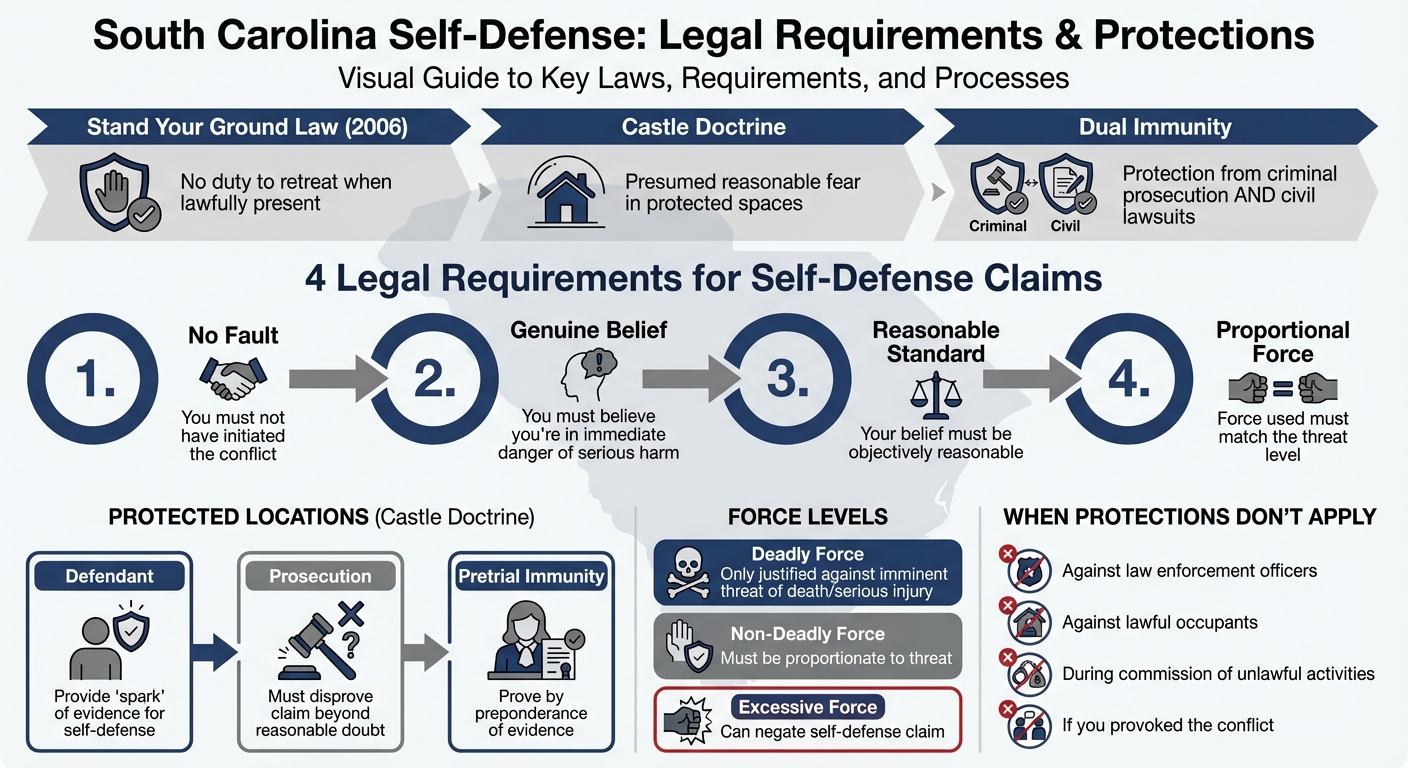
- Stand Your Ground: No duty to retreat if you’re lawfully present in a place like your home, car, or workplace.
- Castle Doctrine: Presumes your fear is reasonable if someone unlawfully enters your home or other protected space.
- Legal Requirements: You must prove you didn’t start the conflict, believed you were in immediate danger, and used proportional force.
- Burden of Proof: You need to provide some evidence of self-defense; the prosecution must then disprove it beyond a reasonable doubt.
Recent cases show how courts carefully examine evidence to decide on immunity. If charged, acting quickly to preserve evidence and consulting an attorney is critical.
South Carolina Self-Defense Legal Requirements and Process
South Carolina’s Stand Your Ground Law
What the Stand Your Ground Law Covers
South Carolina’s Stand Your Ground law, officially called the Protection of Persons and Property Act, became part of state law in 2006 under S.C. Code Ann. § 16-11-440. It removed the obligation to retreat in situations where a person is lawfully present. Whether you’re at home, in an occupied vehicle, or at your workplace, the law allows you to stand your ground rather than retreat when faced with a threat. It authorizes the use of force, including deadly force, if there’s a reasonable belief that such action is necessary to prevent death, serious injury, kidnapping, rape, or robbery.
"Individuals who encounter a threat in a public place need not retreat, but instead can meet force with force."
However, there are specific exceptions. The law does not apply if force is used against law enforcement officers, lawful occupants of a property, or during the commission of unlawful activities.
With this foundation in place, let’s explore how the law protects individuals in both criminal and civil cases.
Protection from Criminal and Civil Cases
South Carolina’s Stand Your Ground law provides immunity on two fronts: criminal prosecution and civil lawsuits, as long as the use of force is lawful. In this context, immunity from "criminal prosecution" covers actions like arrest, detention, filing charges, and prosecuting an individual.
This immunity isn’t absolute – it can be revisited if new, relevant evidence comes to light. The law also introduces a presumption of reasonable fear when defending oneself in specific locations, such as a home, occupied vehicle, business, or residence. For instance, if someone unlawfully attempts to enter one of these spaces, the court can presume your response was reasonable under the circumstances.
sbb-itb-ce0cbb0
Legal Requirements for a Self-Defense Claim
To claim self-defense, you need to meet several key conditions: (1) you must not have initiated the conflict; (2) you must genuinely believe you were in immediate danger of serious harm; (3) your belief must align with an objective standard of reasonableness; and (4) you must have no safe way to escape – unless exceptions like South Carolina’s Stand Your Ground law or the Castle Doctrine apply. These criteria work alongside the protections provided under South Carolina’s Stand Your Ground law.
"the defendant must be without fault in bringing on the difficulty" – State v. Turner
Proving a Reasonable Belief of Immediate Danger
Courts determine if your fear of harm was reasonable by analyzing the specific circumstances you faced at the time of the incident. The threat must be imminent. This evaluation is grounded in South Carolina’s legal standards.
"you must genuinely believe you faced imminent danger of death or serious injury" – State v. Turner
To gain pretrial immunity under the Protection of Persons and Property Act, you must prove these elements by a preponderance of the evidence. This means the trial court will independently review the evidence rather than simply accepting your account. If the evidence is unclear or conflicting, the matter is typically left for a jury to decide during the trial. This standard is crucial for both criminal defense and civil immunity under South Carolina law.
Using Force That Matches the Threat
The force you use in self-defense must be proportionate to the threat you perceive. Deadly force is only justified when you’re facing an imminent threat of death or serious bodily harm. Using deadly force against a non-deadly threat is considered excessive.
This proportionality is tied to the objective standard: what would a reasonable person have done in the same situation? If your fear of harm is reasonable, self-defense applies. However, if your fear is honest but objectively unreasonable, it may fall under "imperfect self-defense." While this won’t result in an acquittal, it might reduce the severity of the charges against you. This proportionality naturally leads to the question of whether or not retreat is required.
When You Must Retreat vs. When You Don’t
South Carolina’s Stand Your Ground law removes the traditional obligation to retreat in most scenarios. If you are in a place where you have a legal right to be – such as your home, vehicle, workplace, or a public space – you generally don’t have to retreat before using force.
"A valid case of self-defense must exist, and the trial court must necessarily consider the elements of self-defense in determining a defendant’s entitlement to the Act’s immunity. This includes all elements of self-defense, save the duty to retreat." – South Carolina Supreme Court, State v. Himes
However, this protection doesn’t apply if you were the one who initiated the conflict or were engaged in unlawful activity at the time. To claim Stand Your Ground protections, you must be lawfully present. South Carolina is one of 38 states with stand-your-ground laws, and it is among at least 11 states that explicitly include "may stand his or her ground" language in their statutes.
The Castle Doctrine and When Fear Is Presumed Reasonable
South Carolina’s Castle Doctrine builds on the principles of self-defense by extending specific protections to individuals within their personal spaces. Alongside the Stand Your Ground law, the Castle Doctrine is a key legal safeguard in the state, codified under the Protection of Persons and Property Act (S.C. Code Ann. § 16-11-420). The General Assembly clearly outlined its purpose:
"It is the intent of the General Assembly to codify the common law Castle Doctrine which recognizes that a person’s home is his castle . . . ." – S.C. Code Ann. § 16-11-420(A)
This doctrine offers a significant legal advantage by presuming that a person acts out of reasonable fear of imminent danger when someone unlawfully and forcibly enters their protected space. Unlike general self-defense claims, this presumption shifts the burden of proof, making it easier to justify defensive actions in such situations. It strengthens the legal framework for protecting individuals in spaces they are entitled to feel secure.
How the Castle Doctrine Works
The Castle Doctrine applies to specific locations: your home, residence, occupied vehicle, or place of business. In these spaces, you are not required to retreat before defending yourself. Additionally, the law extends its protections to visitors or invited guests in a home, granting them the same rights as the homeowner – provided they meet the other self-defense criteria. However, these protections only apply if you did not provoke the conflict. This legal framework plays a crucial role in assessing whether your defensive actions were reasonable.
When the Law Assumes You Acted Reasonably
The law presumes your fear to be reasonable if an intruder unlawfully and forcibly enters your protected space. This presumption is consistent across all areas covered by the Castle Doctrine.
To gain pretrial immunity under the Act, you must demonstrate the elements of self-defense (excluding the duty to retreat) by a preponderance of the evidence during a pretrial hearing. The trial court will independently review the evidence rather than relying solely on your account. As clarified by the South Carolina Supreme Court:
"Consistent with the Castle Doctrine and the text of the Act, a valid case of self-defense must exist, and the trial court must necessarily consider the elements of self-defense in determining a defendant’s entitlement to the Act’s immunity. This includes all elements of self-defense, save the duty to retreat." – State v. Curry
If immunity is granted, you are protected from both criminal charges and civil lawsuits.
Proving Your Case: Evidence and Burden of Proof
When it comes to self-defense cases, understanding how the burden of proof works is key. Initially, you only need to present a "spark" of evidence to show that your actions were defensive. Once you do this, the prosecution has the responsibility to disprove your claim beyond a reasonable doubt. This step is critical in setting the stage for your defense to meet two important tests.
For your self-defense claim to hold, it must pass both a subjective test and an objective test. The subjective test focuses on your personal perspective – did you genuinely believe you were in immediate danger? The objective test, on the other hand, examines whether a reasonable person in your position would have shared that belief.
Evidence That Supports Your Self-Defense Claim
Backing up your claim with strong evidence is essential. Useful evidence can include:
- Video recordings from security cameras, doorbell cameras, or other sources.
- Credible witness testimony that corroborates your account.
- Physical evidence, such as forensic reports or injuries consistent with self-defense.
- Your own account, provided it remains clear and consistent throughout the case.
Each piece of evidence plays a role in reinforcing your claim and addressing both the subjective and objective tests.
Recent Changes to South Carolina Self-Defense Laws
New Laws and Amendments
South Carolina’s self-defense laws, rooted in the Protection of Persons and Property Act of 2006, remain a cornerstone of the state’s legal framework. This act eliminated the traditional "duty to retreat", extending self-defense protections beyond the home to include vehicles and workplaces. While the statute itself hasn’t been altered, its application continues to evolve through courtroom decisions. Both the South Carolina Court of Appeals and the Supreme Court play pivotal roles in interpreting these laws, leading to shifts in how self-defense claims are applied in real-life scenarios. Recent high-profile cases highlight these ongoing developments, shaping how attorneys and courts approach such defenses.
How These Changes Affect Current Cases
A prominent example of these evolving interpretations unfolded in August 2025, when South Carolina Attorney General Alan Wilson ruled that the Protection of Persons and Property Act applied to Weldon Boyd in the September 2023 fatal shooting of Scott Spivey. After reviewing the investigative findings – including eyewitness statements, toxicology reports, and video evidence – the Attorney General’s Office granted Boyd immunity from prosecution. This decision highlights how judicial interpretations can influence the application of self-defense laws in complex cases.
In a statement, the Attorney General’s Office emphasized:
"Our office takes every loss of life seriously and remains committed to pursuing justice. If new material evidence comes to light, whether through the ongoing civil proceedings, further investigation, or new reports to law enforcement, we are fully prepared to reevaluate the case. The pursuit of justice remains active, with new evidence always capable of reshaping the legal landscape."
This case illustrates how Stand Your Ground protections can extend to unique situations, such as road rage incidents where both parties are mobile. It also underscores that immunity decisions are not set in stone, as new evidence can prompt reevaluation. Given the fluid nature of these legal interpretations, working with an attorney well-versed in the latest rulings is crucial for effectively navigating self-defense claims.
Conclusion
Key Takeaways
South Carolina’s self-defense laws hinge on three main factors: an immediate threat, a reasonable fear of harm, and the use of force proportionate to the situation. Thanks to the Protection of Persons and Property Act, individuals are not required to retreat when they are in a space they legally occupy, whether at home or in public.
Under these laws, immunity from criminal prosecution is provided when deadly force is used lawfully. The case of Scott Spivey in August 2025 highlights how decisions on immunity rely heavily on a thorough examination of evidence. As noted by the South Carolina Attorney General’s Office:
"The pursuit of justice does not expire, and we remain open to all credible evidence that could change the legal landscape of this case."
It’s worth noting that immunity decisions are not set in stone. New evidence can lead to a reevaluation, showcasing the state’s nuanced approach to self-defense cases.
What to Do If You’re Facing Criminal Charges
If you find yourself facing criminal charges, it’s crucial to act quickly and strategically. Here’s what you should prioritize:
- Contact an experienced attorney immediately. Legal guidance is essential to navigate these complex laws.
- Preserve all evidence. This includes witness statements, surveillance footage, and medical records.
- Report new information promptly. Emerging evidence can play a pivotal role in altering the outcome of your case.
Taking these steps can make a significant difference in how your case unfolds.
FAQs
Can I get self-defense immunity before trial?
Yes, in South Carolina, it’s possible to pursue self-defense immunity before going to trial. This involves a pretrial hearing where the court evaluates the case using the preponderance of the evidence standard, as outlined by state case law. If the court rules in your favor, the case can be dismissed, avoiding a trial altogether.
What evidence helps prove self-defense in South Carolina?
To establish a self-defense claim in South Carolina, the evidence must indicate that the defendant genuinely believed they were facing an immediate threat of death or severe injury. Furthermore, it must also show that a reasonable person in the same circumstances would have held the same belief. These elements are key to supporting a self-defense argument under South Carolina law.
When can Stand Your Ground be denied?
When claiming Stand Your Ground in South Carolina, a court can deny the defense if the defendant does not meet the legal standards for self-defense. This typically involves failing to demonstrate a reasonable belief that they were in imminent danger or that their use of force was justified. Judges carefully review these elements to decide whether the claim aligns with the state’s legal requirements.