


If you’re pulled over for a DUI in Spartanburg County, here’s what you need to know:
- Traffic Stop: Officers must have a valid reason to stop you, such as a traffic violation. You’re required to provide your license, registration, and insurance.
- Your Rights: You can remain silent and refuse field sobriety tests, but refusing a chemical test (like a breathalyzer) leads to automatic penalties, including a license suspension.
- Testing: South Carolina’s implied consent law means driving in the state requires you to agree to chemical testing if arrested for DUI.
- Penalties: A first offense may result in fines, jail time, and license suspension. Repeat offenses carry harsher penalties, including longer suspensions, higher fines, and potential felony charges.
- Legal Process: After arrest, you’ll face both administrative penalties (license suspension) and criminal charges. You have 30 days to request a hearing to challenge a suspension.
- Video Evidence: Traffic stops and tests must be recorded. Missing recordings could impact your case.
- Act Quickly: Contacting an attorney immediately ensures you meet deadlines and build a strong defense.
Understanding your rights and acting promptly can make a significant difference in the outcome of your case.
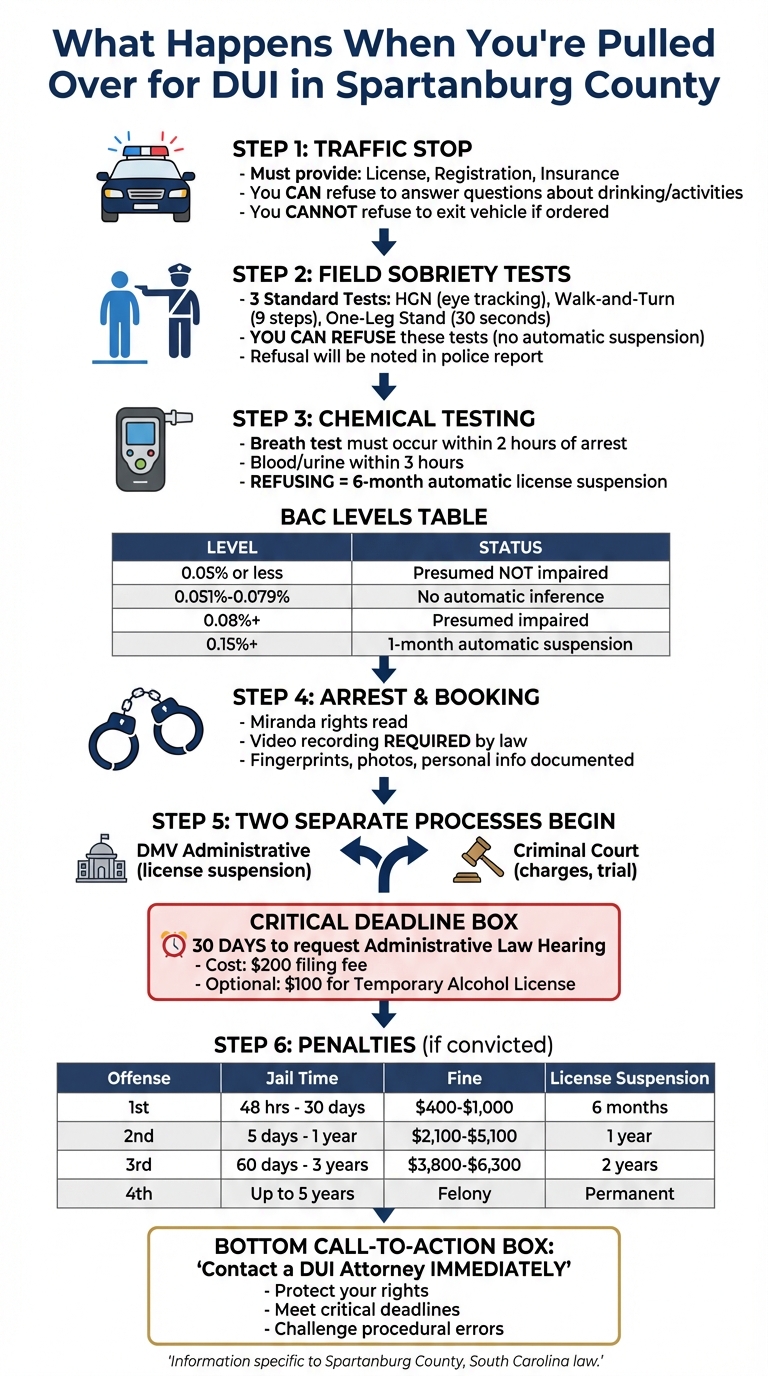
DUI Traffic Stop Process and Timeline in Spartanburg County SC
What Happens During the Initial Traffic Stop
How Officers Conduct DUI Stops
When officers initiate a DUI stop, their first step is to assess your behavior for any signs that might indicate impairment. They pay close attention to details like red or watery eyes, slurred speech, or the smell of alcohol or drugs. These observations play a key role in their decision to investigate further.
During this interaction, the officer may ask questions such as where you’re coming from or if you’ve been drinking. It’s important to know that you are not obligated to answer these questions – you have the constitutional right to remain silent. If the officer believes there is enough reason to suspect impairment, they will likely ask you to step out of the vehicle for additional evaluation. This process is designed to gather more evidence while ensuring your rights are respected.
Your Legal Rights During the Stop
While you’re required to provide basic identification, you are not required to disclose details about your activities or alcohol consumption.
"You are not obligated to answer questions about where you are coming from, whether you have been drinking, or how much alcohol you may have consumed." – The Bateman Law Firm
If the officer requests to search your vehicle, you have the right to clearly state that you do not consent to the search. However, if you’re instructed to step out of the vehicle, you must comply. Refusing to follow basic commands could lead to charges such as disorderly conduct or obstruction of justice. Understanding these rights can help you navigate the situation more confidently.
Documents You Must Provide
Be prepared to provide your driver’s license, vehicle registration, and proof of insurance upon request. Having these documents organized and easily accessible can make a positive impression. Struggling to locate them may be interpreted as a sign of impairment. Keep in mind that refusing to present these documents is not an option – it could result in additional criminal charges. Staying prepared can help the interaction proceed more smoothly.
Field Sobriety Tests and Chemical Testing
Common Field Sobriety Tests
Police officers often rely on Standardized Field Sobriety Tests (SFST) to assess potential impairment. The three most commonly used tests are:
- Horizontal Gaze Nystagmus (HGN): During this test, the officer watches your eyes as you follow a pen or flashlight moving side-to-side. They look for specific signs like jerking movements, lack of smooth tracking, or eye twitching at certain angles.
- Walk-and-Turn Test: You’re asked to take nine heel-to-toe steps in a straight line, turn around, and take nine steps back. Officers look for behaviors such as losing balance, stepping off the line, or taking the wrong number of steps.
- One-Leg Stand Test: This test involves standing on one foot, about six inches off the ground, while counting aloud for 30 seconds. Signs of impairment include swaying, hopping, or needing your arms to balance.
In addition to these, officers might use nonstandard tests, like asking you to recite the alphabet or touch your nose with your finger. Under South Carolina law (Section 56-5-2953), you have the right to refuse field sobriety tests. However, keep in mind that such refusals may be documented in the police report.
Breathalyzer and Blood Tests
If field sobriety tests suggest impairment, officers typically move to chemical testing to measure the concentration of alcohol or drugs in your system. In South Carolina, the process usually begins with a breath test. A blood test might be administered if you’re unable to provide a breath sample – due to injury or unconsciousness – or if drug use is suspected.
South Carolina follows an Implied Consent Law, meaning that by driving in the state, you’ve already agreed to undergo chemical testing if arrested for DUI. Timing is critical: breath samples must be collected within two hours of the arrest, while blood or urine samples must be taken within three hours. Before a breath test is conducted, officers perform a simulator test to ensure the equipment is properly calibrated.
It’s important to note that portable roadside breathalyzers are only used to establish probable cause for an arrest. Results from fully calibrated machines at police stations are the ones admissible in court. Additionally, South Carolina law allows you to request an independent test at your own expense, and officers are required to assist by transporting you to the nearest facility capable of performing the test.
| BAC Level | Legal Inference in South Carolina |
|---|---|
| 0.05% or less | Presumed NOT under the influence |
| 0.051% – 0.079% | No automatic inference; considered alongside other evidence |
| 0.08% or more | Presumed under the influence |
What Happens If You Refuse Testing
Refusing field sobriety tests doesn’t automatically lead to a license suspension, but an officer can still arrest you if they have other probable cause. However, refusing a breathalyzer or chemical test after an arrest has more serious consequences. A refusal triggers a license suspension – six months for a first refusal and up to 12 months for subsequent refusals.
Prosecutors may present your refusal in court as evidence, suggesting you were attempting to conceal intoxication. Additionally, anyone who refuses chemical testing is required to complete the Alcohol and Drug Safety Action Program (ADSAP). If your license is suspended, you have 30 days to request a contested case hearing to challenge the suspension. Alternatively, you might qualify to end the suspension early by enrolling in the Ignition Interlock Device (IID) Program.
"In South Carolina, you have the right to refuse to participate in these [field sobriety] tests. Field sobriety tests are not always accurate, and many factors unrelated to alcohol or drug consumption could cause you to fail."
- John Bateman, Attorney
Being aware of these rules and potential consequences ensures you’re better prepared to make informed decisions during the process.
The Arrest and Booking Process
What Happens When You’re Arrested
When an officer has probable cause, you’ll be taken into custody and transported to a detention facility in Spartanburg County. During this process, the officer will read you your Miranda rights, which include your right to remain silent and to have an attorney present. Be aware that anything you say – whether in the patrol car or at the station – can be used against you in court.
In South Carolina, the law requires that the arrest and any breathalyzer tests be recorded on video. If these recordings are not made, it could potentially invalidate your arrest. It’s crucial to avoid discussing the details of your actions until you’ve consulted with an attorney.
The Booking Process
Once you’re at the detention facility, you’ll go through the booking process. This includes being photographed, fingerprinted, and having your personal information documented. If you refuse to take a breathalyzer test or if your blood alcohol content (BAC) is recorded at 0.15% or higher, your driver’s license will be automatically suspended at the time of your arrest.
After the booking process, you’ll typically be allowed to contact a family member or an attorney. Following this, a bond hearing will take place where a judge will determine the terms of your release. These terms may include specific conditions, such as restrictions on leaving the state. If your license is suspended, you’ll need to act quickly – file a request for an Administrative Law Hearing within 30 days. This process involves a $200 fee, and you’ll also need to pay an additional $100 if you want to apply for a Temporary Alcohol Restricted License to regain driving privileges.
Your Right to an Attorney
Reaching out to an attorney as soon as possible is vital. A skilled attorney can examine the details of your arrest, including whether the officer had legitimate probable cause, adhered to the required video recording laws, and properly informed you of your implied consent rights. Acting quickly ensures you don’t miss critical deadlines, like the 30-day window to request an administrative hearing. Having legal counsel early on can help protect your rights, build a defense, and guide you through the legal and administrative steps that follow a DUI charge.
sbb-itb-ce0cbb0
Legal and Administrative Consequences of a DUI
License Suspension and Implied Consent Hearings
Getting arrested for a DUI in Spartanburg County triggers two separate processes: an administrative review by the DMV and a criminal court case. A win in one doesn’t automatically resolve the other.
South Carolina’s implied consent law comes into play here. Refusing a breathalyzer or blowing a BAC of 0.15% or higher leads to an automatic suspension – six months for refusing the test and one month for hitting the BAC threshold. As stated in the South Carolina Code of Laws:
"The Department of Motor Vehicles shall suspend the driver’s license, permit, or nonresident operating privilege of… a person who drives a motor vehicle and refuses to submit to a test… or has an alcohol concentration of fifteen one-hundredths of one percent or more."
- South Carolina Code of Laws Section 56-5-2951
If your license is suspended, you can request a contested case hearing with the Office of Motor Vehicle Hearings (OMVH) within 30 days. This requires a $200 money order. While waiting for the hearing, you can apply for a Temporary Alcohol License (TAL) for $100, which allows you to drive until a decision is made. Make sure you use the correct mailing address on the request form since all correspondence will be sent to the address listed on your DUI ticket.
During the hearing, the focus will be on whether the officer had legal grounds to arrest you, whether you were informed of your implied consent rights, and whether you refused testing or blew a BAC of 0.15% or higher. If the officer doesn’t show up, the suspension is usually dropped. However, if the suspension sticks, you’ll need to complete the Alcohol and Drug Safety Action Program (ADSAP) and pay a $100 reinstatement fee to get your license back.
It’s important to note that these administrative penalties are separate from the criminal court process.
The Criminal Court Process
While the DMV handles your driving privileges, your criminal case moves forward in court. It starts with an arraignment, where you’ll hear the charges and enter a plea. After that, your attorney might file pre-trial motions to challenge parts of the case, like whether field sobriety tests were administered correctly. If a plea deal isn’t reached or the charges aren’t dismissed, the case will go to trial.
At trial, the prosecution must prove beyond a reasonable doubt that you were driving under the influence. Evidence can include the officer’s observations, how field sobriety tests were conducted, the timing of chemical tests (breath samples must be taken within two hours of arrest, while other samples have a three-hour window), and any procedural missteps. Remember, the criminal case is entirely separate from the administrative license suspension.
Possible Penalties for DUI Convictions
The penalties for a DUI vary depending on the number of prior offenses. These include jail time, fines, and license suspensions, as outlined below:
| Offense Number | Jail Time | Fine Range | License Suspension |
|---|---|---|---|
| 1st Offense | 48 hours – 30 days | $400 – $1,000 | 6 months |
| 2nd Offense | 5 days – 1 year | $2,100 – $5,100 | 1 year |
| 3rd Offense | 60 days – 3 years | $3,800 – $6,300 | 2 years |
| 4th Offense | Up to 5 years (Felony) | Varies (Felony) | Permanent/Varies |
For first-time offenders, community service may be an option instead of jail time, but this requires court approval. Regardless of the offense number, completing ADSAP is mandatory. The program can cost up to $500 for education, $2,000 for treatment, or $2,500 for both.
Starting May 19, 2024, an Ignition Interlock Device (IID) will be required to clear certain suspensions. For a second offense, you’ll need to use the IID for two years. A third offense means three years – or four years if all offenses occurred within five years.
A fourth DUI within 10 years is a felony. If the DUI causes great bodily harm, fines range from $5,100 to $10,100. If it results in a death, the fines increase to $10,100–$25,100. Additionally, for a third offense or beyond within 10 years, the vehicle involved may be confiscated if it belongs to you or someone in your household.
To reinstate your license, you may also need SR-22 insurance, which is a high-risk policy. Keep in mind, the fines listed here don’t include additional court costs, surcharges, or administrative fees. Altogether, the financial and personal toll of a DUI conviction can be overwhelming, especially for repeat offenses, potentially costing tens of thousands of dollars.
How to Protect Your Rights During and After a DUI Stop
Stay Calm and Cooperate Respectfully
The moment those flashing lights appear in your rearview mirror, staying calm is your first priority. Keep your hands in plain view, and when asked, provide only your license, registration, and proof of insurance. Beyond that, you have the right to remain silent, and it’s wise to exercise it.
If the officer requests that you perform field sobriety tests, you can politely decline. Under South Carolina law, you have the right to refuse these tests. However, refusing a breathalyzer test can lead to an automatic six-month license suspension for a first refusal. Speak as little as possible, avoid giving extra information, and decline additional tests respectfully. Keeping the interaction calm and professional helps prevent unnecessary escalation.
Once the immediate situation is under control, focus on documenting everything to preserve crucial details.
Document the Incident
After maintaining a calm demeanor during the stop, take steps to record every detail of the encounter. Note the reason the officer gave for pulling you over, as well as the time, location, weather conditions, and road surface where any tests were conducted. Environmental factors, such as uneven pavement or poor lighting, along with any personal medical conditions that could have impacted your performance during field sobriety tests, might be important later.
South Carolina law (Section 56-5-2953) requires officers to video record field sobriety and breathalyzer tests. If these procedures weren’t followed, it could be a critical point in challenging the arrest. Also, if there were passengers or witnesses present, collect their contact information. Their observations could be helpful when your attorney reviews dashcam footage or other evidence.
Contact a Criminal Defense Attorney
After a DUI arrest in Spartanburg County, time is of the essence. You have only 30 days to request an Administrative Law Hearing to challenge a license suspension. An experienced criminal defense attorney can handle this paperwork quickly, help secure a Temporary Alcohol License, and thoroughly review the evidence for any procedural errors.
DUI cases involve two separate processes: the criminal court case and an administrative process with the DMV. Having a seasoned attorney by your side ensures your rights are protected throughout both proceedings.
Conclusion
Facing a DUI stop in Spartanburg County can feel overwhelming, but understanding your rights and the proper steps to take can profoundly impact the outcome of your case. From the moment those flashing lights appear, every choice you make is important – whether it’s staying composed, providing only the necessary documents, or understanding the implications of refusing a chemical test.
One critical point to keep in mind is the 30-day deadline to request an Administrative Law Hearing. Missing this deadline leads to an automatic license suspension, entirely separate from any criminal charges. This makes acting quickly not just important, but essential.
"The process of protecting yourself begins now. While it may ultimately take several months to resolve your DUI case, there are steps you need to take immediately in order to protect your driving privileges." – Rad Deaton, DUI Defense Lawyer
Hiring an experienced defense attorney is a key step in navigating the complexities of a DUI case. A skilled lawyer can identify procedural missteps, challenge the legality of the traffic stop, review video evidence as outlined in South Carolina Code Section 56-5-2953, and handle both the administrative and criminal aspects of your case. In South Carolina, a first-offense DUI conviction can result in fines ranging from $400 to $1,000, along with court costs, a license suspension, and mandatory enrollment in the Alcohol and Drug Safety Action Program (ADSAP).
FAQs
What happens if I refuse a breathalyzer test in Spartanburg County?
Refusing a breathalyzer test in Spartanburg County, South Carolina, comes with serious consequences under the state’s implied consent law. Simply by driving on public roads, you’ve already agreed to undergo chemical testing if law enforcement suspects you of driving under the influence (DUI). If you decline to take the test, your driver’s license will likely be suspended – six months for a first offense and longer for subsequent refusals. This suspension is enforced by the Department of Motor Vehicles, regardless of whether you’re ultimately convicted of DUI. On top of that, your refusal can be presented as evidence against you in court.
If you decide not to take the test, it’s important to remain calm, keep your hands visible, and politely request to speak with an attorney. You’re still required to provide basic information like your name, address, driver’s license, vehicle registration, and proof of insurance. However, you’re not obligated to answer questions about alcohol consumption or agree to additional testing. Avoid arguing or resisting, as these actions could result in further charges. Reaching out to an experienced DUI defense attorney as soon as possible is key to protecting your rights and handling the license suspension process effectively.
How can I fight a DUI-related license suspension in South Carolina?
If your license gets suspended following a DUI or DUAC arrest in South Carolina, you have the option to challenge it. To do this, you need to request a contested-case hearing in writing through the Office of Motor Vehicle Hearings. This must be done within 30 days of receiving the suspension notice, and you’ll also need to pay a filing fee of about $200. After submitting your request, you’ll typically receive a temporary alcohol license, which allows you to continue driving while you wait for the hearing.
During the hearing, you’ll have the opportunity to argue against your suspension. Common defenses include highlighting errors such as improper testing procedures, inaccurate BAC results, or the officer not following required protocols. If your arguments hold up, the suspension might be lifted, shortened, or replaced with conditions like completing an Alcohol and Drug Safety Action Program (ADSAP).
Timing is everything here – missing that 30-day window usually means losing your chance to contest the suspension. Working with an experienced DUI defense attorney can make navigating this process much smoother and help safeguard your ability to drive.
What are the penalties for repeat DUI offenses in Spartanburg County?
In Spartanburg County, the consequences for multiple DUI offenses escalate with each violation:
- Second offense: You could face a fine ranging from $2,100 to $5,100, jail time between 5 days and 1 year, and a 1-year suspension of your driver’s license.
- Third offense: Penalties include fines from $3,800 to $6,300, jail time ranging from 60 days to 3 years, a 2-year license suspension (or 4 years if your third offense happens within 5 years of the first), and the possibility of having your vehicle confiscated.
- Fourth or subsequent offenses: These carry the harshest penalties, with 1 to 5 years in prison and permanent revocation of your driver’s license.
These strict penalties underscore how crucial it is to know your rights and consult legal professionals if you’re facing a DUI charge.