


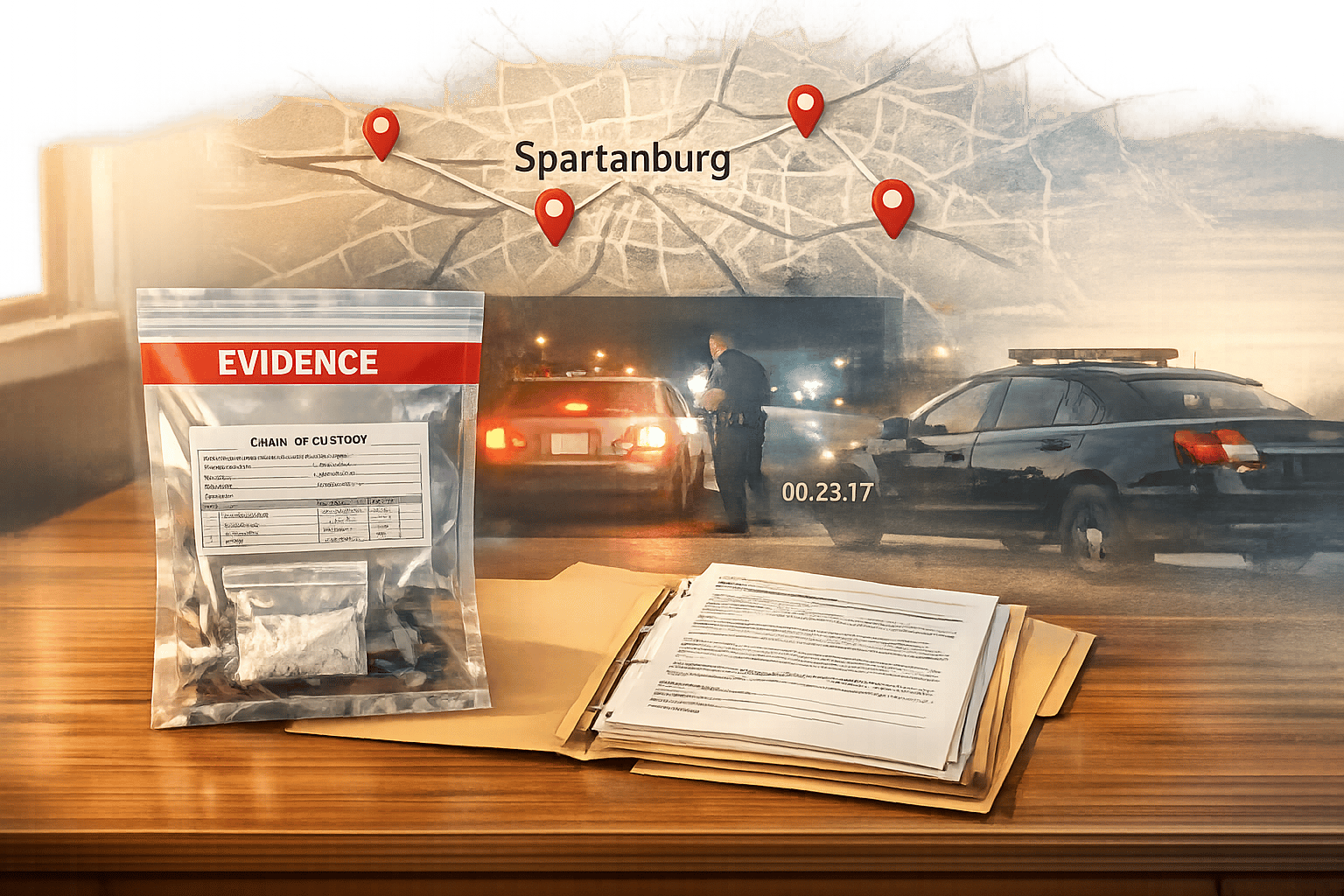
In Spartanburg, police use a combination of traffic stops, surveillance, informants, and evidence collection protocols to build drug possession cases. Key tactics include:
- Traffic Stops: Minor violations (e.g., speeding, following too closely) often lead to searches. Drug-sniffing dogs are commonly used to establish probable cause.
- Surveillance: Officers monitor highways like I-85 and I-26, use unmarked vehicles, and stake out high-crime areas. Electronic tools like license plate readers track vehicle movements.
- Undercover Operations: Officers conduct stings, including reverse drug buys, often using body cameras for evidence.
- Informants: Confidential informants and cooperating defendants provide intelligence, but their reliability is often questioned.
- Evidence Handling: Strict protocols govern the collection, storage, and testing of seized drugs. Any lapse in the chain of custody can weaken cases.
Defense attorneys frequently challenge these cases by questioning the legality of searches, the reliability of informants, and the integrity of evidence. Recent scandals, such as corruption charges against former Sheriff Chuck Wright, have further raised concerns about the credibility of investigations.
Understanding your rights – like refusing warrantless searches and seeking legal advice promptly – is critical to protecting yourself in these situations.
Surveillance Methods Used by Spartanburg Police
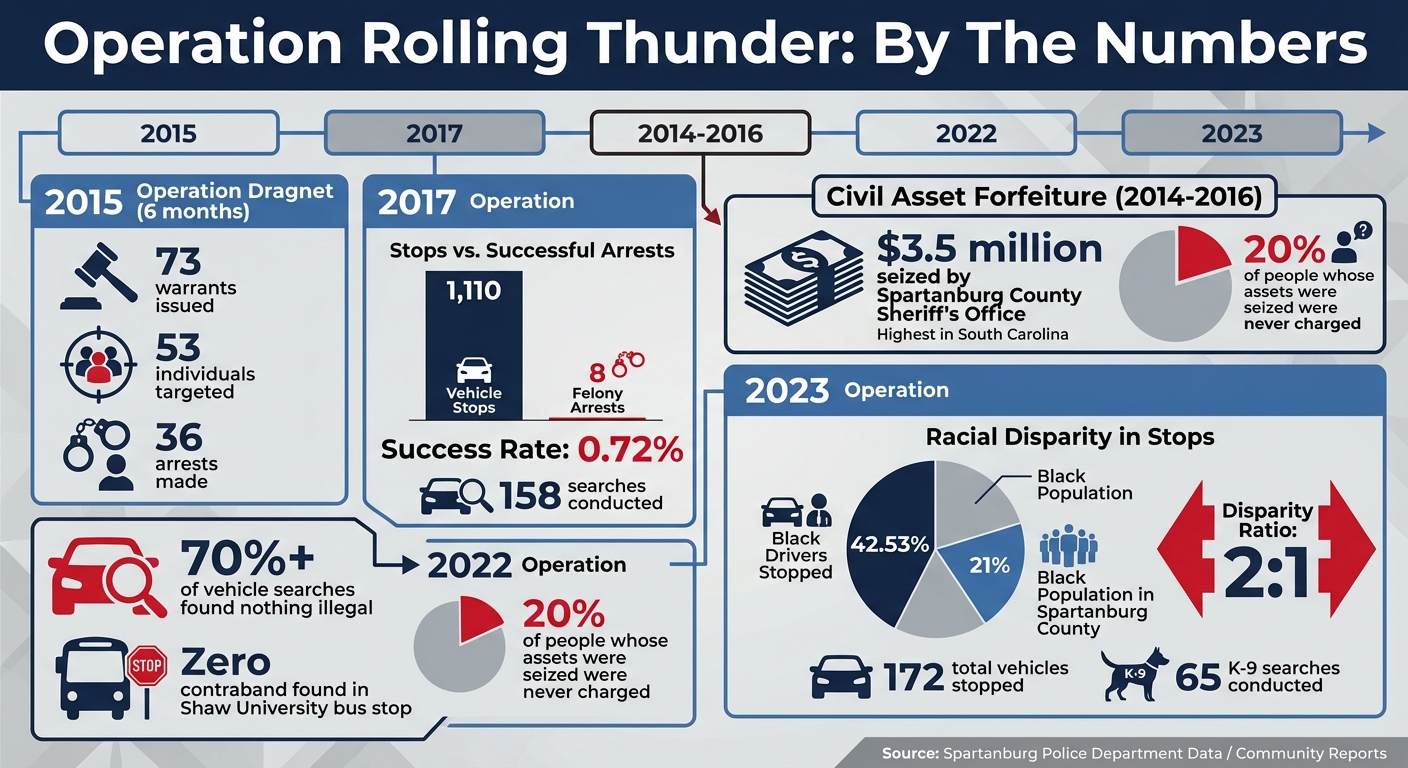
Spartanburg Police Drug Case Statistics: Operation Rolling Thunder Results 2017-2023
The Spartanburg Police Department employs a mix of physical, undercover, and electronic surveillance to monitor suspected drug activity and gather evidence. These strategies often serve as the foundation for broader operations, combining different methods to build strong cases.
Physical Surveillance
Spartanburg officers focus on key highways like I-85 and I-26, often referred to as drug corridors. For example, during a 2017 operation, police conducted 1,110 vehicle stops in just one week, resulting in 158 searches. Officers use unmarked SUVs to discreetly monitor traffic, positioning themselves at interchanges to identify potential targets. Corporal Danny Blackwell of the Spartanburg County Sheriff’s Office likened the approach to fishing:
"They aren’t assigned specific locations, so they go looking for prime spots. ‘Kinda like fishing’".
In addition to highway surveillance, officers stake out high-crime areas within the city, often relying on K-9 units to assist in searches. A notable example is the 2023 Operation Rolling Thunder, which involved 65 K-9 searches across 172 vehicles. With Spartanburg’s crime rate standing at 81.85 per 1,000 residents – one of the highest in South Carolina – stakeouts are a critical tool for observing hand-to-hand transactions and other suspicious activities in public spaces.
Undercover Operations
Undercover officers play a significant role in Spartanburg’s drug enforcement efforts. These teams often conduct reverse buys, posing as sellers to catch suspects in the act. One such operation, "Operation Dragnet", ran for six months in 2015. During this sting, officers used body cameras to record transactions involving various drugs. Sheriff Chuck Wright explained:
"Undercover teams participated in reverse buys while wearing the body cameras, which caught the suspects buying illegal items".
This operation resulted in 73 warrants for 53 individuals, leading to 36 arrests. These long-term operations allow officers to build extensive cases, often targeting multiple suspects simultaneously. By using unmarked vehicles and blending into communities, undercover officers establish trust with suspects before making arrests.
Electronic Surveillance
Spartanburg law enforcement also leverages technology like Automated License Plate Readers (ALPR) to track and monitor vehicles. These systems capture license plate information, along with timestamps and GPS data, which are then uploaded to central databases such as Vigilant Solutions‘ LEARN system. This enables officers to review travel histories and identify vehicles associated with specific locations tied to drug activity.
How Informants Help Build Drug Cases
Informants are a key part of how Spartanburg police tackle drug cases, complementing surveillance and undercover work. They allow officers to penetrate drug networks that would otherwise be out of reach for uniformed law enforcement. Instead of waiting for crimes to surface, Spartanburg authorities use informants to actively investigate and uncover hidden criminal activity.
Types of Informants
Spartanburg officers rely on two main types of informants. Confidential informants are individuals who work secretly with detectives, often providing long-term intelligence from within drug networks. Meanwhile, cooperating defendants are individuals already charged with crimes who share information in hopes of receiving lighter sentences.
Informants often assist by performing controlled drug buys in specific locations. They alert nearby officers when drugs are detected, setting the stage for arrests. Operations like Dragnet highlight how informants can directly lead to significant busts. However, working with informants isn’t without its challenges – there are risks that can compromise the integrity of a case.
Reliability and Legal Challenges
One of the biggest hurdles in using informants is their reliability. Their motives can be as questionable as the crimes they expose. Many informants have criminal records and cooperate primarily to avoid jail, which can create incentives to exaggerate or fabricate information.
Defense attorneys often target this vulnerability by questioning whether search warrant affidavits sufficiently establish the informant’s reliability and the basis of their knowledge. A notable case, State v. Dunbar (2004), saw a South Carolina appellate court overturn drug trafficking convictions. The court found that the officer who signed the search warrant affidavit lacked personal knowledge of the informant’s tip, and the officer who actually spoke to the informant was never sworn in. The ruling emphasized that magistrates must remain "neutral and detached", rather than merely approving police requests without scrutiny.
Recent scandals have further complicated informant credibility. For example, in October 2025, former Sheriff Chuck Wright pleaded guilty to federal charges, including conspiracy to commit wire fraud and illegally obtaining 147 pills of oxycodone and hydrocodone through the department’s drug disposal program between May and September 2023. This FBI and SLED investigation into Wright’s corruption provides defense attorneys with fresh arguments to challenge the integrity of drug cases handled during his tenure. Such events underscore the importance of questioning the reliability of investigations and the informants involved.
Evidence Collection and Seizure Methods
When Spartanburg law enforcement identifies a suspect or location, they adhere to strict evidence collection protocols. Any misstep in these procedures could provide a defense attorney with grounds to challenge the case.
Search and Seizure Protocols
According to South Carolina Code § 17-13-140, search warrants for drugs must be issued by a magistrate or judge. These warrants are based on a sworn affidavit that demonstrates probable cause and must clearly specify the property to be seized and the person or location to be searched. Officers are required to execute the warrant within 10 days. After carrying out the search, they must prepare a signed inventory of all seized items and submit it to the issuing judicial officer. If requested, a copy of this inventory must also be given to the individual from whom the property was taken.
In addition to warrant-based searches, Spartanburg law enforcement also conducts searches during traffic stops. Officers may use minor infractions, like a missing license plate or following another vehicle too closely, as legal grounds to initiate a stop. If the driver refuses to consent to a search, drug-sniffing dogs are often brought in to establish probable cause.
Seizing Drugs and Paraphernalia
Once officers locate drugs or drug-related items, they must document the seizure immediately and meticulously. South Carolina regulations mandate that a written record of any controlled substance seizure be completed within 72 hours. This record must include details such as the officer’s name, their agency, the date, location, and method of seizure.
To maintain the integrity of the evidence, officers complete an Initial Custody Form, which provides a detailed description of the substance or container, ensuring it can be distinguished from other evidence. This form stays with the evidence until it is sent to a forensic laboratory for testing. If the evidence changes hands, the transferring officer must include a statement confirming that the substance remains in "substantially the same condition" as when it was originally seized. Any modifications, such as opening a container for field testing, must be documented in writing and included in the chain of custody records.
Seized drugs must be delivered to a secure repository or forensic lab within 72 hours unless specific exceptions apply. If the evidence is suspected of being contaminated with bloodborne pathogens, it must be sealed in leak- and puncture-resistant containers marked with a red or orange biohazard symbol.
Chain of Custody Procedures for Drug Evidence
Once drugs are seized, maintaining a meticulous chain of custody is critical to ensure the evidence is handled properly and remains admissible in court. This process tracks every movement of the evidence from the moment of seizure to its presentation in court. Any gap in this chain can render the evidence unusable.
Evidence Collection Stage
When an officer in Spartanburg seizes drugs, they are required to document the incident within 72 hours. This documentation, known as the Initial Custody Form, includes key details such as the officer’s name and agency, the exact date and location of the seizure, whether the drugs were obtained via a warrant or arrest, and a detailed description of the substance or its container. The description must be thorough enough to distinguish this evidence from other items. If the container is opened or altered in any way, it must be noted and attached to the custody record. After this, the evidence is forwarded for forensic analysis, with its handling carefully tracked at every step.
Testing and Analysis Stage
When the evidence arrives at a forensic lab, every transfer is logged on a Subsequent Change of Custody Form. This form requires details about who received the evidence, the date it was received, whether it arrived in person or by mail, and the identity of the person who handed it over. Additionally, the recipient must confirm that the evidence is in "substantially the same condition" as when it was initially received. For the lab results to hold up in court, the analysis must be conducted by a chemist certified by the State Law Enforcement Division (SLED), following approved SLED protocols. After testing, strict procedures govern how the evidence is stored and transported.
Storage and Transportation Protocols
The Spartanburg Police Department Property and Evidence Division follows rigorous procedures to ensure evidence security. According to department policies, "All property and evidence coming into or leaving the division are strictly regulated under our ‘chain of custody’ policy". Evidence custodians are prohibited from altering controlled substances except for necessary forensic testing, and any changes must be documented in writing. The original signed custody forms must remain with the evidence until it reaches the lab for analysis. For items suspected of containing bloodborne pathogens, they must be sealed in leak-resistant containers clearly marked with a red or orange biohazard symbol.
sbb-itb-ce0cbb0
How Police Establish Probable Cause for Arrest
Probable cause is the legal standard that officers must meet before making an arrest or conducting a search. In Spartanburg, establishing probable cause involves a two-step process: first, identifying the historical facts that led to the stop or search, and second, determining if those facts would lead a reasonable officer to believe a crime had occurred. This standard is stricter than reasonable suspicion, which is sufficient only to initiate contact. Together, these elements form the foundation for evidence used in ongoing investigations.
Traffic stops often serve as the starting point for deeper investigations. Officers commonly use minor traffic violations – like speeding, following too closely, or failing to wear a seatbelt – as a reason to pull drivers over. Once the stop is made, further investigation often relies on subjective observations. For instance, the smell of marijuana or a drug-sniffing dog’s alert during a stop can provide the legal basis for a search, even without the driver’s consent.
Justice Jean H. Toal explained: "First, a court must determine the events which occurred leading up to the stop or search. Second, the court must decide whether these historical facts, viewed from the standpoint of an objectively reasonable police officer, amount to reasonable suspicion or to probable cause".
Probable cause isn’t limited to physical evidence; testimonial inputs also play a role. Witness statements and informant tips can help establish probable cause, but they must meet certain reliability standards. A case from January 2017 highlights this: Laurens County deputies received a tip claiming Sylvester Ferguson was "cooking dope" in an apartment near Spartanburg. Acting on this information, officers conducted a "knock and talk", which led to the discovery of methamphetamine manufacturing equipment. However, in June 2022, the South Carolina Court of Appeals ruled this evidence inadmissible because the tip didn’t meet reliability criteria. The officer had failed to obtain the informant’s name, verify how they knew the information, or conduct independent surveillance before proceeding.
Probable cause can also be established without finding drugs directly on a person. This is where the concept of constructive possession comes into play – officers can link suspects to drugs found in property they control. However, proving this connection isn’t always straightforward. For example, in one case, US$1.7 million in cash was discovered hidden in an SUV, but charges weren’t filed because there was no direct evidence tying the driver to the money. Hampton County Chief Deputy William Jarrell explained:
"The driver ‘denied any knowledge of the money, and we had no way to connect it to him’".
Common Weaknesses in Drug Possession Cases
Even when law enforcement follows established procedures, drug possession cases often have inherent flaws that defense attorneys can target. From questionable search methods to mishandled evidence and unreliable informants, these weak points frequently play a key role in defending Spartanburg drug possession cases.
Challenging Illegal Searches
The exclusionary rule is one of the most effective tools in a defense attorney’s arsenal. It bars prosecutors from using evidence obtained through unconstitutional searches. If a search violates your Fourth Amendment rights, any drugs or related evidence obtained unlawfully can be excluded from trial.
Take Spartanburg’s Operation Rolling Thunder campaigns as an example. These initiatives highlight how often searches might fail to meet legal standards. During the October 2022 campaign, more than 70% of the vehicle searches turned up nothing illegal. Similarly, in 2017, officers stopped 1,110 vehicles but made only eight felony arrests. These numbers suggest that many stops may have lacked sufficient probable cause. Defense attorneys can file motions to suppress such evidence, which can significantly weaken the prosecution’s case.
Another common issue arises with extended traffic stops. Once the original purpose of a stop – like issuing a speeding ticket – is resolved, officers need additional reasonable suspicion to justify further detention. The South Carolina Supreme Court has expressed skepticism about officers relying on vague indicators like "nervousness" to prolong stops. Justice Kittredge captured this concern, stating:
"We, like many appellate courts, have become weary with the many creative ways law enforcement attempts to parlay the single element of nervousness into a myriad of factors supporting reasonable suspicion."
Carefully documenting the timeline of a stop, including any delays for drug-sniffing dogs, can expose procedural missteps. If delays are unjustified, the evidence obtained may be ruled inadmissible.
Disputing Evidence Integrity
Even when evidence is legally obtained, its integrity can come under scrutiny. Issues like chain-of-custody lapses create opportunities for contamination or mishandling, which can weaken the prosecution’s case. Defense attorneys often question whether evidence was properly collected, stored, tested, and transported. Laboratory results aren’t immune to errors either – questions about the accuracy of drug identification, the qualifications of lab technicians, or incomplete documentation can all cast doubt on the evidence.
Drug-sniffing dogs also introduce potential problems. Records from Spartanburg show instances of false positives, which can undermine probable cause. Defense strategies often include challenging a dog’s training records or alert history to expose inconsistencies. These tactics can further erode the prosecution’s case and lead to broader questions about the reliability of informant testimony.
Addressing Informant Credibility
Informant testimony is another area ripe for challenge. Informants often have credibility issues, and defense attorneys should investigate whether law enforcement independently verified the information or conducted surveillance before taking action.
Financial incentives can also cast doubt on the motivations behind informant tips. Between 2014 and 2016, the Spartanburg County Sheriff’s Office seized nearly $3.5 million through civil forfeiture – more than any other agency in South Carolina. Alarmingly, nearly 20% of the individuals who had assets seized during this period were never charged with a related crime. This raises questions about whether stops were based on solid intelligence or driven by revenue goals.
Racial disparities in stop patterns further undermine the credibility of informant-based intelligence. During the 2023 Operation Rolling Thunder, 42.53% of those stopped were Black, despite Black residents making up only 21% of Spartanburg County’s population. Such disparities suggest profiling may have influenced stops rather than legitimate probable cause. In one incident from October 2022, law enforcement stopped a bus carrying students from Shaw University, a historically Black college, for a lane violation. A search involving drug-sniffing dogs found no contraband, and the driver received only a traffic citation. This incident led to a federal civil rights complaint against the Spartanburg Sheriff’s Office. These patterns of questionable informant reliability and profiling can bolster a defense against charges based on weak or biased intelligence.
Protecting Your Rights in Spartanburg
Understanding how law enforcement operates in Spartanburg is crucial to safeguarding your rights. By familiarizing yourself with local police tactics, you can better recognize and respond to situations where your constitutional protections might be at risk. For example, stops initiated on shaky pretexts or based on informant tips can sometimes infringe on your rights. Being prepared for these scenarios can help you act decisively and protect yourself.
One key step is to assert your rights immediately. Refuse any warrantless searches to uphold your Fourth Amendment protections. Keep your interactions focused solely on the reason for the stop, as sharing more information than necessary could inadvertently provide grounds for further investigation.
Civil asset forfeiture is another area of concern in South Carolina. Between 2014 and 2016, authorities seized nearly $3.5 million in assets, often with delayed filings and no public defenders available to assist those affected. If you find yourself in such a situation, seeking legal counsel without delay is critical.
South Carolina’s Constitution offers even stronger privacy protections than the federal Fourth Amendment, especially when it comes to your home. The South Carolina Court of Appeals has underscored this point:
The privacy interests in one’s home are the most sacrosanct, [and] there must be some threshold evidentiary basis for law enforcement to approach a private residence.
This means that before conducting a "knock and talk" investigation, police must have reasonable suspicion of illegal activity.
The Brendan M. Delaney Law Firm LLC brings over 24 years of experience to cases involving constitutional violations, informant credibility, evidence challenges, and civil asset forfeiture. If you’re facing drug possession charges or asset seizures, securing specialized legal representation right away is essential. Taking a proactive stance can make all the difference in defending your case in Spartanburg.
FAQs
How do police in Spartanburg determine probable cause for drug possession arrests?
In Spartanburg, police determine probable cause for drug possession arrests by collecting evidence and making observations that reasonably indicate a crime has taken place. This might involve surveillance, tips from investigations, or direct encounters, such as spotting drugs in plain view during a traffic stop or observing what appears to be a drug deal.
Officers may also use information from informants or evidence gathered during operations focused on illegal drug activities. These approaches are designed to align with constitutional standards, ensuring there’s a solid basis for any arrests or searches. Knowing how these processes work can help you better understand your rights and prepare a defense if necessary.
What do informants do in drug possession investigations?
Informants play a significant role in drug possession cases in Spartanburg, offering law enforcement critical insights and assistance. They might provide tips or observations about suspected drug activity, helping authorities pinpoint individuals or locations for further investigation. In some instances, informants take part in controlled buys, where they purchase drugs from suspects under police supervision. These operations typically involve tools like recording devices and marked money to collect solid evidence.
However, while informants can be helpful in building cases, their reliability isn’t always guaranteed. Defense attorneys often scrutinize their credibility or question the legality of their actions during court proceedings. Knowing how informants are utilized can give you a clearer understanding of your rights and possible legal strategies if you’re facing drug possession charges.
What are the most common defenses against drug possession charges in Spartanburg?
Defending against drug possession charges in Spartanburg often hinges on scrutinizing how the evidence was gathered or challenging the prosecution’s ability to prove their case beyond a reasonable doubt. For example, if law enforcement carried out a search or seizure without probable cause, any evidence they obtained could be deemed inadmissible. Likewise, if the drugs were discovered in a shared or public area, it might be argued that the defendant neither knowingly nor intentionally possessed them.
Other defense strategies often involve questioning the credibility of informants, highlighting inaccuracies in drug testing or lab reports, or exposing gaps in the chain of custody for the evidence. These approaches aim to weaken the prosecution’s case while safeguarding the defendant’s constitutional rights. The primary objective is to cast doubt on the legitimacy of the charges or the evidence being used.