


In Spartanburg County, South Carolina, juvenile records for nonviolent offenses can be sealed through a legal process called expungement. This process removes records from public access, helping individuals move past their juvenile offenses without the burden of disclosure during job applications, housing, or education opportunities. Here’s what you need to know:
- Eligibility: You must be at least 18 years old (exceptions apply for "Not Guilty" verdicts), have no pending charges, and the offense must be nonviolent.
- Cost: The standard fee is $310, but fees may be waived for dismissed or "Not Guilty" cases.
- Timeline: The process typically takes 6-8 weeks after submitting all required documents.
- Steps:
- Obtain a criminal record check from SLED.
- Gather certified court documents and proof of age.
- Submit your application with fees to the Solicitor’s Office.
- Await eligibility confirmation and court approval.
Law enforcement may retain sealed records for internal use, but they’re inaccessible to the public. Sealing your record can reduce barriers to future opportunities, making it an important step for eligible individuals.
South Carolina Laws for Juvenile Record Sealing
In South Carolina, juvenile records can be removed from public access through a process known as expungement. The state’s Children’s Code, specifically SC Code § 63-19-2050, serves as the guiding statute for the destruction of these records. Once individuals reach the age of 18, they can petition to have nonviolent juvenile offenses expunged.
In Spartanburg County, this process is managed by the Seventh Judicial Circuit Solicitor’s Office, following state law. Applicants must file their petitions in the circuit where the arrest occurred. From there, the Solicitor’s Office works with the Department of Juvenile Justice (DJJ) and the South Carolina Law Enforcement Division (SLED) to determine eligibility.
Sealing vs. Expungement: What’s the Difference?
In South Carolina, "expungement" refers to the removal of a record from public access, while "sealing" means the record is restricted but still accessible to law enforcement and prosecutors. Under SC Code § 17-1-40, records that are sealed are "not subject to disclosure other than to a law enforcement or prosecution agency, and attorneys representing a law enforcement or prosecution agency, unless disclosure is allowed by court order."
Law enforcement agencies retain sealed records for three years and 120 days. After this period, the records are destroyed unless they are actively needed for an investigation or legal proceedings.
Relevant South Carolina Statutes
Several key statutes outline the rules and procedures for expunging or sealing juvenile records:
| Statute | Purpose |
|---|---|
| SC Code § 63-19-2050 | Governs the destruction of juvenile records for nonviolent offenses |
| SC Code § 17-1-40 | Defines "under seal" and specifies retention guidelines for law enforcement |
| SC Code § 17-22-910 | Provides the general framework under the Uniform Expungement Act |
| SC Code § 17-22-940 | Describes the administrative steps for applying through the circuit solicitor |
| SC Code § 17-22-950 | Covers expungements for cases dismissed, nolle prossed, or resulting in a "not guilty" verdict |
These statutes clarify that individuals must generally wait until they turn 18 to file a petition, unless a "Not Guilty" verdict was issued in Family Court. To qualify, the offense must be nonviolent, and the applicant cannot have any additional adjudications or pending charges in Family Court or General Sessions.
The next sections will break down the qualifications and step-by-step process for sealing juvenile records in Spartanburg County.
Who Qualifies to Seal Juvenile Records
Sealing juvenile records in Spartanburg County comes with specific requirements. South Carolina law outlines these criteria clearly, so it’s important to review them carefully to avoid unnecessary delays or expenses.
To file for expungement of non-violent juvenile offenses, you must be at least 18 years old . The only exception is if you were found "Not Guilty" in Family Court, in which case you can apply before turning 18. Additionally, you must have completed your sentence and met all associated requirements .
Your criminal history is another crucial factor. At the time of your application, you cannot have any pending charges in Family Court or General Sessions. Moreover, you must not have any new convictions or adjudications linked to the offense you’re seeking to expunge. As the Spartanburg County Solicitor’s Office states:
We do not know what can be expunged until we can look at the complete criminal record.
Below, we’ll explore which juvenile cases qualify for sealing and the factors that might disqualify you.
Which Juvenile Cases Can Be Sealed?
Certain cases are eligible for sealing, particularly those resolved through diversion programs like the Juvenile Arbitration Program offered by the 7th Circuit Solicitor’s Office. Once all program requirements are fulfilled – typically within about three months – the case is closed as a "Diverted charge", leaving no record of conviction or adjudication.
Some outcomes require mandatory expungement, meaning the records must be destroyed regardless of the offense. These include cases where you were found not guilty, or where charges were dismissed or nolle prossed . For these outcomes, you don’t have to wait until you’re 18 to apply for expungement.
Next, let’s look at the circumstances that could prevent a record from being sealed.
Factors That May Prevent Sealing
Certain situations make sealing juvenile records impossible. For example, adjudications for violent crimes are not eligible for expungement .
You’re also ineligible if the offense you were adjudicated for would carry a maximum sentence of five years or more if committed by an adult. This applies even if the offense isn’t classified as violent. Additionally, failing to complete your sentence or facing new criminal charges will result in denial .
How to Seal Juvenile Records in Spartanburg County
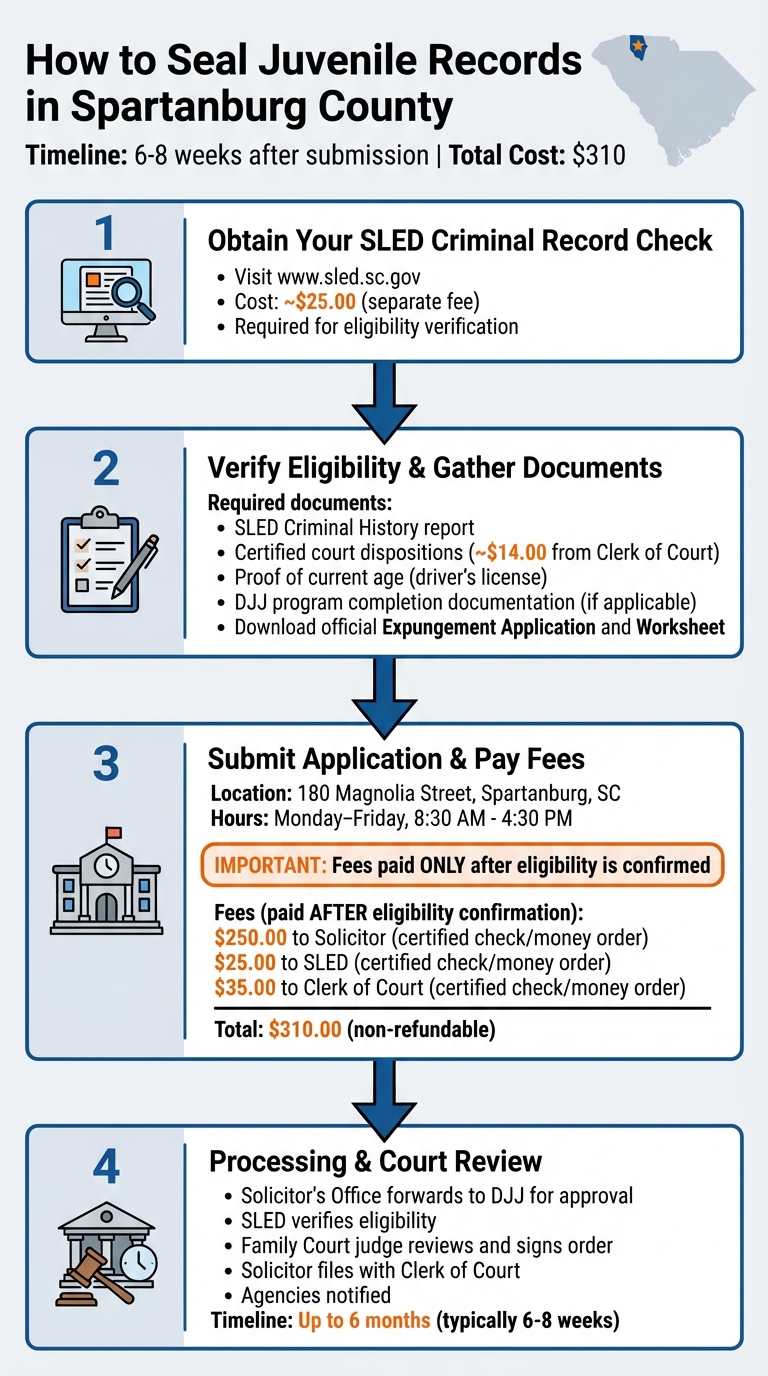
4-Step Process to Seal Juvenile Records in Spartanburg County SC
If you’re eligible to seal your juvenile records in Spartanburg County, you’ll need to follow the steps outlined by the Seventh Judicial Circuit Solicitor’s Office. This process involves several agencies and can take up to six months to complete. Here’s a breakdown of the steps:
Step 1: Obtain Your SLED Criminal Record Check
Start by getting your SLED Criminal History report from www.sled.sc.gov. Be aware that this background check requires an additional fee, which is separate from the application fees.
Step 2: Verify Eligibility and Gather Necessary Documents
Collect all required certified documents and proof of your current age. You can download the official Expungement Application and Worksheet from the 7th Circuit Solicitor’s Office website.
For charges related to your case, obtain certified dispositions from the Clerk of Court in the county where the charges were filed. Keep in mind that standard printouts or public index copies won’t work – you must provide official certified copies, which generally cost about $14.00. Additionally, include proof of your current age, such as a driver’s license. If your case involved arbitration or a Department of Juvenile Justice (DJJ) program, you’ll need documentation showing you successfully completed it.
Once you’ve gathered all the required documents, you’re ready to move forward with your application.
Step 3: Submit Your Application and Pay the Fees
Submit your application in person at the Solicitor’s Office, located at 180 Magnolia Street, Spartanburg, SC. Office hours are Monday through Friday, from 8:30 a.m. to 4:30 p.m. According to Spartanburg County Government:
"Fees are not due at the time of application. If your charge(s) is eligible for expungement, you will be notified of any fees necessary to process your request".
Upon confirmation of eligibility, you’ll need to pay the following fees using separate certified checks or U.S. Postal Money Orders:
- $250.00 to the Solicitor
- $25.00 to SLED
- $35.00 to the Clerk of Court
Step 4: Processing and Court Review
After submitting your application and fees, the Solicitor’s Office will forward your paperwork to the Department of Juvenile Justice (DJJ) for approval, followed by SLED for eligibility verification. Once SLED confirms your eligibility, a family court judge will review and sign your expungement order. The Solicitor’s Office will then file the order with the Clerk of Court and notify the relevant agencies.
The entire process can take up to six months, though records are usually removed from your file within 6 to 8 weeks after the court approves the expungement .
Costs and Fees for Sealing Juvenile Records
When applying to seal juvenile records, it’s important to understand the associated costs to avoid surprises. The typical fee for sealing records amounts to $310.00, broken down as follows: $250.00 for the Solicitor’s Office, $25.00 for SLED, and $35.00 for the Clerk of Court. Additionally, there’s an approximate $25.00 charge for the initial SLED background check.
Payments must be made via separate certified checks or money orders, as personal checks are not accepted. These fees are non-refundable, even if your application is denied.
Fee Reductions and Exceptions:
If your case was dismissed, nol prossed, or resulted in a not guilty verdict – and the dismissal wasn’t tied to a plea deal – the standard fees may be reduced. In such cases, the Spartanburg County Clerk of Court may only charge around $14.00 for certified copies.
In rare situations, such as cases involving identity theft, the $250 administrative fee can be waived. According to Spartanburg County Government, this waiver is only granted if SLED verifies the identity theft through fingerprinting. Understanding these exceptions is key before moving forward with your application.
While hiring an attorney isn’t required, which can help lower costs, South Carolina Legal Services provides free legal help to eligible low-income residents. However, even with free legal assistance, you’ll still need to cover the statutory fees unless you qualify for a waiver.
Before making any payments, wait for the Solicitor’s Office to confirm your eligibility. This step ensures you avoid unnecessary expenses.
sbb-itb-ce0cbb0
Cases That Cannot Be Sealed
In Spartanburg County, not all juvenile records qualify for sealing. South Carolina law explicitly excludes certain offenses and situations from eligibility. For instance, adjudications for violent crimes, as outlined in South Carolina Code Section 16-1-60, are permanently ineligible for sealing. The SC Eleventh Judicial Circuit Solicitor’s Office confirms that violent crimes and specific traffic convictions under this section cannot be sealed.
Additionally, records tied to serious offenses – those that would result in a maximum prison sentence of five years or more if committed by an adult – are also excluded. If the terms of the original sentence, such as probation, restitution, or community service, remain incomplete, the record cannot be sealed.
Other circumstances that disqualify records include subsequent convictions, pending charges in Family Court or General Sessions, and certain traffic-related offenses or charges dismissed during a preliminary hearing. It’s essential to ensure all legal matters are fully resolved before applying, as the application fees are non-refundable.
To avoid unnecessary costs and delays, confirm your offense classification and review your case details thoroughly to determine if your record is eligible for sealing.
How Sealing Juvenile Records Affects Your Future
Once your juvenile record is sealed, it’s no longer accessible to the public. This step helps restore your legal standing and gives you a fresh start.
In South Carolina, you’re not legally required to disclose sealed records on job, housing, or school applications. However, some private background check companies might still show outdated information. If this happens, you can provide a certified copy of your sealing order to have the records corrected. To confirm the sealing has been properly executed, you can request a SLED criminal background check at www.sled.sc.gov after the process is complete.
Here’s what you need to know about how sealed records appear on background checks and when law enforcement can still access them.
How Sealed Records Show Up on Background Checks
Once sealed, juvenile records in Spartanburg County are removed from public files by government agencies. Depending on the process, the records are either destroyed or securely sealed. This means that standard background checks conducted by employers, landlords, or educational institutions won’t reveal the sealed charges.
"When the expungement process is complete, the expunged charges are removed from the public record files of government agencies and the expunged charges are either destroyed or sealed."
– SC Eleventh Judicial Circuit Solicitor’s Office
Because of this, you’re legally allowed to answer “no” if asked whether you’ve been arrested or charged with a crime.
When Law Enforcement Can Still Access Sealed Records
Although sealed records are hidden from public view, certain agencies retain access. Law enforcement and prosecution agencies can keep sealed records, such as arrest details, mugshots, and fingerprints, for at least three years and 120 days.
"Law Enforcement, Prosecution agencies and Detention/Correctional facilities are not obligated to destroy records under state law; however the information is not for public dissemination."
– Spartanburg County FAQ
Law enforcement can access sealed records indefinitely for investigations, prosecutions, legal hearings, or defending against litigation. In some cases, courts may order the release of sealed records. However, these records cannot be shared with the general public. Any government employee who intentionally violates this confidentiality could face contempt of court charges, a misdemeanor conviction, a fine of up to $100, and up to 30 days in jail.
Conclusion
Sealing juvenile records in Spartanburg County offers a way to clear your criminal history and move forward. If you’re 18 or older and have completed all court-ordered obligations for a nonviolent offense, you may qualify for record expungement. The process, managed by the Solicitor’s Office, DJJ, SLED, and Family Court, usually takes about 6 to 8 weeks to complete. Successfully sealing your record can help remove long-standing challenges in areas like employment, housing, and education.
The total cost for expungement is $310.00, which must be paid using certified funds. Keep in mind, these fees are non-refundable, even if your application is denied . To avoid unnecessary expenses, it’s crucial to first request a SLED criminal record check to confirm your eligibility.
"The effect of the expungement order is to restore the person in the contemplation of the law to the status the person occupied before being taken into custody."
– S.C. Code Ann. § 63-19-2050(E)
Once your record is sealed, you are no longer legally required to disclose it when applying for jobs, housing, or educational opportunities. This process helps eliminate barriers tied to past offenses, giving you a chance to reclaim opportunities that might have been out of reach. Make sure to keep a certified copy of your final expungement order indefinitely, as it may be needed to address outdated information on private background checks.
Because the process involves multiple agencies and has strict eligibility criteria, seeking legal advice can make a big difference in ensuring your application is complete and accurate. In Spartanburg County, juvenile expungement applications for the 7th Judicial Circuit are handled by the Pre-Trial Intervention Office located at 180 Library St.. For additional guidance, reach out to the appropriate legal office to confirm your application meets all necessary requirements.
FAQs
What are the advantages of sealing juvenile records in Spartanburg County?
Sealing juvenile records in Spartanburg County can open doors to new opportunities. It removes the weight of past charges, making it easier for individuals to find employment, secure housing, and pursue education without the stigma of a juvenile record holding them back. Once sealed, these records are no longer available to the public, clearing the path for a fresh start.
This process also safeguards privacy by restricting access to sensitive personal information. By focusing on rehabilitation, it offers eligible individuals the chance to rebuild their lives and become fully engaged members of their communities. For many, this step can profoundly impact their ability to move forward and create a better future for themselves and their families.
Can fees for sealing juvenile records in Spartanburg County be waived?
Yes, under South Carolina law, certain fees for sealing juvenile records in Spartanburg County can be waived depending on the situation. Normally, these fees include a $250 administrative fee, a $25 SLED verification fee, and a $35 filing fee to the county clerk of court. However, there are specific cases where exemptions might apply.
For instance, if the charges were dismissed, discharged, or marked as nolle prossed, the administrative fee may not be required. That said, exceptions exist – such as when charges are dismissed during a preliminary hearing or are tied to other pending charges from the same incident. Additionally, cases handled in magistrate or municipal courts that end in dismissal or a not-guilty verdict may also qualify for fee waivers.
Some local offices, like the Spartanburg Pre-Trial Intervention Office, may provide free processing for certain expungements if applicants meet the required criteria. To confirm eligibility for a fee waiver, it’s best to consult with the relevant local office or a legal professional.
How can I check if my juvenile record has been sealed in Spartanburg County?
If you want to check whether your juvenile record has been sealed in Spartanburg County, start by using the South Carolina Judicial Branch’s public case records system. Typically, if the record has been sealed, it won’t show up in the public index, or it might explicitly state that it’s sealed or expunged.
Another option is to contact the office that handles juvenile records or the solicitor’s office in Spartanburg County. They can give you official confirmation that your record has been sealed and is no longer publicly accessible. For the most reliable details, it’s best to connect directly with these local authorities.