




Filing for divorce in South Carolina involves clear steps and specific legal requirements. Here’s what you need to know:
- Residency: One spouse must have lived in SC for at least one year (or three months if both live in SC).
- Grounds: Choose between the no-fault option (1-year separation) or fault-based reasons like adultery, physical cruelty, habitual drunkenness, or desertion.
- Filing: Submit a Summons and Complaint for Divorce, Financial Declaration, and Family Court Cover Sheet. The filing fee is $150, but fee waivers are available if you qualify.
- Serving Papers: Your spouse must be served by a third party. They have 30 days to respond.
- Property and Alimony: SC follows equitable distribution for assets and debts. Adultery disqualifies a spouse from receiving alimony.
- Timeline: No-fault divorces require a 1-year separation before filing, with a 30-day wait for finalization. Fault-based divorces require at least 90 days post-filing.
Understanding these steps ensures smoother navigation of the process. Proper documentation, legal knowledge, and preparation are key.
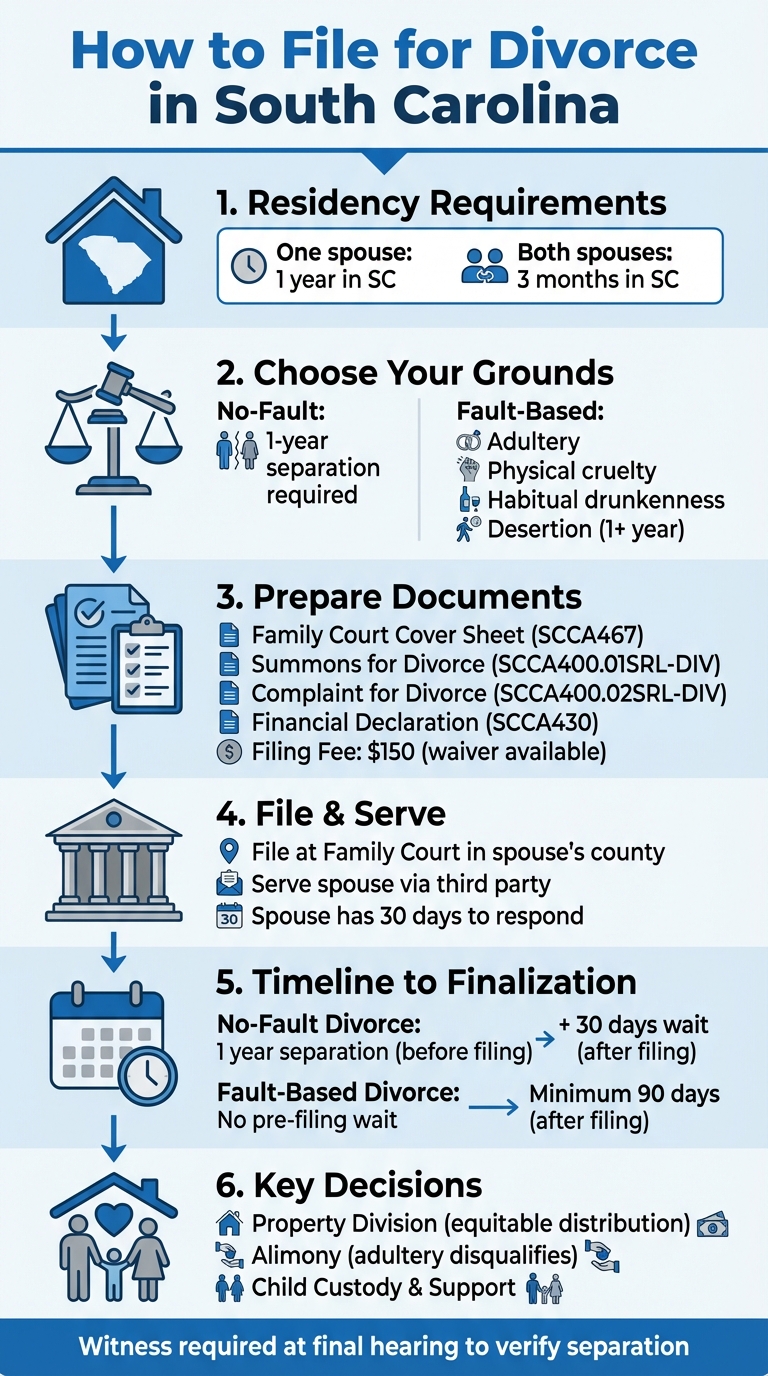
South Carolina Divorce Filing Process: Steps, Timeline, and Requirements
Eligibility and Grounds for Divorce in South Carolina
Residency Requirements
To file for divorce in South Carolina, either you or your spouse must meet specific residency rules. If only one of you lives in the state, that person must have been a resident for at least one year. However, if both spouses live in South Carolina, the residency requirement drops to three months.
When filing, submit your divorce petition to the Family Court in the county where your spouse currently resides. If your spouse lives outside the state, you can file in the county where you live or where you both last lived together. Be sure to have proof of residency ready, such as a driver’s license or utility bills. These documents are essential for meeting the filing requirements and moving forward with establishing the grounds for divorce.
Grounds for Divorce
South Carolina allows for five legal grounds for divorce: one no-fault option and four fault-based reasons. For a no-fault divorce, you and your spouse must live in completely separate residences for a continuous year.
The four fault-based grounds include:
- Adultery
- Physical cruelty
- Habitual drunkenness
- Desertion for at least one year
Choosing a fault-based ground can have a significant impact, especially on alimony. For instance, a spouse found guilty of adultery is disqualified from receiving spousal support. In cases involving physical cruelty, you’ll need to provide evidence or witness testimony to support your claim.
Contested vs. Uncontested Divorce
Divorces in South Carolina fall into two categories: uncontested and contested.
An uncontested divorce happens when both spouses agree on all major issues, such as dividing property, allocating debts, and determining child custody and support. These divorces are typically filed under the no-fault ground of one-year separation. Both parties must also waive their right to alimony. As South Carolina Legal Services explains:
In a simple divorce, both spouses must waive the right to alimony.
In contrast, a contested divorce arises when spouses cannot agree on key issues. These cases often involve fault-based grounds or disputes over assets, custody, or support – even when filed as no-fault. Contested divorces usually take longer and cost more because they often require multiple court hearings or even a trial to resolve the disagreements.
| Feature | Uncontested Divorce | Contested Divorce |
|---|---|---|
| Primary Ground | No-fault (1-year separation) | Fault-based or disputed no-fault |
| Pre-Filing Wait | 1 year of separation required | None for fault-based grounds |
| Post-Filing Wait | 30 days for final decree | Minimum 90 days for final decree |
| Alimony | Must be waived by both parties | Can be requested and litigated |
| Witness Requirement | Requires witness to verify separation | Requires evidence or witnesses for fault |
Knowing these differences can help you decide the best path forward based on your circumstances and priorities.
Preparing to File for Divorce
Required Documentation
Before filing for divorce in South Carolina, it’s crucial to gather all necessary documents to meet state requirements and provide a clear record of your marriage. Start with proof of residency, such as a driver’s license, utility bills, or lease agreements that confirm you’ve lived in South Carolina for the required duration. If you’re filing for a no-fault divorce, include documentation verifying that you and your spouse have been separated for at least one year.
You’ll also need to complete the Financial Declaration (Form SCCA430), which requires notarized signatures. If you have minor children, prepare proof that they’ve lived in South Carolina for at least six months.
For fault-based divorces, gather evidence to support your claims. This could include witness statements for issues like adultery or physical cruelty, or documentation of desertion or habitual substance abuse. Make at least three copies of every document – one for the court, one for your records, and one to serve to your spouse.
Once your documents are ready, review the official forms required to start the filing process.
South Carolina Divorce Forms You’ll Need
You can download all necessary divorce forms from the South Carolina Judicial Branch website or complete them through LawHelp.org/sc.
The filing packet typically includes the following forms:
- Family Court Cover Sheet (SCCA467)
- Summons for Divorce (SCCA400.01SRL-DIV)
- Complaint for Divorce (SCCA400.02SRL-DIV)
- Financial Declaration (SCCA430)
- Certificate of Exemption (SCRFCMFORM02)
The filing fee is $150, but if you cannot afford it, you can request a waiver by submitting a Motion and Affidavit to Proceed In Forma Pauperis (SCCA405).
Additionally, you’ll need service forms like the Acceptance of Service or Affidavit of Service when filing. To finalize the divorce, you’ll later submit a Request for Hearing, Report of Divorce or Annulment (DHEC0682), and Final Order of Divorce (SCCA400.10SRL-DIV).
For your final hearing, ensure you bring a witness who can testify to your year-long separation, as their statement is a legal requirement.
Key Legal Issues to Address
After completing the forms, focus on addressing the legal matters the court will evaluate. Proper preparation here can make a significant difference.
South Carolina follows the principle of equitable distribution, meaning marital property and debts are divided fairly, though not necessarily equally. This includes assets like real estate, retirement accounts, vehicles, and household items. Prepare a comprehensive list of all marital assets and debts to include in your filing.
Alimony is another critical issue. It can be awarded as periodic payments, a lump sum, rehabilitative support, or reimbursement. However, South Carolina law prohibits a spouse who committed adultery from receiving alimony. If alimony is a factor in your case, collect documentation of both spouses’ income, financial needs, and earning potential.
For couples with children, custody and support decisions are based on the child’s best interests. The court considers factors like who has been the primary caregiver and who can best meet the child’s needs. Child support is calculated using the South Carolina Child Support Guidelines. If custody is contested, the court may appoint a Guardian ad Litem to represent the child’s interests, with both parents sharing the associated fees. Understanding these issues in advance will help you complete your forms accurately and prepare for any negotiations or court proceedings.
Filing and Serving the Divorce
Filing the Divorce Complaint
To start the divorce process, submit your completed divorce packet to the Family Court in the county where your spouse lives. If your spouse lives out of state, you can file in your own county. The filing fee is $150, but if you can’t afford it, you can request a fee waiver by submitting Form SCCA405.
Make sure your packet includes all the necessary forms listed in the Divorce Forms section. Even if you’re not seeking financial support, the Financial Declaration is mandatory. Prepare at least three copies of every document – one for the court, one for your records, and one to serve to your spouse.
Once you file, the court clerk will assign a case number and provide stamped copies of your documents. Keep in mind that your case won’t move forward until your spouse is properly served by a third party. With your case number in hand, the next step is serving the divorce papers to your spouse.
Serving the Other Spouse
South Carolina law requires that divorce papers be served by someone other than you. A third party must handle this step, and you have a few options: a sheriff’s deputy, a professional process server, or any adult who is not involved in the case. If your spouse is willing to cooperate, they can sign an Acceptance of Service form (SCCA400.03SRL-DIV), which can save you the cost of formal service.
Another option is to serve the papers by certified mail. Use registered or certified mail with a return receipt, and make sure your spouse signs for it to confirm receipt. If you’re unable to locate your spouse after making reasonable efforts, you can ask the court for permission to use Service by Publication. This usually means publishing a notice in a local newspaper.
After your spouse has been served, you’ll need to file proof with the court. This proof could be an Affidavit of Service or the signed return receipt. Once the court confirms service, your spouse has 30 days to respond, allowing the case to move forward.
Responding to Divorce Papers
If your spouse responds within the 30-day window, they might include a Counterclaim, which turns the case into a contested divorce. In this scenario, you may need to negotiate or attend court hearings to resolve any disagreements.
If your spouse does not respond within 30 days, you can file an Affidavit of Default (SCCA400.07SRL-DIV) to proceed with the case as uncontested. Even in an uncontested divorce, you’ll still need to attend a final hearing. At this hearing, you must bring a witness to confirm that you and your spouse have been separated for at least one year. If your divorce is based on a one-year separation, it can be finalized after 30 days. For divorces based on other grounds, the timeline may extend to 90 days, depending on the court’s schedule.
sbb-itb-ce0cbb0
Court Proceedings and Finalizing the Divorce
Temporary and Settlement Hearings
During the divorce process, you might need to request temporary relief to establish rules until everything is finalized. These temporary hearings tackle urgent issues like child custody, visitation, child support, spousal support, who stays in the marital home, and how bills or debts are handled in the interim.
Unlike final trials, temporary hearings are brief and don’t involve live witness testimony. Instead, both parties submit written affidavits (usually limited to eight pages) and financial documents for the judge to review. Supporting paperwork, such as financial statements and parenting plans, is essential for these hearings.
"The hearing on a Motion for Temporary Relief is often referred to as the ‘temporary hearing.’ … It starts when the case is filed and ends when a Final Order is issued." – Megan Dell, Attorney
Temporary orders remain in effect until they are replaced by the final decree or modified due to significant changes. If no agreement is reached during the temporary hearing, the next step is mandatory mediation. A mediator, acting as a neutral party, works with both spouses to negotiate matters like property division and custody, aiming to avoid a trial.
Final Divorce Hearing or Trial
Once temporary matters are resolved, the case moves to the final hearing where the divorce is officially decided. For an uncontested divorce, you must attend the final hearing in person, though your spouse is not required to be there. A witness may also need to confirm the required separation period. During the hearing, the judge will ask questions, review testimony from you and your witness, and examine your settlement agreement and financial disclosures. The divorce becomes official only after the judge signs the Final Order of Divorce and the Judgment in a Family Court Case, and both are filed with the court clerk.
This final hearing can only happen after the mandatory waiting period: 30 days for no-fault divorces and 90 days for fault-based divorces.
For a contested divorce, where no agreement is reached, the case proceeds to trial. At trial, the judge resolves all unresolved issues, including property division, alimony, and child custody. Contested trials involve discovery (gathering evidence), live witness testimony, and formal presentation of exhibits. Depending on the complexity of the case, these trials can range from a few hours to several days.
Post-Divorce Actions
After the divorce is finalized, there are critical steps to complete. Once the judge signs the Final Order of Divorce and the Judgment, confirm that both documents have been filed with the court clerk. You’ll also need to file a Report of Divorce or Annulment of Marriage (Form DHEC0682) with vital records.
If your decree includes a name change, use the certified divorce decree to update your Social Security records, driver’s license, and other forms of legal identification. Remember, decisions about property division and debt allocation are final and cannot be revisited by the court. However, issues like child custody, child support, and certain types of alimony can be modified later if circumstances change.
If you disagree with the judge’s ruling, you must file an appeal notice within 30 days of receiving written notice of the order. Additionally, ensure compliance with all court-ordered mandates regarding property transfers, debt payments, and support obligations to avoid being held in contempt of court.
Legal Support from Brendan M. Delaney Law Firm LLC

Navigating the divorce process in South Carolina can feel overwhelming, but having the right legal support can make all the difference. Brendan M. Delaney Law Firm LLC brings over 24 years of experience in South Carolina family law, offering tailored guidance to help clients through the complexities of divorce.
The firm handles both no-fault and fault-based divorces, addressing key issues like custody, support, property division, and alimony. With a client-focused approach, they simplify the process of dividing assets, arranging custody agreements, and negotiating financial support. Their services cover everything from preparing and filing documents to mediation, final hearings, and even appeals when necessary.
One of the standout features of Brendan M. Delaney Law Firm LLC is their offer of a free initial consultation. This session allows them to review your case, confirm eligibility requirements, and determine whether your situation qualifies as no-fault or fault-based.
For cases involving intricate matters like property division, debt allocation, or alimony, having experienced legal representation is crucial. Courts typically don’t revisit these decisions once a final order is issued, so getting it right the first time is essential. In fault-based divorces, where evidence and witness testimony may be required, or in contested cases heading to trial, skilled legal counsel ensures your rights and interests are protected. The firm’s comprehensive approach helps you manage every legal and procedural hurdle with confidence.
Conclusion
Filing for divorce in South Carolina involves meeting specific requirements laid out by the state. To begin, you’ll need to satisfy South Carolina’s residency and separation criteria. From there, determine whether your case qualifies as a no-fault divorce or a fault-based divorce. These initial steps serve as the foundation for the entire process.
When filing, ensure all necessary forms are completed and submitted correctly. Additionally, your spouse must be served through a third party before the case can proceed. The filing fee in South Carolina is $150. As South Carolina Legal Services explains:
It is not necessary to have an attorney, but divorce and family law issues can be very complex. You should try to have an attorney represent you.
Keep in mind that court decisions regarding property division and alimony waivers are final. This makes it especially important to get everything right from the outset, particularly in contested cases or when fault-based grounds like adultery are cited, as these can impact alimony eligibility.
FAQs
What documents do I need to file for divorce in South Carolina?
To start the divorce process in South Carolina, you’ll need to assemble several important documents. These include the Complaint for Divorce, Summons for Divorce, Family Court Coversheet, and any additional forms required by the state. If finances are a concern and you qualify for a fee waiver, you’ll also need forms like the Motion and Affidavit to Proceed In Forma Pauperis and the Certificate of Exemption. Additionally, a Financial Declaration may be necessary to outline your income, expenses, assets, and debts.
Here’s what you should have ready:
- Personal details for both spouses, including full names, dates of birth, Social Security numbers, and current addresses
- A copy of your marriage certificate
- Financial documents such as pay stubs, tax returns, bank statements, and property deeds
- Information about any minor children, such as birth certificates and school-related details
Once all these documents are organized, you can file your case with the appropriate family court to officially begin the divorce proceedings.
Can adultery impact alimony eligibility in South Carolina?
In South Carolina, adultery plays a major role in determining alimony eligibility. According to state law, a spouse who has engaged in adultery cannot receive alimony, no matter the other circumstances. This rule holds true even if the infidelity happened before the divorce papers were filed.
If adultery might be relevant in your case, it’s crucial to collect evidence and speak with a legal expert to understand the potential impact on your divorce process.
How do I serve divorce papers to my spouse in South Carolina?
After filing for divorce in South Carolina, the next step is to notify your spouse by serving them with the divorce papers. This step is essential for officially starting the legal process. Here’s how it works:
- Get the certified divorce papers: After filing, you’ll receive a certified copy of the Summons and Complaint – these are the official divorce documents.
- Select someone to serve the papers: The person delivering the documents must be at least 18 years old and not directly involved in the case. This could be a trusted friend, a relative, or a professional process server.
- Serve the papers: The server must hand the documents directly to your spouse. Alternatively, if your spouse has an attorney, their attorney can accept the papers on their behalf.
- Complete the proof of service: Once the papers are delivered, the server needs to fill out a proof-of-service form, detailing when and how the delivery occurred.
- File the proof with the court: Submit the completed proof-of-service form to the court clerk. This step officially confirms that your spouse has been served.
After being served, your spouse has 30 days to respond to the Complaint. Proper service is a crucial step to ensure the divorce proceedings can continue smoothly and without unnecessary delays.