




Facing criminal charges in South Carolina can be intimidating. Here’s what you need to know:
- Types of Charges: Offenses are categorized as infractions, misdemeanors, or felonies. Felonies carry heavier penalties, including longer jail terms.
- Arrest Process: After an arrest, expect booking, a bond hearing within 24 hours, and court appearances. You have 10 days to request a preliminary hearing in General Sessions Court.
- Your Rights: You have the right to remain silent, legal representation, and protection from unlawful searches. Exercise these rights immediately.
- Court Process: Most cases are resolved through plea deals (95%). Trials involve 6- or 12-person juries depending on the court.
- Legal Help: Hiring an experienced lawyer early is critical. They can challenge evidence, negotiate plea deals, and guide you through the legal system.
Understanding your rights and acting quickly can significantly impact your case’s outcome. If you’re facing charges, consult a lawyer immediately.
Types of Criminal Charges in South Carolina
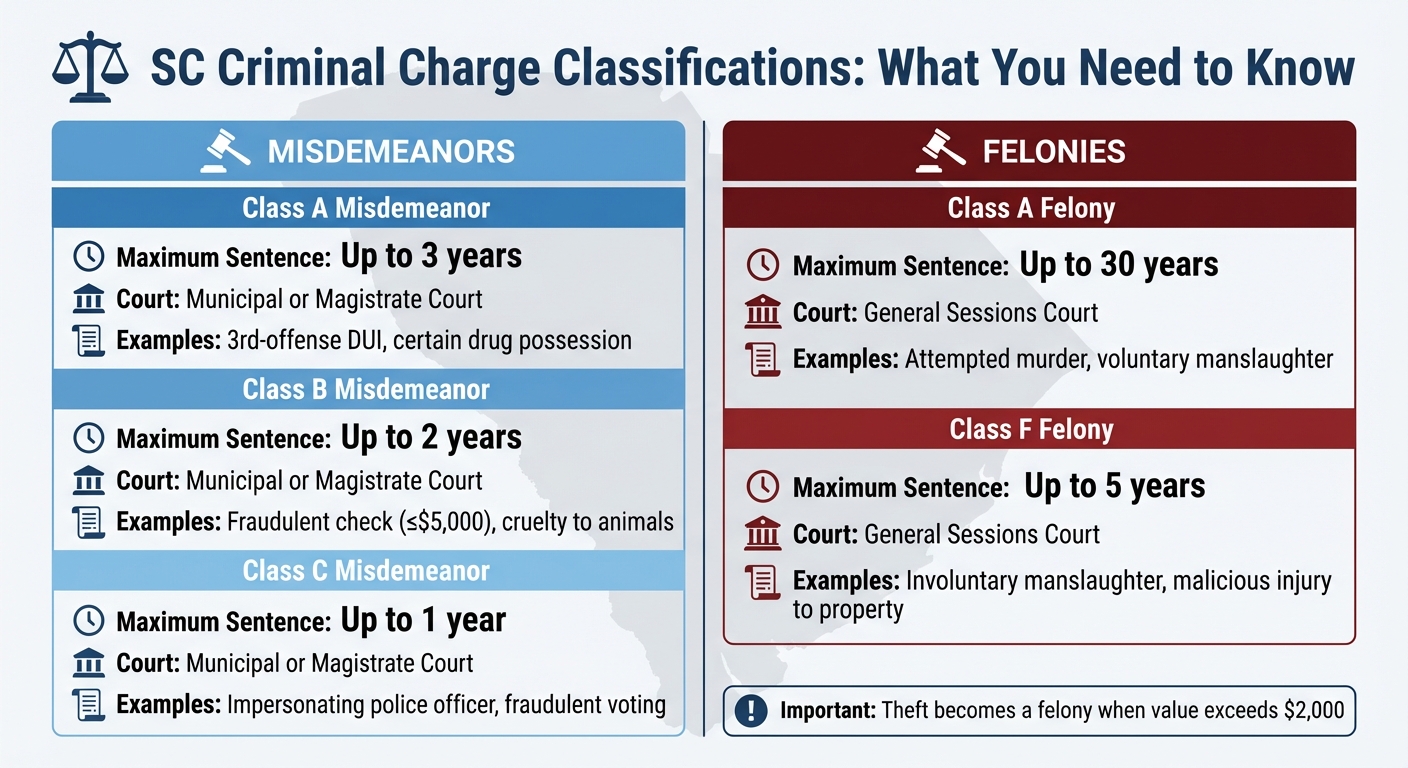
South Carolina Criminal Charge Classifications: Misdemeanors vs Felonies Sentencing Guide
South Carolina categorizes offenses into infractions, misdemeanors, and felonies. Infractions are minor violations, such as speeding or littering, typically resulting in fines without jail time or a criminal record. Misdemeanors and felonies, however, carry more serious consequences, including potential incarceration and long-term effects.
Misdemeanors vs. Felonies
Criminal offenses are further divided into three classes of misdemeanors (A, B, and C) and six classes of felonies (A through F). These classifications determine the court’s jurisdiction, the length of imprisonment, and other outcomes. Interestingly, South Carolina allows for sentences of up to three years for some Class A misdemeanors, which is longer than in many other states.
| Classification | Maximum Sentence | Court Jurisdiction | Examples |
|---|---|---|---|
| Class A Misdemeanor | Up to 3 years | Municipal or Magistrate Court | 3rd-offense DUI, certain drug possession |
| Class B Misdemeanor | Up to 2 years | Municipal or Magistrate Court | Fraudulent check (≤ $5,000), cruelty to animals |
| Class C Misdemeanor | Up to 1 year | Municipal or Magistrate Court | Impersonating a police officer, fraudulent voting |
| Class A Felony | Up to 30 years | General Sessions Court | Attempted murder, voluntary manslaughter |
| Class F Felony | Up to 5 years | General Sessions Court | Involuntary manslaughter, malicious injury to property |
"The difference matters. It shapes which court you’ll appear in, how much time you could face, and what rights or opportunities you might lose even after your case is over." – Lawyer Lori, Law Offices of Lori S. Murray
Some charges may escalate from misdemeanors to felonies based on certain factors, such as repeated offenses or the use of a deadly weapon. For example, theft becomes a felony when the value exceeds $2,000.
Most Common Criminal Offenses
Frequent charges in South Carolina include DUI, drug possession, assault and battery, domestic violence, shoplifting, and probation violations. The state also ranks high in violent crime rates nationally.
DUI cases are particularly prevalent and can escalate quickly. While a first offense is typically a misdemeanor, a third offense is classified as a Class A misdemeanor, carrying a maximum penalty of three years in jail. Drug possession penalties vary depending on the type and amount of the substance. Small amounts might result in misdemeanor charges, but larger quantities can lead to felony-level trafficking charges.
Domestic violence offenses are categorized by degrees, with penalties ranging from short jail terms for third-degree charges to up to 20 years for more severe cases. Similarly, property crimes are classified based on the value of the stolen items. Theft of property below $2,000 is usually a misdemeanor, while amounts exceeding that threshold may result in felony charges.
State vs. Federal Cases
Most criminal cases in South Carolina are handled at the state level by local circuit solicitors and tried in Municipal, Magistrate, or General Sessions Courts. However, some offenses fall under federal jurisdiction, prosecuted by the U.S. Attorney’s Office in collaboration with agencies like the FBI, DEA, or ATF.
Federal cases typically involve crimes that cross state lines, occur on federal property, or violate federal laws. Common federal charges include drug trafficking, firearms violations, tax evasion, computer crimes, and white-collar crimes like mail or wire fraud. State cases, by contrast, generally involve more common offenses such as DUI, simple drug possession, assault, and theft.
Federal cases require grand jury indictments and follow strict sentencing guidelines.
"A criminal proceeding is initiated by the government, usually through the U.S. Attorney’s Office in coordination with a law enforcement agency." – U.S. District Court, District of South Carolina
One unique aspect of South Carolina law is its lack of a statute of limitations for criminal charges. This makes South Carolina one of only two states in the U.S. where charges can be filed at any time, regardless of how much time has passed since the alleged offense. This sets the state apart from most other jurisdictions.
With this overview of charges, the next step is understanding the procedures that follow an arrest.
What Happens After an Arrest
When you’re arrested, a specific process kicks off, and understanding these steps is key to protecting your rights during what can be a very stressful time.
Arrest and Booking
After you’re taken into custody, you’ll be transported to a local police station or detention center – places like the Alvin S. Glenn Detention Center in Richland County or the Kershaw County Detention Center. This is where the booking process happens, officially documenting your arrest. It involves recording your personal details, taking your photograph and fingerprints, conducting a full-body search, checking for any outstanding warrants, and collecting your personal belongings, which may be held as evidence.
"The booking process creates a formal record of your arrest, and typically involves… recording your identifying information… taking your photograph and fingerprints; a full body search and surrendering your personal belongings." – Michael L. Brown, JR., Criminal Defense Attorney
While officers may read your Miranda rights when you’re arrested, they are only required to do so before questioning you while in custody. You are obligated to provide only your name and address. Beyond that, anything you say voluntarily can be used against you later in court. It’s crucial to ask for legal representation right away – you have the right to have an attorney present during both booking and any interrogation.
Knowing what to expect during this phase can help you navigate the situation with a clearer understanding of your rights.
Bond Hearings and Getting Released
In South Carolina, the law requires a bond hearing to take place within 24 hours of your arrest. The purpose of this hearing is to determine whether you’ll return for future court dates and whether you pose any risk to public safety.
"South Carolina law requires that every defendant be released on his or her own recognizance (released without paying anything) pending trial, unless the judge determines the defendant is a flight risk or a threat to public safety." – Bouley Law Firm
A magistrate or municipal judge typically oversees the bond hearing unless the charges involve life imprisonment or the death penalty. In those cases, a Circuit Court judge is required. The judge will consider factors like your ties to the community, employment status, criminal history, and the seriousness of the charges when making a decision about bond.
There are several types of bond options:
- Personal recognizance: You’re released based on your promise to appear in court.
- Cash bond: You pay the full amount upfront, which is refunded if you comply with court requirements.
- Surety bond: A bondsman pays on your behalf, but you’ll owe a non-refundable fee, often around 10% of the total bail.
Once bond is posted, you must be released within four hours. Judges may also impose additional conditions like electronic monitoring, travel restrictions, curfews, or orders to stay away from victims or witnesses.
These early decisions can shape the direction of your case and your defense strategy as it progresses.
First Court Dates and How Cases Move Forward
After the bond hearing, you’ll face several court appearances. If your case is in General Sessions Court, you have 10 days to request a preliminary hearing to challenge whether there was probable cause for the charges. Missing this deadline means giving up that right.
The first court appearance, often called "roll call", typically happens within 45 days of your arrest. Failing to show up can result in a bench warrant for your arrest. During this time, your defense attorney will review the evidence the state has against you. A second court appearance usually follows within 120 days, at which point you’ll decide whether to accept a plea deal or proceed to trial.
Meanwhile, a grand jury will review the evidence. If they find enough cause, they issue a "true bill", which is an indictment. If not, they issue a "no bill", effectively dismissing the charges. Your attorney might also explore options like Pre-Trial Intervention (PTI) for first-time offenders or negotiate a plea deal to reduce your sentence. In South Carolina, about 95% of criminal cases are resolved through guilty pleas. If no agreement is reached, the case moves to trial, where a jury – six members in Magistrate Court or twelve in General Sessions Court – will decide the outcome.
Each step in this process plays a critical role in determining how your case unfolds.
Your Rights in Criminal Cases
Knowing your constitutional rights is crucial if you’re facing criminal charges. These protections are in place to ensure you’re treated fairly during both investigations and court proceedings.
Rights During Police Investigations and Arrests
The Fifth Amendment gives you the absolute right to remain silent when questioned by the police, protecting you from self-incrimination. Anything you say voluntarily can be used against you in court, and officers often employ strategies to obtain a confession.
"You have the right to effective counsel to assist in your defense, and you have the absolute right to remain silent in the face of police questioning." – Thompson & Hiller Defense Firm
The Sixth Amendment guarantees your right to legal representation. If you’re unable to afford an attorney and your charges could result in jail time, the government is required to appoint one for you. Police are also obligated to inform you of your Miranda rights before questioning. Once you request an attorney, all interrogation must stop.
Additionally, the Fourth Amendment protects you from unreasonable searches and seizures. Officers generally need a warrant to search your property, and if they execute a search warrant, they must provide you with a copy of it along with the affidavit that supports it. If you’re unsure about your rights, you can ask, "Am I free to go?" or "Am I under arrest?" It’s often best not to consent to a search without first consulting an attorney.
Asserting your rights early on can have a significant impact on how your defense is built. With this foundation, let’s move on to what happens when your case proceeds to court.
Jury Trials and Plea Agreements
Your constitutional protections extend beyond arrest and into the courtroom. In South Carolina, for example, you have the right to a jury trial. For felonies and serious misdemeanors in General Sessions Court, the jury consists of 12 members. Minor offenses tried in Magistrate or Municipal Courts involve 6-person juries. In General Sessions Court, all 12 jurors must agree unanimously for a conviction or acquittal. If they can’t, the result is a hung jury and potentially a mistrial.
During the trial, you are presumed innocent, and the state must prove your guilt beyond a reasonable doubt. Interestingly, in South Carolina, about 95% of criminal cases are resolved through plea agreements rather than trials.
Plea bargaining can take several forms:
- Charge bargaining: Pleading guilty to a lesser charge.
- Sentence bargaining: Agreeing to a specific sentence recommendation.
- Count bargaining: Pleading guilty to some charges while others are dismissed.
You can choose to plead guilty, not guilty, or nolo contendere (no contest). A nolo contendere plea results in the same sentencing as a guilty plea, but it doesn’t admit guilt in potential civil cases.
"Entering a plea is a critical moment in the legal process, as it sets the stage for the direction the case will take and can have a significant impact on the case’s outcome." – SeiferFlatow, PLLC
Before accepting a plea, the judge must confirm that it’s made voluntarily and that there’s a factual basis for it. Some jurisdictions, like the 14th Judicial Circuit, have strict sentencing guidelines and discourage plea deals. Keep in mind that pleading guilty can limit your ability to appeal later, so consulting an attorney about your options is essential.
sbb-itb-ce0cbb0
Hiring a Criminal Defense Lawyer
Getting legal representation early is crucial to protecting your rights and building a solid defense.
When You Need a Criminal Defense Lawyer
The moment you learn you’re facing criminal charges or are under investigation, it’s time to hire a lawyer. Prosecutors waste no time building their case, so securing legal counsel early gives you the best chance to prepare.
Before speaking with police or investigators, consult an attorney. Law enforcement officers are trained to gather evidence, often using strategies designed to elicit confessions, sometimes through deceptive tactics. If you’re being questioned, explicitly request your attorney.
"If you are being questioned by police, they are probably not trying to help you; they are gathering evidence to use against you." – Thompson & Hiller Defense Firm
Legal representation is also critical for bond hearings, which usually happen within 24 hours of an arrest to determine if and how you can be released. Representing yourself in these situations is risky – crafting a strong defense requires expertise and experience. While public defenders are capable, their heavy caseloads often limit the time they can dedicate to individual cases. Private attorneys, on the other hand, can offer more focused attention and resources.
Taking this proactive step is essential to protecting your rights and ensuring your case is handled effectively as it progresses.
How a Defense Attorney Helps Your Case
An experienced defense lawyer works to safeguard your constitutional rights and thoroughly examine all evidence. They can file discovery motions to compel the prosecution to share all evidence, including any that might support your innocence, as required under Brady v. Maryland.
Defense attorneys also conduct independent investigations, interviewing witnesses and issuing subpoenas to gather critical information. They negotiate with prosecutors to seek case dismissals, reduced charges, or plea deals that minimize the long-term impact on your criminal record and job prospects. Additionally, your lawyer will guide you through every step of the South Carolina court system, from preliminary hearings to roster meetings, ensuring you’re prepared for each stage.
When choosing a lawyer, ask about their experience with cases like yours, their familiarity with the specific court handling your case (whether Magistrate, Municipal, or General Sessions), and their success in negotiations. It’s also worth discussing whether you’re eligible for diversionary programs like Pre-Trial Intervention (PTI), which can help you avoid a permanent criminal record. Most criminal defense lawyers in South Carolina offer either hourly rates or flat-fee options for their services.
Getting the right attorney can make all the difference in how your case unfolds.
Brendan M. Delaney Law Firm LLC: Criminal Defense Services

Brendan M. Delaney Law Firm LLC provides comprehensive criminal defense services across South Carolina, backed by over 24 years of legal experience. The firm takes a client-centered approach, tailoring its strategies to the unique circumstances of each case. Whether you’re facing charges in Magistrate, Municipal, or General Sessions Court, the firm is committed to protecting your rights and pursuing the best possible outcome.
The firm offers free initial consultations to help you understand your rights and explore potential defense strategies. During this consultation, you’ll have the opportunity to discuss your case in a supportive and confidential setting, empowering you to make informed decisions about your legal representation – all without any upfront financial commitment.
Conclusion
Facing criminal charges in South Carolina comes with serious consequences, from losing the right to vote or own firearms to potential jail time – even for misdemeanors. These charges can also create significant hurdles when seeking employment or housing.
It’s important to know that law enforcement isn’t required to read your Miranda rights during casual questioning. Anything you say can still be used against you in court. To protect yourself, it’s essential to exercise your right to remain silent and ask for an attorney right away. Keep in mind, court staff can explain procedures but are not allowed to give legal advice or guide you on what to say.
While understanding your rights is critical, having strong legal representation is equally important. A skilled attorney can take steps like filing discovery motions to gather evidence, conducting independent investigations, negotiating with prosecutors to reduce charges or seek dismissals, and presenting mitigating evidence during sentencing. They can also evaluate whether you qualify for diversion programs, such as Pre-Trial Intervention, which might lead to dismissed charges and even expunged records.
If you’re under investigation or facing charges, don’t wait to act. Brendan M. Delaney Law Firm LLC offers free initial consultations to help you understand your options and build a defense strategy. Taking action quickly and securing experienced legal help can make all the difference in protecting your future.
FAQs
What should I do if I’m arrested in South Carolina?
If you’re arrested in South Carolina, the first thing to do is stay calm and focus on protecting your rights. Provide only your name and basic identifying details, but avoid answering further questions. Make it clear that you are invoking your right to remain silent under the Fifth Amendment and your right to an attorney under the Sixth Amendment. Do not agree to searches or make any statements without a lawyer present.
Your next step is to contact an experienced criminal defense attorney as soon as possible. They can help you navigate the legal process, including booking, bail, and preparing your defense. While you wait, try to remember key details, such as the officers’ names, badge numbers, and anything noteworthy about the arrest. Share your situation with a trusted family member or friend for support, but avoid discussing the details of your case with anyone other than your lawyer. Having legal representation early on is essential to safeguarding your rights and creating a solid defense.
How does a criminal defense lawyer help with plea bargains?
A criminal defense lawyer plays a key role in guiding you through plea bargains, breaking down your options, and working to secure the best possible outcome. They carefully assess the evidence, charges, and potential penalties to determine if accepting a plea deal aligns with your best interests. Drawing on their knowledge of South Carolina laws and local legal practices, they negotiate for alternatives like reduced charges, probation instead of jail time, or a lighter sentence.
When engaging with the prosecutor, your attorney emphasizes mitigating factors that could strengthen your case – such as a clean record or involvement in rehabilitation programs. They also ensure you fully understand the rights you’ll waive by accepting a plea deal and craft strong arguments to present before the judge for approval.
By combining their expertise and negotiation skills, a defense attorney works to achieve the most favorable terms possible. Whether it’s reduced fines, limited jail time, or access to diversion programs, their focus remains on finding solutions tailored to your specific situation.
What’s the difference between state and federal criminal charges?
State criminal charges arise from violations of state laws and are prosecuted by state or local authorities. These cases usually deal with offenses that directly affect local communities, such as theft, assault, or traffic violations.
Federal criminal charges, however, stem from breaking federal laws and are handled by federal agencies and courts. These cases often involve crimes that cross state lines or impact national interests, like drug trafficking, immigration violations, or large-scale fraud. Penalties for federal charges are often more severe than those for state offenses.
Knowing whether you’re facing state or federal charges is essential, as it determines the court system and the potential consequences you might face. If you’re uncertain about your situation, reaching out to an experienced attorney can provide clarity and help you navigate the legal process.