



In South Carolina, weapons charges are governed by strict laws under Title 16, Chapter 23 of the state code. These laws cover offenses like carrying a concealed weapon without a permit, unlawful possession by prohibited individuals, and using a firearm during a violent crime. Penalties range from misdemeanors, which can result in fines up to $1,000 and one year in jail, to felonies carrying up to five years in prison and fines of $2,000.
Key updates include the Constitutional Carry Act of March 2024, allowing eligible adults 18+ to carry handguns openly or concealed without a permit. However, restrictions remain for specific locations like schools or businesses that prohibit weapons. Violations can lead to severe consequences, including mandatory consecutive sentences for crimes involving firearms.
If charged, consulting an attorney is critical. Defense strategies may include demonstrating valid permits, self-defense claims, or seeking expungement for non-violent charges. Understanding these laws ensures responsible firearm ownership while avoiding legal trouble.
Overview of South Carolina Weapons Laws
South Carolina’s weapons laws, outlined in Title 16, Chapter 23, govern firearm possession and carrying within the state. These regulations specify who can legally own and carry firearms, identify restricted areas for weapons, and define what constitutes illegal possession or misuse. Recent legislative updates, particularly in the area of constitutional carry, have brought significant changes to these laws.
Constitutional Carry and Recent Legal Changes
In March 2024, South Carolina passed the Constitutional Carry/Second Amendment Preservation Act, introducing new rules for firearm carrying. Under this law, residents 18 years or older who are not otherwise prohibited by law can carry handguns – either concealed or openly – without needing a permit. This applies specifically to firearms with a barrel length of less than 12 inches.
The law also broadened the rules for carrying firearms in vehicles. Now, individuals can store or transport handguns anywhere in a vehicle, removing previous restrictions that required firearms to be stored in designated areas like the glove compartment or trunk. Additionally, the law eliminates the requirement to inform law enforcement officers about firearm possession during a traffic stop or other encounters.
The South Carolina Law Enforcement Division (SLED) clarified the limits of enforcement regarding firearm visibility:
"Possession of a firearm alone is NOT a reason to stop an individual. To make a stop, there must be reasonable and articulable suspicion a crime has occurred."
This means officers cannot stop someone solely for openly carrying a firearm. While a Concealed Weapons Permit (CWP) is no longer required for carrying within South Carolina, it remains advantageous for reciprocity in other states and for simplifying firearm purchases through dealers. Despite these changes, ownership restrictions and penalties for violations remain in place under state law.
Key Legal Provisions for Gun Ownership
Several statutes provide the framework for firearm ownership and penalties for violations:
- SC Code §16-23-20: Defines unlawful possession of handguns and lists exceptions for legal carrying.
- SC Code §16-23-50: Outlines penalties for illegal firearm possession or carrying by prohibited individuals, such as convicted felons, those with violent crime convictions, drug addicts, undocumented immigrants, and individuals deemed mentally incompetent.
- SC Code §16-11-440: Known as the "Protection of Persons and Property Act", this statute supports Castle Doctrine and Stand Your Ground rights. It states, "A person who is not engaged in an unlawful activity and who is attacked in another place where he has a right to be… has no duty to retreat and has the right to stand his ground and meet force with force.".
- SC Code §23-31-510: Establishes state preemption, preventing local governments from creating their own firearm regulations regarding transfer, ownership, or possession.
Businesses retain the right to prohibit weapons on their premises by displaying a sign at least 8 inches wide by 12 inches tall that reads "NO CONCEALABLE WEAPONS ALLOWED". Violating such a sign is a misdemeanor offense, which can result in up to 2 years in jail.
sbb-itb-ce0cbb0
Common Weapons Charges in South Carolina
While the Constitutional Carry law, effective March 2024, allows permitless carry for eligible individuals, there are still several weapons-related offenses that remain illegal. Knowing these charges can help clarify what is and isn’t lawful when it comes to firearm possession and use. Below are some of the most common charges, along with the relevant statutes and what they entail.
Unlawful Possession of a Handgun
According to SC Code § 16-23-30, certain individuals are prohibited from possessing a handgun. This includes those convicted of violent crimes, fugitives, habitual drunkards, drug addicts, or individuals deemed mentally incompetent.
Pointing a Firearm at Another Person
Under SC Code § 16-23-410, it is illegal to point a firearm at another person, regardless of intent. This statute aims to prevent reckless or threatening behavior involving firearms.
Illegal Carrying of Firearms
Although permitless carry is allowed under the new law, there are still restrictions based on location. For example, it is unlawful to carry a firearm onto private or public school property or into publicly owned buildings without explicit permission. However, interstate rest areas are an exception to this rule.
Additionally, businesses have the right to prohibit firearms on their premises. To do so, they must post a sign that is at least 8 inches wide by 12 inches tall and clearly states: "NO CONCEALABLE WEAPONS ALLOWED." Violating these location-based restrictions is considered illegal carrying.
Penalties for Weapons Violations
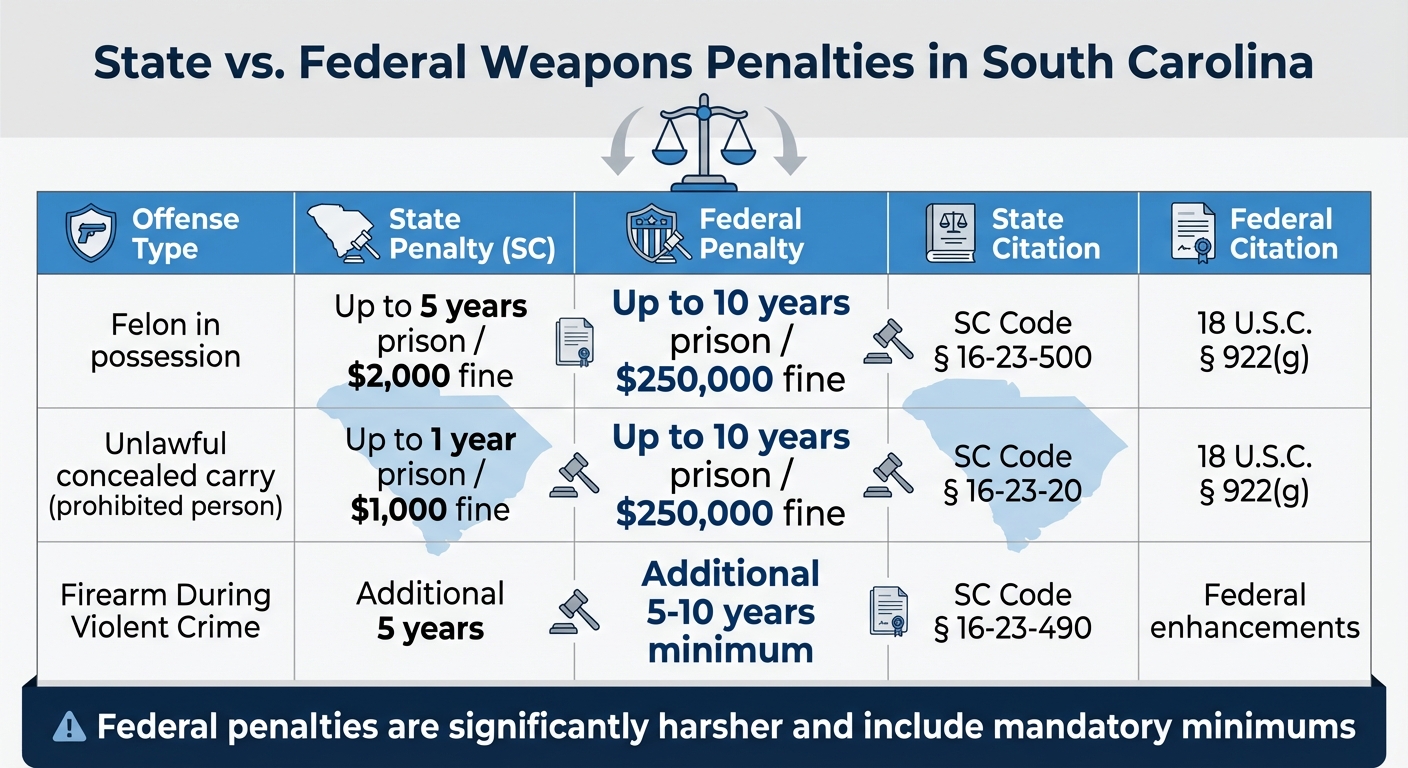
South Carolina Weapons Violations: State vs Federal Penalties Comparison
State-Level Penalties
In South Carolina, weapons violations are classified as either misdemeanors or felonies, with penalties ranging from fines to extended prison sentences. The severity of the punishment depends on the specific offense and whether the individual has prior convictions.
Misdemeanor violations, such as carrying a concealed weapon without a permit, are subject to increasing penalties for repeat offenses. For instance, under SC Code § 16-23-20, carrying a concealed weapon without a permit can result in up to 1 year in prison and fines of up to $1,000. Other minor violations, like possessing a firearm in restricted areas, may lead to penalties of up to $500 in fines or 30 days in jail.
Felony charges, on the other hand, come with much harsher consequences. For example, unlawful possession of a firearm by a prohibited individual, as outlined in SC Code § 16-23-500, can lead to up to 5 years in prison and fines of up to $2,000. More serious offenses, such as possessing machine guns or sawed-off shotguns, can carry penalties of up to 10 years in prison.
Repeat offenses escalate the consequences significantly. A second concealed carry violation can result in a prison sentence of up to 3 years, while a third offense is classified as a felony, punishable by up to 5 years in prison. Additionally, using a firearm during the commission of a violent crime under SC Code § 16-23-490 adds a mandatory 5-year sentence, which may be served consecutively with the sentence for the underlying crime.
Federal laws can further amplify these penalties in certain situations.
Federal Penalties and How They Apply
Federal law applies when cases involve prohibited individuals or firearms crossing state lines. According to 18 U.S.C. § 922(g), individuals such as convicted felons, domestic violence offenders, and others deemed prohibited are barred from possessing firearms. When such cases arise, the ATF may become involved, and federal charges can be pursued.
Under this statute, felons found in possession of firearms can face up to 10 years in prison and fines of up to $250,000. Federal courts also impose mandatory minimum sentences and lifetime bans on firearm ownership. These stricter penalties are why prosecutors often opt for federal charges in severe cases. The table below highlights key differences between state and federal penalties.
State vs. Federal Penalty Comparison
| Offense Type | State Penalty (SC) | Federal Penalty | State Citation | Federal Citation |
|---|---|---|---|---|
| Felon in possession | Up to 5 years / $2,000 fine | Up to 10 years / $250,000 fine | SC Code § 16-23-500 | 18 U.S.C. § 922(g) |
| Unlawful concealed carry (prohibited person) | Up to 1 year / $1,000 fine | Up to 10 years / $250,000 fine | SC Code § 16-23-20 | 18 U.S.C. § 922(g) |
| Firearm during violent crime | Additional 5 years | Additional 5–10 years minimum | SC Code § 16-23-490 | Federal enhancements |
Aside from imprisonment and fines, a weapons conviction in South Carolina can lead to other consequences, such as probation (typically lasting 1–5 years), permanent loss of firearm rights, weapon forfeiture, and mandatory community service. These convictions can also have long-term effects on employment prospects, especially in fields like security or law enforcement.
How to Defend Against Weapons Charges
Expungement and Dismissal Procedures
One effective way to address weapons charges is by seeking expungement or dismissal, which can help reduce the long-term impact on your record.
If you avoid a conviction, you might be eligible for expungement. This applies to charges that are dismissed, nol prossed, no-billed, or end in a "not guilty" verdict. As outlined by the SC Eleventh Judicial Circuit:
"An expungement is a court order that removes criminal arrests/dispositions from your criminal record. It is also called an Order for Destruction of Arrest Records."
The process for expungement depends on how the case is resolved. If the charges are dismissed outright or you are acquitted, there’s no administrative fee. However, if the dismissal occurs as part of a plea deal, a $250 administrative fee is required. Additionally, completing a diversion program, such as Pretrial Intervention (PTI), can also pave the way for expungement. This option works well alongside other defense strategies.
To begin the process, you need to contact the appropriate office in the county where the arrest took place. For cases handled in Magistrate or Municipal Court, reach out to the court clerk. For General Sessions charges, start with the Circuit Solicitor’s Office. It’s also necessary to obtain a certified disposition from the Clerk of Court, as public index printouts won’t be accepted. Once your application is submitted, the process can take up to six months to complete. However, it’s important to remember:
"convictions classified as violent crimes under Section 16-1-60 of the Code of Laws of South Carolina (1976, as amended) cannot be expunged."
What Affects Your Case Outcome
How Prior Convictions Affect Your Case
Prior convictions can heavily influence the outcome of weapons charges. In South Carolina, if you’ve previously been convicted of a felony – or any crime carrying a sentence of more than one year – state law prohibits you from possessing a firearm or ammunition. Under South Carolina Code Section 16-23-500, violating this law is classified as a felony, punishable by up to $2,000 in fines or 5 years in prison. Essentially, simply owning a firearm under these circumstances can lead to serious legal consequences. When combined with additional charges, the situation becomes even more complicated, increasing the likelihood of harsher penalties.
Weapons Charges Combined with Other Crimes
When weapons charges are tied to other offenses, the penalties are not just added – they are compounded. South Carolina law mandates consecutive sentencing for such cases. For instance, under Section 16-23-490, using or displaying a firearm during a violent crime adds an automatic 5-year sentence on top of the penalty for the primary offense. Take an example: if someone is convicted of assault while carrying a firearm, they could face the standard sentence for assault plus an additional 5 years, potentially resulting in a decade or more in prison.
Similarly, Section 16-23-495 stipulates that crimes involving concealable weapons carry an additional sentence of up to 3 years, which must be served consecutively to the underlying offense. In cases where drug possession is paired with illegal firearm possession, the penalties increase further since the sentences for each offense are stacked rather than served at the same time. These cumulative penalties can result in significantly longer prison terms.
Legal Representation in South Carolina Courts
Given the complexities of prior convictions and stacked charges, having skilled legal representation is crucial. The outcome of a case often hinges not just on the charges themselves but also on how they interact with past offenses and concurrent crimes. Attorneys with experience in South Carolina law can navigate these intricacies, potentially reducing charges or even getting them dismissed. For instance, they might argue to lessen a felony charge to a misdemeanor or challenge the impact of prior convictions.
Local factors also play a role. For example, carrying a weapon into a business that serves alcohol can increase the severity of penalties. Brandishing a firearm in certain locations can escalate the charge to a felony, with fines of up to $5,000 or 5 years in prison. As discussed in earlier sections, personalized legal strategies are essential for addressing these complex scenarios, helping to identify defenses that could lead to more favorable outcomes.
Conclusion
Facing weapons charges can have serious consequences for your freedom, finances, and future. While Constitutional Carry allows eligible citizens to carry firearms openly or concealed, it’s essential to remember that restrictions still apply in certain areas like schools, courthouses, and law enforcement facilities. Understanding these laws is key to exercising your rights responsibly and avoiding legal trouble.
If you’re dealing with weapons-related charges, having experienced legal representation is critical. Brendan M. Delaney Law Firm LLC brings over 24 years of experience in South Carolina’s legal system, offering guidance and protection of your rights to help you navigate this challenging process and work toward the best possible outcome.
FAQs
Where am I still not allowed to carry a handgun in South Carolina?
You can’t carry a handgun in places where firearms are banned by law. These include spots like government buildings, schools, and private property that clearly prohibit firearms. Make sure to check posted signs or relevant regulations to stay within South Carolina’s legal requirements.
Can a weapons charge be expunged in South Carolina, and how long does it take?
In South Carolina, if someone is charged with unlawful firearm possession for the first time, they might qualify for expungement. This is possible as long as they avoid any additional convictions within three years of the offense. The process to clear the record usually takes several months to finalize.
What should I do right after I’m arrested for a gun charge in South Carolina?
If you’re arrested for a gun charge in South Carolina, it’s crucial to stay calm and respectful. Use your right to remain silent and avoid discussing the situation with law enforcement without legal representation. The first step should be to request an attorney. Reaching out to a skilled criminal defense lawyer right away is key to safeguarding your rights, understanding the legal process, and preparing a solid defense. Your attorney can also provide advice on how to manage interactions with law enforcement moving forward.