



Facing criminal charges in Spartanburg can significantly impact your job prospects and current employment. Employers often review criminal records using the SLED CATCH portal, and South Carolina law allows them to consider convictions indefinitely. Jobs in healthcare, education, finance, and law enforcement are especially strict about background checks. Even pending charges can lead to termination in certain roles. However, expungement of eligible charges can help clear your record, and federal laws like Title VII protect against unfair hiring practices based on criminal history.
Key Points:
- Employers can access criminal records indefinitely under South Carolina law.
- Public sector jobs follow "ban-the-box" policies, but private employers can run checks anytime.
- Professional licenses may be denied or revoked for certain offenses.
- Expungement can legally erase eligible charges, preventing employers from using them in hiring decisions.
- Federal laws require employers to assess criminal records individually, not apply blanket bans.
What You Can Do:
- Check your record through SLED for accuracy.
- Pursue expungement for eligible charges under S.C. Code Ann. § 17-22-960.
- Be honest about your history during the job application process.
- Know your rights under the Fair Credit Reporting Act (FCRA) and Title VII.
Legal help can guide you through expungement, licensing issues, and minimizing the impact of charges on your career.
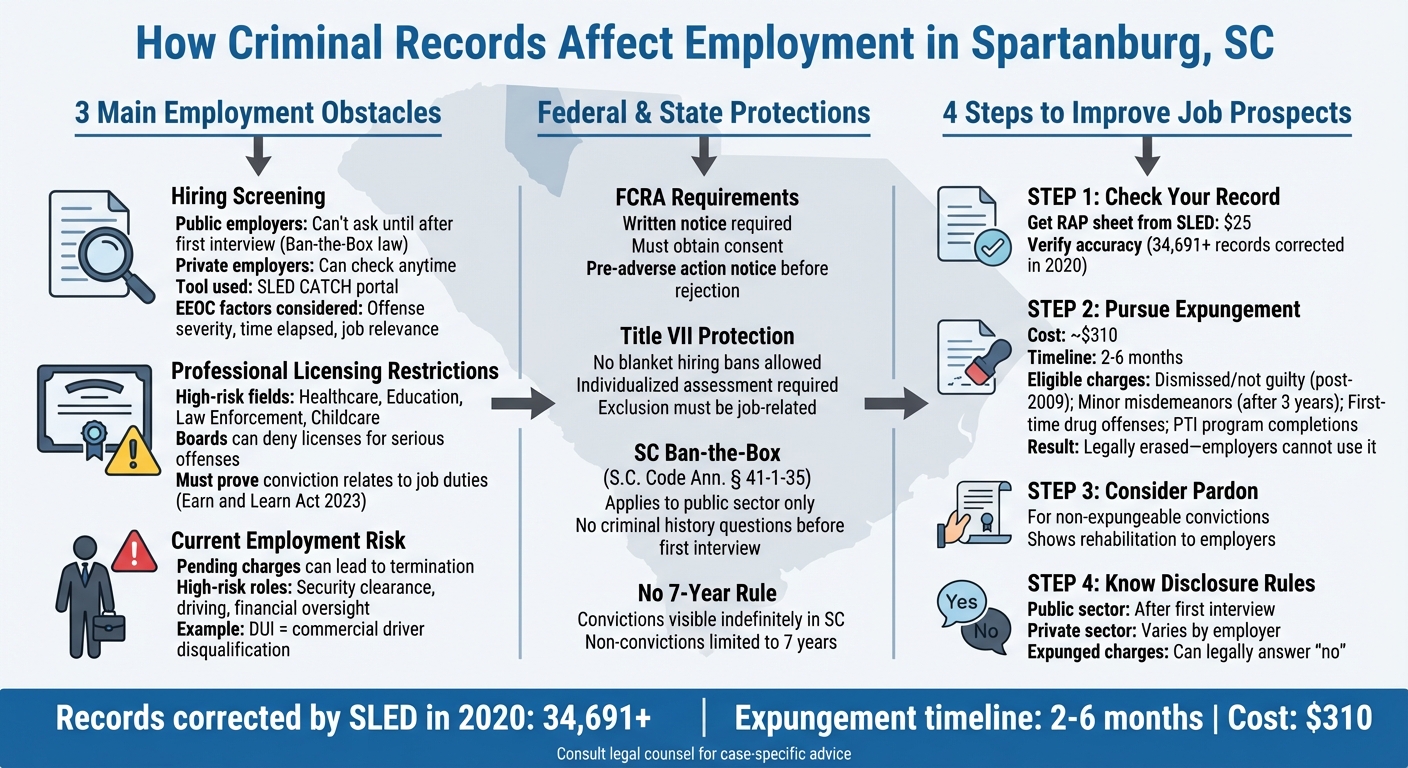
How Criminal Records Affect Employment in South Carolina: Key Barriers and Solutions
How Criminal Records Create Employment Barriers
A criminal record can make finding and keeping a job in Spartanburg a serious challenge. Three main obstacles stand out: hiring policies that screen you out early, licensing boards that can block access to certain professions, and the risk of termination if you’re already employed. Here’s a closer look at how these barriers work and their impact.
How Employers Screen Applicants with Criminal Records
In Spartanburg, employers often use the South Carolina Law Enforcement Division (SLED) CATCH portal to check criminal records. This system provides statewide arrest histories, though comprehensive background checks usually come with fees. Under the Fair Credit Reporting Act (FCRA), employers must inform you in writing and get your consent before using third-party agencies for these checks.
However, the rules differ between public and private sector employers. Public employers in South Carolina follow the "ban-the-box" law (S.C. Code Ann. § 41-1-35), which means they can’t ask about your criminal history until after the first interview. Private employers, on the other hand, can conduct background checks at any point in the hiring process. When reviewing your record, employers consider three factors outlined by the Equal Employment Opportunity Commission (EEOC): the seriousness of the offense, how long ago it occurred, and its relevance to the job duties.
Professional Licensing Restrictions by Industry
If you’re aiming for a career that requires a professional license, your criminal record could be a hurdle. Licensing boards have the authority to deny licenses for serious offenses. This is particularly common in fields like healthcare, education, law enforcement, and childcare, where background checks are especially strict.
The Earn and Learn Act of 2023 has made some progress in this area. Now, licensing boards in South Carolina can’t deny a license just because of a criminal record. They must prove that the conviction is directly related to the responsibilities of the job. As Attorney Chris Fedalei explains:
"In certain fields, a criminal conviction can make it nearly impossible to obtain or keep a job. For example, careers in healthcare, education, law enforcement, and childcare often have strict background check requirements".
If you’re denied a license, you can request a hearing to argue your case and show you’re qualified for the profession.
How Criminal Charges Affect Current Employment
Even if you’re already employed, criminal charges can put your job at risk. Pending charges are especially concerning for positions that require security clearance, driving privileges, or financial oversight. For example, a DUI charge can immediately disqualify a commercial driver, while fraud allegations can end a banking or accounting career. Employers often rely on SLED records, which might show arrests but not the outcomes of court cases. Unfortunately, sometimes just an arrest is enough to lead to termination.
For public sector employees, South Carolina law requires employers to consider whether an offense is directly related to job duties before taking disciplinary action. Private employers, however, have more leeway in these decisions. It’s worth noting that expunged or sealed records cannot legally be used as grounds for termination under S.C. Code Ann. § 17-22-960.
South Carolina Background Check Laws and Criminal Records
South Carolina has specific laws that govern background checks, ensuring that your rights as a job applicant are protected. Here’s an overview of employer guidelines, access to criminal records, and the expungement process.
FCRA Requirements for Employers
In South Carolina, employers must comply with the Fair Credit Reporting Act (FCRA) when using third-party agencies for background checks. This means they are required to:
- Provide written notice before conducting the check.
- Obtain your consent.
- Follow an "adverse action" process if they decide not to hire you based on the report.
The adverse action process includes giving you a pre-adverse action notice, a copy of the background report, and a summary of your FCRA rights. This allows you to review the report and dispute any inaccuracies before a final decision is made.
Unlike some other states, South Carolina does not have a "seven-year rule" for criminal convictions. Employers can review convictions regardless of how long ago they occurred. However, the FCRA limits the reporting of non-conviction information, such as arrests without a verdict, to seven years.
Employers in South Carolina often rely on the South Carolina Law Enforcement Division (SLED) for background checks, as it provides access to detailed records.
How Employers Access Criminal Records Through SLED
Most employers in South Carolina use the SLED CATCH portal to access name-based arrest histories. For positions requiring a higher degree of trust – like teaching or nursing – employers may also use SLED’s Automated Fingerprint Identification System (AFIS) for additional verification.
If you’re concerned about the accuracy of your record, you can request a personal review under S.C. Code Regs. § 73-24. In 2020 alone, SLED manually corrected over 34,691 records to ensure accuracy. However, errors can still occur, making it essential to verify your information.
Understanding these record access methods is particularly important if you’re considering expungement to clear your record.
Expungement Options Under South Carolina Law
Expungement offers a way to remove certain criminal charges or convictions from your record, effectively erasing them from public view. Once a record is expunged under S.C. Code Ann. § 17-22-960, employers – both public and private – are prohibited from using it in hiring decisions. The law treats the matter as if it never happened.
Here are some key points about expungement in South Carolina:
- Charges that were dismissed or resulted in a "not guilty" verdict after 2009 are often automatically expunged.
- Minor misdemeanors with a maximum sentence of 30 days and/or a $1,000 fine may be expunged after a three-year waiting period.
- First-time drug offenses and charges resolved through diversion programs like Pre-Trial Intervention (PTI) are also eligible.
To start the process, you’ll need to file through the Solicitor’s Office in the county where the charges originated. The total cost is approximately $310, although dismissed charges under plea agreements may have different fees. After the court order is sent to SLED, it typically takes about four weeks for the charge to be removed from the state repository. Once this is done, you can purchase a SLED criminal records check (CATCH) to confirm that the record has been cleared.
How to Improve Employment Prospects with a Criminal Record
Having a criminal record doesn’t mean your career is over. In South Carolina, there are specific steps you can take to improve your chances of securing a job, as long as you understand your rights and options.
When and How to Disclose Criminal Records to Employers
Being upfront about your criminal history is essential during your job search. Never provide false information about convictions on applications or in interviews. If you’ve had a charge successfully expunged, you’re legally allowed to answer "no" when asked about that particular conviction.
Timing matters in South Carolina. Public employers are not allowed to ask about your criminal history until after an initial interview or a conditional job offer has been made. However, private employers can typically ask about it earlier in the process, unless you’re applying in areas like Columbia, where stricter rules apply.
To prepare, obtain your RAP (Record of Arrests and Prosecutions) sheet from SLED for $25. This ensures your record is accurate and helps you craft a clear, honest explanation of your past. Employers often appreciate honesty and transparency.
Building a recent and consistent work history can also make a big difference. Start with part-time or temporary positions and gather professional references. Employers are more likely to focus on a steady work history from the past 6–12 months rather than an older criminal record.
If your record is holding you back, consider exploring expungement options.
Pursuing Expungement for Eligible Charges
Expungement can remove certain charges from your record, making it easier for you to move forward. If expungement isn’t an option, you might consider applying for a pardon, which many employers view as a sign of rehabilitation.
The expungement process usually takes two to six months after you submit your application. Once approved, employers – both public and private – are legally barred from considering the expunged charges during the hiring process, as outlined in S.C. Code Ann. § 17-22-960. To ensure private background check companies update their records, provide them with a copy of your expungement order, as they don’t always update their databases automatically.
While clearing your record is a great step, federal laws also offer protections that can help you in your job search.
Your Rights Under Title VII and EEOC Guidelines
Federal laws safeguard you from discrimination based on your criminal record. Title VII of the Civil Rights Act prohibits blanket hiring bans that automatically disqualify anyone with a criminal record. Employers must show that any exclusion is directly related to the job and necessary for their business. As the South Carolina Appleseed Legal Justice Center explains:
"A general refusal to hire anyone with a criminal record probably violates civil rights law".
The Equal Employment Opportunity Commission (EEOC) advises employers to perform an individualized assessment rather than applying a one-size-fits-all approach. This involves considering factors like the nature and severity of the offense, how much time has passed, and its relevance to the job duties.
Be prepared to demonstrate your rehabilitation. Evidence such as completing probation, maintaining a crime-free record, or an honorable military discharge can strengthen your case. The South Carolina General Assembly emphasizes:
"The opportunity to secure employment or to pursue, practice, or engage in a meaningful and profitable trade, occupation, vocation, profession, or business is essential to rehabilitation".
If you suspect you were denied a job unfairly because of your criminal record, you can file a complaint with the South Carolina Human Affairs Commission at 1-800-521-0725. Additionally, make sure your employer followed the Fair Credit Reporting Act by providing a pre-adverse action notice and a copy of your background check report.
sbb-itb-ce0cbb0
Legal Help for Employment Issues: Brendan M. Delaney Law Firm LLC

Facing criminal charges can have far-reaching effects on your employment and future opportunities. Legal guidance becomes essential in navigating these challenges. Brendan M. Delaney Law Firm LLC focuses on reducing the broader consequences of criminal charges, such as job loss, professional licensing restrictions, and housing difficulties. Start taking control of your future with their free consultation service.
Free Initial Consultation for Criminal Defense Cases
Understanding how criminal charges affect your job prospects is the first step. Brendan M. Delaney Law Firm LLC provides a free initial consultation to review your case and outline potential paths forward. During this consultation, you’ll gain insight into how specific outcomes, like a "nolle prossed" charge, show up on background checks and whether you qualify for expungement or alternative sentencing options. The firm also helps identify weaknesses in the prosecution’s evidence, which can significantly influence what employers see during background checks.
You’ll also learn about your eligibility for programs such as Pre-Trial Intervention (PTI), Alcohol Education Programs (AEP), or Traffic Education Programs (TEP). These programs can result in dismissed charges, which may then be expunged from your record, offering a clean slate.
Customized Criminal Defense Representation
After your initial consultation, the firm crafts a defense strategy tailored to your specific situation. This personalized approach aims to safeguard your employment and professional reputation. For instance, attorneys may negotiate with prosecutors to reduce felony charges to misdemeanors, a key step in lessening the long-term effects on background checks and job eligibility. As attorney Chris Fedalei points out:
"A skilled South Carolina criminal defense lawyer can work to minimize the penalties and collateral consequences of a conviction."
The firm also provides expungement services to help clear your record legally. For professionals like nurses, real estate agents, or cosmetologists facing license reviews, they offer representation to help prevent credential suspension or revocation. If expungement isn’t an option, they can assist with pardon applications to help restore your opportunities.
Conclusion
Criminal charges can create tough hurdles when it comes to finding work in Spartanburg. Background checks often reveal past offenses, and professional licensing restrictions can further narrow career options. Employers generally have the freedom to reject applicants with criminal records, especially for jobs involving financial duties or working with vulnerable groups. Knowing how these issues affect your job prospects is crucial to planning your next steps. Thankfully, there are ways to address these barriers.
One solution is expungement, which removes eligible charges from your record. Once expunged, you’re no longer required to disclose those charges on job applications, and South Carolina law ensures employers cannot hold an expunged record against you. The process usually takes 2 to 6 weeks and costs around $310. For convictions that don’t qualify for expungement, seeking a pardon can show rehabilitation and potentially boost your chances with employers.
Additionally, federal guidelines from the EEOC discourage blanket hiring bans against individuals with criminal records. Employers who automatically disqualify candidates based solely on a criminal history may violate civil rights laws. Understanding these protections can help you identify and challenge unfair hiring practices when they arise.
To navigate these challenges, legal assistance can make a huge difference. An experienced attorney can help reduce charges, assist with expungement, and advocate for you before licensing boards. Acting quickly – whether through expungement, a pardon, or other legal measures – can protect your career and future opportunities in Spartanburg.
FAQs
How can I verify my criminal record in South Carolina?
If you need to check your criminal record in South Carolina, the process goes through the South Carolina Law Enforcement Division (SLED). Start by filling out the "Individual Request for Criminal Record Review" form. You’ll also need to verify your identity and follow the steps provided by SLED. For a fee of $25, you can request a copy of your record.
Keeping tabs on your criminal record is a smart move to ensure the details are correct and current. This is especially crucial if you’re dealing with legal matters like expungements or preparing for background checks during a job hunt.
What can I do to improve my chances of getting a job with a criminal record?
If you have a criminal record, there are ways to improve your chances of finding a job. One key step is looking into expungement or sealing of eligible records. In South Carolina, certain offenses – like dismissed charges, specific misdemeanors, or juvenile records – may qualify for expungement. This process can remove these records from background checks, making it easier to clear employer screenings.
Another option is tapping into programs that assist individuals with criminal records. For instance, SC Works provides resources like job training, case management, and other tools aimed at helping those with past convictions reenter the workforce. When it comes to job interviews, honesty about your history is crucial, but you should also highlight the steps you’ve taken to rehabilitate and the skills or experiences that make you a strong candidate.
Speaking with a legal professional can also be a smart move. They can guide you through your rights and help you explore options to boost your employment prospects, even with a criminal record.
What is expungement in South Carolina, and which charges qualify?
Expungement in South Carolina offers a way to remove certain criminal records from public view, making them inaccessible during background checks. This process can be a significant step for individuals looking to move forward without the weight of a visible record. To initiate the process, you’ll need to file a request with the appropriate court or solicitor’s office, depending on where your case was handled. The associated costs typically include a $250 administrative fee, a $25 SLED verification fee (if applicable), and a $35 filing fee, though some cases may qualify for fee waivers.
Eligible charges often include non-convictions, such as dismissals, not guilty verdicts, and charges that were nol prossed (not prosecuted). First-time offenses or minor infractions may also qualify, while serious crimes, violent offenses, and certain convictions are excluded. Interestingly, some dismissed charges after 2009 may be automatically expunged. Eligibility depends on factors like the nature of the offense, the court involved, and the case outcome. If you’re unsure whether you qualify, reaching out to a legal professional can help clarify your options.