




Getting arrested for a DUI in South Carolina can lead to serious legal and financial consequences. You’ll face two separate legal processes: a criminal case and an administrative review for your driving privileges. Missing key deadlines or making poor decisions after your arrest can worsen your situation. Here’s what you need to know:
- You have 30 days to request an administrative hearing to fight a license suspension.
- Refusing a breath test or registering a BAC of 0.15%+ results in automatic license suspension.
- A DUI conviction can mean fines up to $992, jail time, and a six-month license suspension for a first offense.
- Common mistakes include talking to police without a lawyer, missing deadlines, and accepting plea deals without understanding the long-term impact.
Act quickly, document everything, and consult an experienced attorney to protect your rights and improve your case outcome.
How DUI Cases Work in South Carolina
South Carolina DUI Laws You Need to Know
In South Carolina, driving under the influence (DUI) laws are strict. It’s illegal to drive if your abilities are materially and appreciably impaired by alcohol or drugs. For drivers aged 21 and older, the blood alcohol content (BAC) limit is 0.08%. However, even with a BAC between 0.05% and 0.08%, you can still face arrest if other evidence points to impairment. For drivers under 21, the state enforces a zero-tolerance policy, setting the BAC limit at just 0.02%.
By driving in South Carolina, you automatically consent to chemical testing under implied consent laws. Refusing these tests results in an immediate six-month license suspension. Additionally, law enforcement must record field sobriety and breath tests as required by Section 56-5-2953 of state law.
A DUI arrest triggers two separate legal proceedings: the criminal case, which deals with penalties like fines, jail time, and a permanent criminal record, and the administrative case, managed by the DMV and the Office of Motor Vehicle Hearings, which focuses on your driving privileges.
These laws set the foundation for what happens after a DUI arrest.
What Happens After a DUI Arrest
Once arrested for DUI, the legal process begins quickly. It starts with bond court, where you’ll appear within 24 hours to determine bail. After posting bail, the DMV is notified, initiating a 30-day period during which you can challenge any license suspension.
Your first court date, called an arraignment, is when the charges are formally read, and you enter a plea. Although arraignments are typically scheduled as bench trials, your attorney can request a jury trial, which may delay proceedings to allow time to build your defense.
During the discovery phase, your attorney will examine all available evidence, such as video recordings and test results, to identify weaknesses in the prosecution’s case. Meanwhile, both the administrative and criminal processes move forward simultaneously. The administrative hearing focuses on whether the arresting officer had probable cause and if proper procedures were followed under implied consent rules. The criminal trial, on the other hand, requires the prosecution to prove your guilt beyond a reasonable doubt.
Missing court dates can lead to serious consequences, including a bench warrant for your arrest and the revocation of your bond.
Knowing this process is essential for navigating the legal system and avoiding critical missteps.
sbb-itb-ce0cbb0
7 Common Mistakes After a DUI Arrest and How to Avoid Them
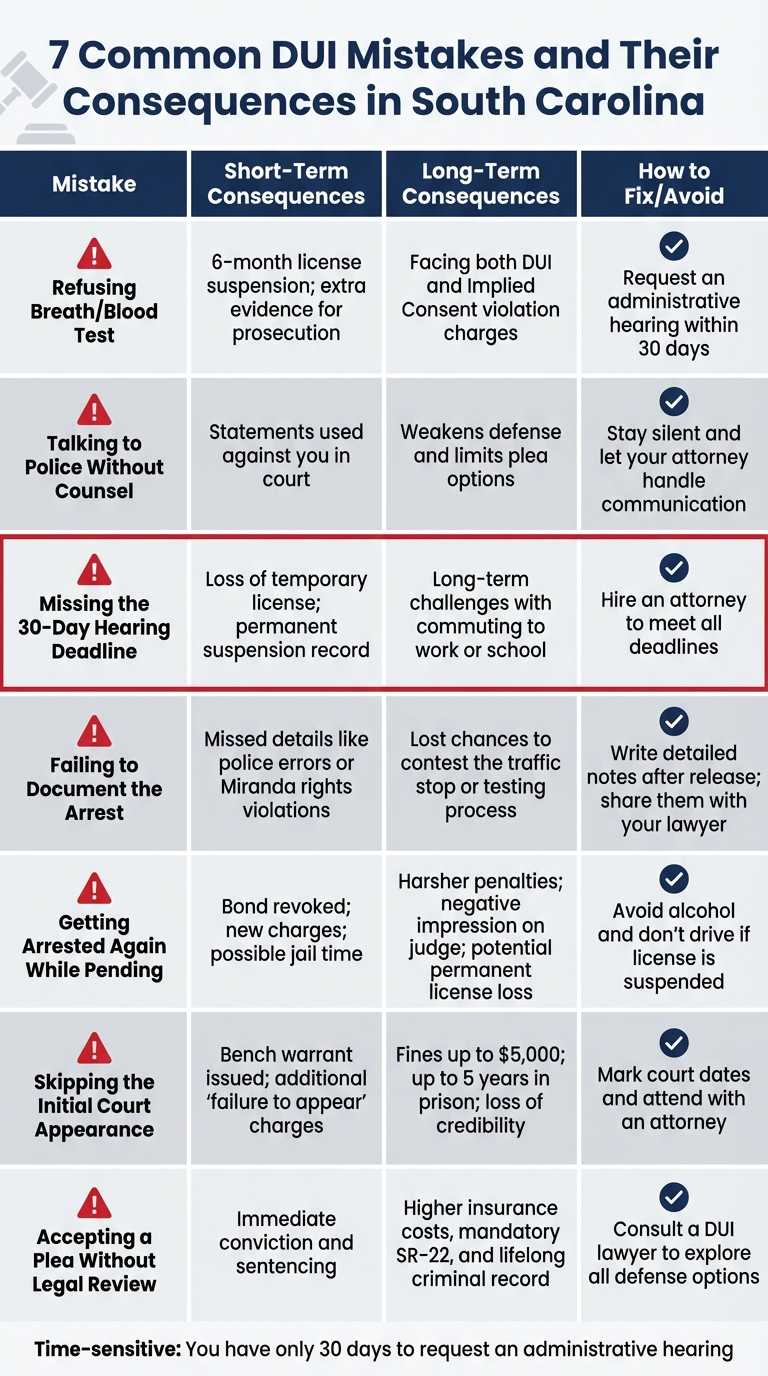
7 Common DUI Mistakes and Their Consequences in South Carolina
What you do after a DUI arrest can have a huge impact on your case. Making the right moves – and avoiding common pitfalls – can protect your rights and keep your defense intact. Here are seven mistakes to steer clear of and tips on how to handle your situation wisely.
Mistake 1: Saying Too Much to Police
Police officers are trained to gather information that could be used against you. Remember:
Anything you say can and will be used against you.
From the moment you’re stopped, you have the right to remain silent. While you must provide your driver’s license, vehicle registration, and proof of insurance, you’re not obligated to answer questions about where you’ve been or what you’ve been doing.
Trying to explain yourself or defend your actions might seem harmless, but even innocent comments can be twisted into evidence. Instead, politely decline to answer further questions and ask for an attorney. Also, avoid discussing the incident with friends, coworkers, or on social media – those conversations can come back to haunt you.
Mistake 2: Confusing Roadside Tests with Official Testing
It’s important to understand the difference between voluntary roadside tests and mandatory chemical tests. In South Carolina, field sobriety tests – like walking in a straight line or balancing on one leg – are optional. You can decline them without facing automatic penalties. Official chemical tests, however, fall under implied consent laws. Refusing a breath, blood, or urine test typically results in an automatic six-month license suspension.
Field sobriety tests are often subjective and unreliable, while chemical tests must follow strict procedures to be valid in court. An experienced attorney can examine these procedures and potentially challenge their accuracy.
Mistake 3: Missing the Deadline to Challenge License Suspension
In South Carolina, you have just 30 days after your arrest to request an administrative hearing to contest your license suspension. Miss that deadline, and you lose your chance to fight the suspension. Even if you’re found not guilty of DUI, your driving privileges could still be revoked.
Requesting a hearing is also the only way to get a Temporary Alcohol Restricted License (TARL), which allows you to drive legally while your case is pending. The request must be submitted to the Office of Motor Vehicle Hearings (OMVH) with a $200 money order, not to the DMV. If approved, there’s an additional $100 fee for the TARL. Missing this step could mean a suspension lasting six months to several years and might require you to complete the Alcohol and Drug Safety Action Program (ADSAP), which can cost anywhere from $500 to $2,500.
Mistake 4: Failing to Document Evidence
Details fade quickly, so it’s crucial to document everything as soon as possible. Write down what the officer said, how tests were conducted, and any observations about road and weather conditions. If you have medical conditions or take medications that could affect sobriety tests, make a note of those too. Gathering contact information from witnesses can also be a game-changer for your defense.
Mistake 5: Delaying Legal Representation
Waiting to hire an attorney can seriously hurt your case. Time-sensitive evidence – like dashcam or bodycam footage – can disappear if not preserved quickly. An attorney can act fast to secure this evidence and help you meet critical deadlines, such as requesting an administrative hearing. They’ll also guide you through questioning to prevent unintentional self-incrimination.
Mistake 6: Creating New Problems After Release
Your actions after posting bail can have ripple effects on your case. Publicly discussing your arrest, especially on social media, gives prosecutors more ammunition. Missing a court date is even worse – it can lead to a bench warrant, bond revocation, and additional charges. Fines for missing court can reach up to $5,000, and you could face up to five years in prison.
Stay organized. Keep track of all court dates, and follow any bond conditions to the letter. A small misstep could make your situation much worse.
Mistake 7: Accepting a Plea Without Understanding the Consequences
A DUI conviction isn’t just about fines or jail time – it can follow you for years. In South Carolina, penalties include mandatory ignition interlock devices, escalating fines for repeat offenses, and potential jail time. Beyond the courtroom, a conviction can cause your insurance rates to soar, hurt your job prospects (especially if driving is part of your work), and even affect professional licenses. It also creates a permanent criminal record that can impact housing, education, and child custody cases.
Before accepting a plea deal, make sure you fully understand the long-term effects. Work with your attorney to assess whether fighting the charges or negotiating a different outcome is the better path for your future.
Comparison: Common Mistakes and Their Consequences
Understanding how each mistake impacts your case can help you take the right steps after a DUI arrest. The table below breaks down common errors, their immediate and long-term effects, and how to address or avoid them.
| Mistake | Short-Term Consequences | Long-Term Consequences | How to Fix or Avoid |
|---|---|---|---|
| Refusing Breath/Blood Test | 6-month license suspension; extra evidence for prosecution | Facing both DUI and Implied Consent violation charges | Request an administrative hearing within 30 days |
| Talking to Police Without Counsel | Statements can be used against you in court | Weakens your defense and limits plea options | Stay silent and let your attorney handle communication |
| Missing the 30-Day Hearing Deadline | Loss of temporary license; permanent suspension record | Long-term challenges with commuting to work or school | Hire an attorney to meet all deadlines |
| Failing to Document the Arrest | Missed details like police errors or Miranda rights violations | Lost chances to contest the traffic stop or testing process | Write detailed notes after release; share them with your lawyer |
| Getting Arrested Again While Pending | Bond revoked; new charges; possible jail time | Harsher penalties; negative impression on the judge; potential permanent license loss | Avoid alcohol and don’t drive if your license is suspended |
| Skipping the Initial Court Appearance | Bench warrant issued; additional "failure to appear" charges | Fines up to $5,000; up to 5 years in prison; loss of credibility in your case | Mark court dates and attend with an attorney |
| Accepting a Plea Without Legal Review | Immediate conviction and sentencing | Higher insurance costs, mandatory SR-22, and a lifelong criminal record | Consult a DUI lawyer to explore all defense options |
Every mistake comes with its own set of penalties, but quick action can often reduce the damage. For instance, missing the 30-day deadline to request a hearing means forfeiting your chance to challenge a license suspension or secure temporary driving privileges. Similarly, staying quiet during your arrest and documenting every detail after release equips your attorney with the tools to build a stronger case.
Keep in mind that multiple mistakes can make things much worse. For example, if you talk to police without a lawyer and miss your hearing deadline, it becomes significantly harder to resolve your case. Acting quickly and working with an experienced attorney can help you navigate these challenges and minimize the consequences.
Conclusion
Avoiding key missteps is crucial when defending against a DUI charge in South Carolina. A DUI arrest here comes with strict deadlines and serious consequences that can undermine your case before it even begins.
The seven mistakes discussed – from speaking to law enforcement without legal representation to accepting a plea deal without fully understanding its impact – can quickly escalate into bigger problems. These errors can leave lasting marks on your record, drain your finances, and limit future opportunities. Penalties for a DUI often include steep fines, potential jail time, and a record that can follow you for years.
Time is of the essence. Securing critical evidence, such as dashcam and bodycam footage, is vital before it gets lost or overwritten. Be sure to document every detail of your arrest, including whether the officer properly explained field sobriety tests or read your Miranda rights. These details are key to helping your legal team develop a stronger defense.
South Carolina’s implied consent laws and overlapping legal processes make it essential to seek expert legal guidance immediately. Acting quickly can also help you secure a Temporary Alcohol License (TAL), allowing you to keep driving legally while your case moves forward.
Reach out to Brendan M. Delaney Law Firm LLC today for a personalized DUI defense strategy. With over 24 years of experience in South Carolina’s legal system, the firm is dedicated to protecting your rights with client-focused representation. Remember, administrative and criminal proceedings happen simultaneously, so prompt and informed action is critical. Taking the right steps now can preserve your driving privileges and strengthen your defense.
FAQs
What should I do right after being arrested for a DUI in South Carolina?
If you’re arrested for a DUI in South Carolina, there are a few key steps you need to take right away to safeguard your legal rights. First and foremost, stay silent – don’t discuss the details of the incident with law enforcement, friends, or even on social media. Anything you say could potentially be used against you later. Your next move should be to contact a skilled DUI defense attorney without delay. They can help you navigate the legal process, secure important evidence, and ensure you meet crucial deadlines.
Take time to write down everything you remember about the traffic stop, the field sobriety tests, and the arrest itself while the details are still fresh in your mind. This information could play a critical role in building your defense. Additionally, if your license has been suspended – whether for refusing a breath test or for having a blood-alcohol concentration over 0.15% – you need to act fast. You have 30 days to request an administrative hearing to challenge the suspension. Acting quickly on these steps can make a big difference in protecting your rights and strengthening your case.
What steps can I take to fight a license suspension after a DUI arrest in South Carolina?
If you’ve been arrested for a DUI in South Carolina, there’s an opportunity to challenge the suspension of your driver’s license – but time is of the essence. You only have 30 days from the date you receive the "Notice of Suspension" to request an administrative hearing with the South Carolina Department of Motor Vehicles (SCDMV). If you miss this window, the suspension will automatically take effect.
After requesting the hearing, you’ll need to file a petition with the Office of Motor Vehicle Hearings. During this process, you might be eligible for a Temporary Alcohol License (TAL), which lets you continue driving while your case is under review. At the hearing itself, you’ll have the chance to contest key aspects of your case, such as the legality of the traffic stop, the reliability of any tests conducted, or whether proper protocols were followed.
Having an experienced DUI attorney on your side can make a big difference in navigating this process and increasing your chances of maintaining your driving privileges.
What are the long-term effects of accepting a plea deal for a DUI in South Carolina?
Accepting a plea deal for a DUI charge isn’t a decision to take lightly – it can leave a lasting mark on your life. For starters, a plea deal often means a DUI conviction on your record, which could lead to license suspension or revocation, hefty fines, and even time behind bars.
But the fallout doesn’t stop there. You might also see your auto insurance premiums skyrocket, and a permanent criminal record could create hurdles when it comes to finding or keeping a job. That’s why it’s so important to fully understand how a plea deal could affect your future. Make sure to consult with an experienced attorney to weigh your options and make an informed choice.