




If you’re arrested for domestic violence in Spartanburg County, the actions you take immediately are critical. South Carolina’s strict domestic violence laws mean the state pursues charges even if the alleged victim doesn’t press them. Penalties can range from 90 days in jail for a third-degree offense to 20 years for the most severe charges, along with fines and long-term consequences like firearm bans, eviction, and custody loss.
Key Steps After Arrest:
- Stay Silent: Do not speak to law enforcement without a lawyer. Anything you say can be used against you.
- Bond Hearing: Expect a hearing within 24 hours. Follow all release conditions strictly to avoid further legal trouble.
- Understand Your Charges: Domestic violence charges are categorized into degrees, each carrying specific penalties.
- Hire an Attorney: A skilled local attorney can help navigate the legal process, challenge evidence, and explore options like diversion programs.
Act quickly to protect your rights and prepare your defense. Violating bond conditions or court orders can worsen your situation, so compliance is crucial throughout the case.
What to Do Immediately After Your Arrest
The first few hours after an arrest are critical. Every decision you make can affect your case, so it’s important to proceed carefully. Start by prioritizing your right to remain silent.
Do Not Speak Without a Lawyer Present
The single most important step you can take after being arrested is to stay silent until you have legal representation. Anything you say to law enforcement can and will be used as evidence against you. In Spartanburg County, officers meticulously document statements to strengthen the prosecution’s case.
Avoid the temptation to explain or clarify your actions. Even seemingly harmless comments can be misinterpreted or manipulated to fit the state’s narrative. Instead, calmly and politely assert your rights by saying you will not answer questions without an attorney present.
This silence should extend to everyone – not just law enforcement. Casual remarks to other individuals can also be used against you later.
What Happens at Your Bond Hearing
Your bond hearing takes place at the Spartanburg County Detention Facility. During this hearing, a magistrate judge will determine if you can be released and under what conditions. The judge considers factors like the seriousness of your charges, your criminal record, and whether you pose a risk to the alleged victim or the community.
If your case involves domestic violence, expect strict conditions, such as no-contact orders. For more information about bond procedures, you can contact the Solicitor’s Office at 864-596-2575 or the Magistrate’s Office at 864-596-2564 during business hours (Mon–Fri, 8:30 A.M.–5:00 P.M.).
Once your release terms are set, following them to the letter is absolutely necessary.
Follow All Release Conditions
Violating any condition of your bond can escalate your legal troubles quickly. For example, breaking a no-contact order or ignoring other restrictions may result in your bond being revoked, meaning you could be sent back to jail. Additionally, you could face new criminal charges.
In Spartanburg County, bond violations trigger a three-step process. First, the Spartanburg County Sheriff’s Office (864-503-4500) files a report. Next, both the Magistrate’s Office and the Solicitor’s Office are informed, which can lead to immediate legal action regarding your release.
Treat all bond conditions as non-negotiable. These rules remain in effect until your case is resolved or a judge modifies them. Following them closely is key to maintaining your freedom and building a strong defense.
Understanding Your Charges and Legal Rights
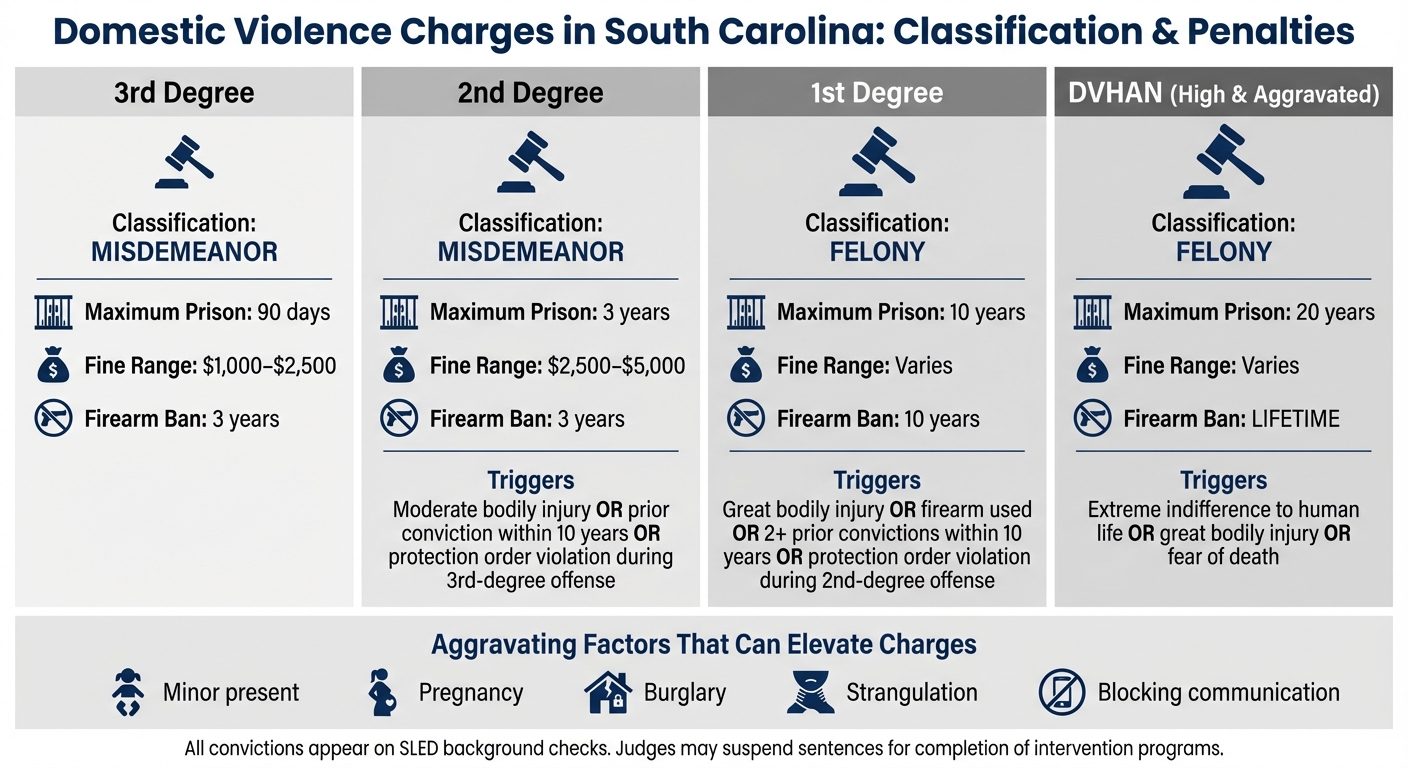
South Carolina Domestic Violence Charges: Penalties and Consequences by Degree
Once your immediate rights are secured, it’s critical to grasp the nature of the charges against you and your legal standing. In South Carolina, domestic violence charges are categorized into four levels, each with specific penalties and long-term consequences.
How Domestic Violence Charges Are Classified in South Carolina
Domestic violence charges in South Carolina are divided into four levels, determined by the severity of the alleged actions and any prior criminal history. Here’s a breakdown of these classifications:
- Domestic Violence 3rd Degree: This is the least severe charge – a misdemeanor involving physical harm or threats of harm with the apparent ability to carry them out.
- Domestic Violence 2nd Degree: Also a misdemeanor, this charge applies when moderate bodily injury occurs, there is a prior conviction within 10 years, or a protection order is violated during a 3rd-degree offense.
- Domestic Violence 1st Degree: The first felony level, this charge applies when great bodily injury occurs, a firearm is used, there are two or more prior convictions within 10 years, or a protection order is violated during a 2nd-degree offense.
- Domestic Violence of a High and Aggravated Nature (DVHAN): The most serious charge, this felony involves acts showing extreme indifference to human life, causing great bodily injury, or instilling a fear of death.
Certain aggravating factors, such as the presence of a minor, pregnancy, burglary, strangulation, or blocking communication, can elevate the severity of the charge. These charges apply when the alleged victim is a current or former spouse, someone with whom you share a child, or a cohabitant.
Possible Penalties and Long-Term Consequences
The penalties for domestic violence convictions vary significantly depending on the charge level:
| Charge Degree | Classification | Maximum Prison Term | Fine Range | Firearm Restriction |
|---|---|---|---|---|
| DVHAN | Felony | 20 years | Varies | Lifetime Ban |
| 1st Degree | Felony | 10 years | Varies | 10-Year Ban |
| 2nd Degree | Misdemeanor | 3 years | $2,500–$5,000 | 3-Year Ban |
| 3rd Degree | Misdemeanor | 90 days | $1,000–$2,500 | 3-Year Ban |
Convictions carry firearm bans: lifetime for DVHAN, 10 years for 1st-degree, and 3 years for 2nd and 3rd-degree offenses. Judges may suspend sentences if the individual completes a court-ordered domestic violence intervention program. Additional treatment may be required for issues like substance abuse or mental health concerns.
A conviction is recorded on South Carolina Law Enforcement Division (SLED) background checks, which cost $25 for employment screenings and $8 for housing applications. Protection orders tied to these charges can include temporary custody arrangements, financial support orders, and removal from shared residences. In Spartanburg County, domestic violence offenses are excluded from certain diversionary programs, such as Homeless Court.
These penalties highlight why South Carolina enforces a strict mandatory arrest policy in domestic violence cases.
South Carolina’s Mandatory Arrest Policy
South Carolina law allows officers to arrest individuals for domestic violence without a warrant, even if they didn’t witness the incident. Under S.C. Code § 16-25-70, an officer only needs probable cause to arrest for a "freshly committed" domestic violence offense. Evidence such as physical injuries or investigative findings can establish probable cause.
When household members provide conflicting accounts, officers must identify the primary physical aggressor. They assess factors like prior complaints, the severity of injuries, the potential for future harm, whether self-defense was involved, and the household’s history. Only the identified aggressor can be arrested. Officers may also enter a residence without a warrant if necessary to prevent harm.
This mandatory arrest policy means that charges can move forward even if the alleged victim does not want to press charges. Since the state handles prosecution, it’s crucial to have legal representation to challenge the probable cause for arrest and present evidence of self-defense when applicable.
Hiring a Criminal Defense Attorney
If you’re facing domestic violence charges in Spartanburg County, having the right legal representation is crucial. A skilled attorney can help safeguard your rights and guide you through the legal hurdles ahead.
Why Domestic Violence Cases Need an Attorney
The consequences of a domestic violence conviction go far beyond jail time. You could lose your right to own firearms permanently, be forced out of your home, or even face losing custody or visitation rights with your children.
A good attorney doesn’t just review the evidence – they also file motions to modify restrictive bond conditions and build a defense tailored to your case. In South Carolina, any domestic violence conviction from the past 10 years, even from another state, can count as a prior offense. This means your lawyer will need to dig into your full criminal history to anticipate how prosecutors might try to escalate the charges against you.
Picking the Right Attorney in Spartanburg County
Given the high stakes, choosing an attorney with local expertise is key. Look for someone who knows the specific workings of Spartanburg County courts and the Seventh Circuit Solicitor’s Office. Familiarity with the courthouse on Magnolia Street and North Daniel Morgan Avenue can make a difference – local attorneys understand how judges handle bond hearings and what prosecutors typically push for in plea deals.
It’s also wise to find a firm experienced in both criminal defense and family law. Domestic violence cases often intersect with issues like custody battles, divorce, and protection orders, which are dealt with at Safe Homes on the third floor of the Spartanburg courthouse. Brendan M. Delaney Law Firm LLC, located at 184 N. Daniel Morgan Ave. in Spartanburg, combines this multidisciplinary expertise with over 24 years of experience in South Carolina’s legal system.
Take Advantage of a Free Consultation
Many Spartanburg criminal defense firms offer free consultations to review your case and outline your legal options. Use this time to ask how the attorney plans to challenge the probable cause for your arrest, address bond violations, and manage protection order hearings, which are usually scheduled within 15 days. This meeting allows you to assess their approach before deciding to move forward with their representation.
sbb-itb-ce0cbb0
What to Expect During Court Proceedings
Having legal representation can make it easier to handle the challenges of court proceedings.
Your First Court Appearances
Your first court appearance usually happens 30–60 days after your arrest. This hearing focuses on how your case will move forward. You’ll also need to confirm whether you’ve hired an attorney.
You can request a preliminary hearing during this time to review the evidence the state has against you. As the Spartanburg County Solicitor’s Office explains:
A preliminary hearing is the right of the person charged with the crime. It is their chance to hear the evidence that the state has against them.
At this stage, the judge determines if there’s enough probable cause to continue with the case. The judge will also assign your case a timeline, typically aiming for resolution within six months to a year, depending on the seriousness of the charges. This initial appearance lays the groundwork for your defense and the steps that follow.
Your second court appearance occurs within six months of your arrest. You or your attorney will need to inform the court whether you plan to enter a plea or proceed to trial. Due to the heavy caseload, delays are common, so it’s crucial to keep the Solicitor’s Office updated with your contact information. Provide your current mailing address, email, and phone number to ensure you receive all court notifications.
Diversion Programs as an Alternative to Trial
For some defendants, alternative resolutions may be available during these proceedings.
Spartanburg County offers the Solicitor’s Intervention Program (SIP) for specific non-violent domestic violence charges. This program includes a Batterer Intervention Program and provides an alternative to traditional prosecution. Successfully completing SIP can lead to the dismissal of your charges and even make you eligible to apply for an expungement, which can remove the arrest from your record.
Participation in SIP requires approval from the Solicitor’s Office. If your case is in Municipal or Magistrate Court, you must attend court to receive a formal referral before applying. Applications are accepted Monday through Friday, between 8:30 a.m. and 4:30 p.m., at the Solicitor’s Office located at 180 Magnolia Street. Keep in mind that your case remains active while you’re in the program, so you must attend all scheduled court dates until the case is officially resolved.
Following All Court Orders
Complying with court orders is essential throughout the legal process. Violating orders, bond conditions, or no-contact restrictions can lead to additional charges and make your defense more difficult. Ignoring court orders can have serious consequences, including harsher penalties.
Most court proceedings are held at the main courthouse at 180 Magnolia Street in Spartanburg. If you have a protection order hearing, it will take place at Safe Homes on the third floor within 15 days of filing. Missing any hearings or failing to follow court orders can derail your progress and result in further complications. Always prioritize attending your scheduled hearings and adhering to all conditions set by the court.
Conclusion
Facing a domestic violence arrest in Spartanburg County means taking swift and deliberate action to safeguard your rights and prepare your defense. The choices you make in the hours and days following your arrest can shape the outcome of your case. It’s crucial to exercise your right to remain silent and consult with your attorney before making any statements.
Having skilled legal representation is key, as domestic violence cases in South Carolina tend to move quickly. An experienced attorney can review the evidence, file discovery motions, and explore options like diversion programs. They can also work to negotiate reduced charges or alternative sentencing, all of which are essential components of a strong defense.
It’s equally important to comply with all bond conditions and court orders during your case. Violating these terms could lead to bond revocation or even additional charges, complicating your situation further.
Understanding the charges and penalties you face is another vital step in preparing your defense. A conviction could bring lasting consequences, such as restrictions on firearm ownership, difficulties with professional licensing, and challenges in child custody arrangements. Taking these steps can help protect your rights and navigate the legal process more effectively.
Reach out to us as soon as possible to ensure you have the dedicated defense you need.
FAQs
What should I do if I unintentionally break the conditions of my bond?
If you find yourself accidentally violating your bond conditions, it’s important to act fast. The first thing you should do is reach out to your attorney. Be upfront about what happened and ask for their advice on how to handle the situation. Acting quickly shows you’re taking responsibility and can help reduce potential fallout.
Avoid doing anything else that could make matters worse. Follow your lawyer’s instructions carefully – they’re there to guide you through the process and help safeguard your rights.
How do I choose the right attorney for a domestic violence case in Spartanburg County?
Choosing the right attorney for a domestic violence case in Spartanburg County can play a key role in protecting your rights and crafting a solid defense. You’ll want to find a criminal defense attorney who not only has experience with domestic violence cases but also understands South Carolina laws and the specific workings of Spartanburg County’s court system.
An attorney familiar with the local legal landscape can offer personalized guidance and representation tailored to your situation. Look for someone with a strong track record in handling domestic violence charges and a clear, strategic defense approach. If you’re unsure where to start, local resources like the Spartanburg County Public Defender’s Office can provide assistance or connect you with potential attorneys.
Partnering with an attorney who knows the ins and outs of domestic violence cases can greatly influence the direction and outcome of your case.
What are the long-term effects of a domestic violence conviction in South Carolina?
A domestic violence conviction in South Carolina comes with serious and long-lasting repercussions. These can include steep fines, possible jail time, and court-ordered counseling programs. On top of that, you might lose your right to own or carry a firearm. A conviction also leaves a permanent criminal record, which can make finding a job or securing housing much more difficult.
The effects don’t stop at legal penalties. Such a conviction can put a significant strain on personal relationships and damage your reputation within your community. Understanding these consequences is essential to safeguarding your rights and planning for your future.